

A simple CVC word dictation session can follow five familiar steps: listen, repeat, segment, map and write, then read and check. This gives children a consistent way to move from hearing a word to spelling and rereading it.
For kindergarten CVC word dictation, use words built from sound-spelling patterns the child has already learned. Keep most words within one short-vowel focus, add a small amount of cumulative review, and respond to errors by returning to the sound that caused the problem rather than immediately supplying the correct letter.
The routine works for a short home lesson, small-group classroom dictation, tutoring, or a quick spelling check after CVC practice. What changes is the word set. The five-step process stays stable.
Choose CVC Words From a Short-Vowel Pattern the Child Already Knows
Dictation is most useful when it checks whether a child can retrieve familiar phonics knowledge without copying. An untaught spelling pattern changes the task from practice into guessing.
Start by identifying the current short-vowel range. If the focus is short a, words such as map, fan, cap, sat, ham, and rag give useful variety while keeping the middle vowel stable. The child has to listen across all three positions instead of learning one fixed ending.
Main dictation pattern: short a
Keep most of the session inside the vowel pattern currently being taught.
Add light cumulative review
One or two familiar words from earlier vowel work are enough to check retrieval without turning the list into a five-vowel test.
Avoid building the entire session from one word family. A list such as cat, bat, mat, sat, hat can become predictable because the child may reuse -at and attend only to the first consonant. Word families are useful for teaching a pattern, but dictation should eventually require attention to the whole word.
The safest way to choose the range is to follow the phonics patterns already introduced in the Kindergarten phonics program. The kindergarten sequence includes short vowels, CVC words, blending, spelling, and simple reading, so dictation can sit inside an existing learning path instead of becoming an unrelated weekly spelling list.
If the pattern still needs printed practice before dictation, the kindergarten phonics worksheets collection includes short-vowel CVC word-family work for reading and spelling. Use the page to strengthen the pattern, then remove the visible model and dictate a few related words.
How the Five-Step CVC Word Dictation Routine Works
Each step has one job. Keeping those jobs separate makes it easier to see exactly where a child succeeds and where support is needed.
Listen: Hear the Whole Word Before Writing
Say one target word naturally: “Map.” The child listens without immediately writing a letter. That brief pause keeps the beginning of the task focused on spoken language rather than on a hurried guess from the first sound.
“Listen: map.”
Listens to the complete word and waits before writing.
Repeat: Say the Word Back
Ask for the whole word before asking for its sounds. If the child repeats a different word, correct the listening problem first. Segmenting a word the child misheard will not help them spell the intended word.
“Say the word.”
Repeats map accurately as a complete word.
Segment: Pull the Word Apart Into Sounds
Now ask the child to say the phonemes from beginning to end. For map, the response is /m/ /ă/ /p/. Three fingers, counters, or blank sound boxes can make the positions easier to track without supplying any letters.
“Say the sounds slowly. What do you hear first, in the middle, and at the end?”
Segments /m/ /ă/ /p/ in the correct order.
Map and Write: Connect Each Sound to a Letter
After the three sounds are clear, the child writes one letter for each sound from left to right: /m/ becomes m, /ă/ becomes a, and /p/ becomes p.
Avoid saying “m-a-p” for the child. Naming the letters in sequence removes the part of the task that shows whether the child can move independently from sound to print.
“Write one letter for each sound you heard.”
Maps each phoneme and writes map.
Read and Check: Turn the Spelling Back Into a Word
The final step reverses the process. The child looks at the finished spelling, reads it aloud, and compares it with the original word. This reread is where self-checking begins.
A missing vowel or changed sound order may become more obvious when the written form is read back. Give the child that opportunity before correcting it.
“Read what you wrote. Does it say map?”
Reads the word, compares it with the target, and repairs it if needed.
Correct a Dictation Error by Returning to the Sound Position
An error should send the child back to the part of the five-step routine that broke down. It should not immediately trigger the answer.
Suppose the target word is map and the child writes mp. Saying “You forgot the a” repairs the paper but skips the listening problem. Instead, ask the child to repeat map and segment it again.
If the child says only /m/ /p/, focus attention on the middle: “Stretch the word. What sound is between /m/ and /p/?” Once the child identifies /ă/, ask which familiar letter represents that sound. The correction now reconnects listening, segmentation, and spelling.
The same logic applies to other errors. If sit becomes sat, return to the middle sound. If dog becomes god, rebuild the sound sequence from left to right. If the child can say /f/ /ĭ/ /n/ accurately but cannot recall the letter for /f/, the problem is no longer segmentation. The next prompt should support letter retrieval.
Immediate feedback still matters. Do not leave an incorrect spelling sitting on the page until the end of a ten-word list. Correct the process while the word is still active, let the child repair it, reread once, and continue.
Record the Type of Error Instead of Only Counting Correct Words
A total score tells how many responses were correct. An error pattern tells what to teach next.
For CVC spelling practice, four categories are especially practical: vowel choice, omitted sound, sound order, and letter retrieval. There is no need for an elaborate assessment sheet. A few short notes can show whether the same difficulty appears repeatedly.
The consonant frame stays intact, but the middle vowel changes. The next practice should give more attention to the vowel contrast.
One phoneme disappears from the written form. Return to three clear sound positions before asking for letters.
The sounds are present but not sequenced correctly. Slow the mapping step and move deliberately from left to right.
The word can be segmented accurately, but a known sound cannot be matched to its letter quickly enough.
One misspelling is not enough to define a pattern. A child may lose attention, mishear a word, pause over handwriting, or make a one-time guess. Look for the same behavior across several familiar words before changing the practice plan.
Use the Error Pattern to Choose the Next Practice
The next activity should become more precise, not automatically more difficult.
A worksheet can be useful at this point because the dictation error has given it a specific job. If short a is unstable, there is little value in jumping immediately to all five short vowels. Instead, select a worksheet that matches the dictation pattern, complete enough items to revisit the sound-spelling relationship, and then try a few fresh dictated words.
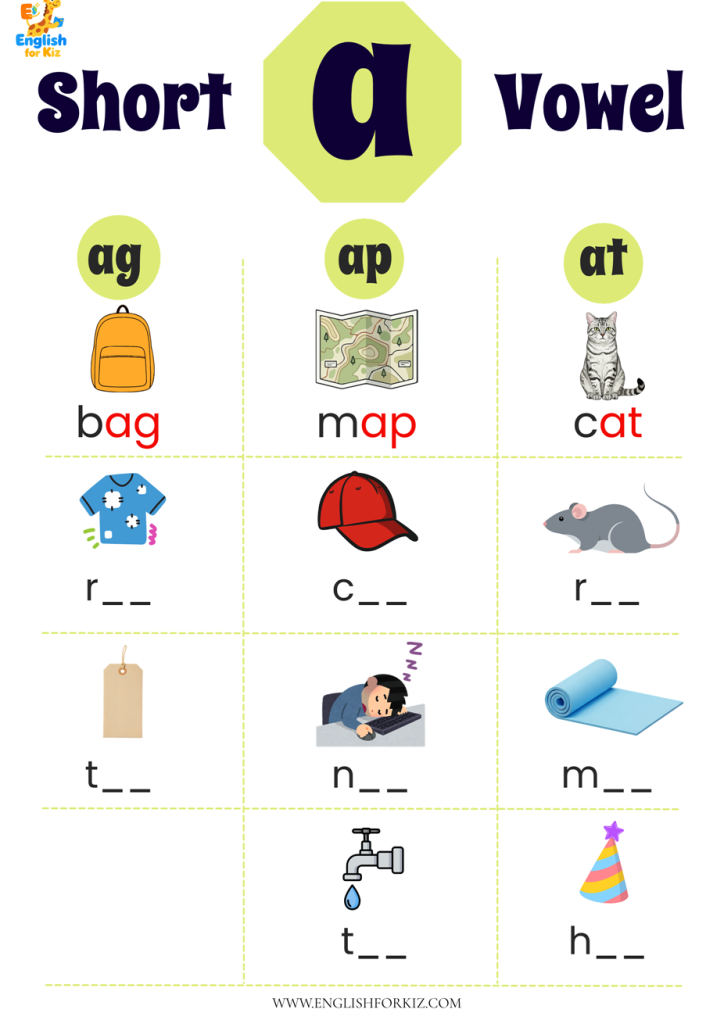
Use the Worksheet to Strengthen the Pattern, Then Remove It
This short a page practices the -ag, -ap, and -at families through familiar CVC words. It is useful when a child needs another round of visible short-vowel spelling before being asked to retrieve the same pattern independently.
The important transfer check happens after the worksheet. Close or cover the page, say a fresh CVC word from the same short-vowel range, and return to Listen → Repeat → Segment → Map and Write → Read and Check.
Choose CVC Worksheets for the Dictation PatternAfter focused written practice, a short round of interactive phonics review can change the format without changing the target skill. Use games for retrieval and review rather than introducing a new spelling rule immediately before dictation.
Move From Word Dictation to Phrases and Simple Sentences Gradually
The next step is not “more words at once.” It is using the same phonics knowledge while managing a slightly larger language task.
Sentence dictation can begin when the child usually segments familiar CVC words without heavy prompting, writes the sounds in the correct order, retrieves the short vowel being practiced, and rereads the completed spelling.
Start with a very short phrase or sentence built from taught spelling patterns and familiar high-frequency words. The child now has to hold several words in memory, leave spaces, and keep writing moving from left to right. That extra load is why a child who spells isolated words accurately may briefly become less accurate in sentences.
If CVC spelling falls apart as soon as the language becomes longer, reduce the amount of text. Return to one or two dictated words, then try the short phrase again. This keeps a memory or transcription problem from being mistaken for a phonics problem.
Let the Same Short-Vowel Pattern Reappear in Reading
Dictation works from speech to print. Decodable reading moves in the opposite direction, from print back to spoken language and meaning. Using both directions can show whether the short-vowel pattern remains useful outside an isolated spelling list.
The EnglishForKiz Kindergarten CVC phonics stories include short-vowel word-family passages. Choose a passage only after its main spelling patterns are familiar enough for the child to attempt the text rather than simply memorize it.
Explore Kindergarten CVC Stories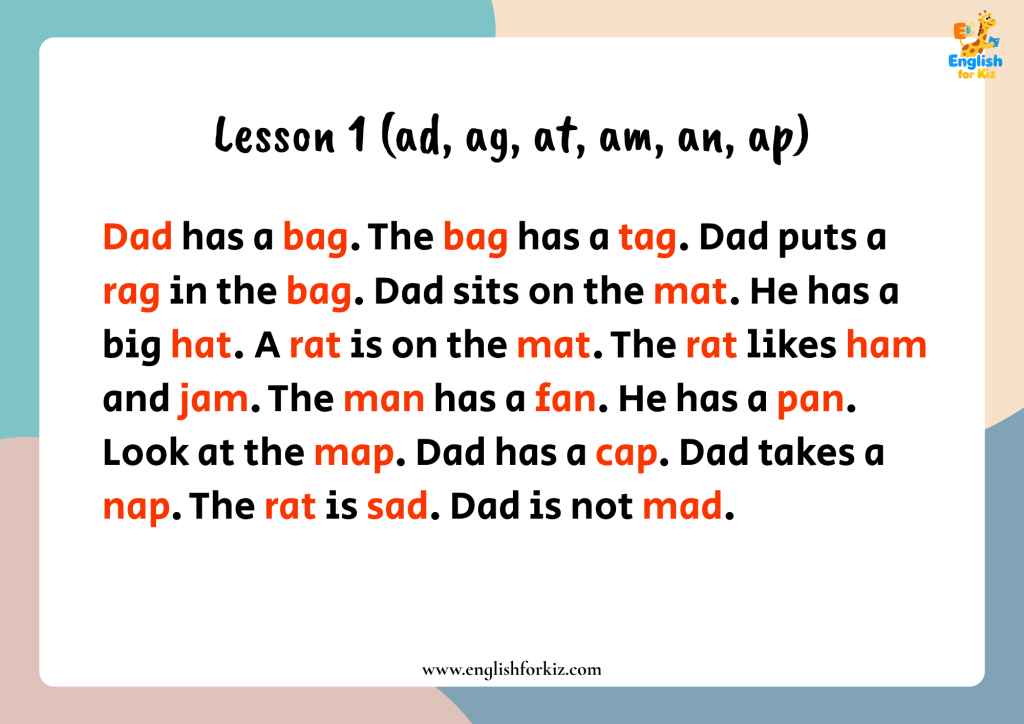
Common Mistakes That Make CVC Dictation Less Useful
The routine becomes weaker when adult help gradually replaces the child’s listening, segmenting, and retrieval.
Keep Doing
- Say the whole word clearly and let the child repeat it.
- Leave enough time for segmentation before writing begins.
- Use consonants and short vowels that have already been taught.
- Correct by returning to the first, middle, or final sound.
- Mix a small amount of cumulative review into the word set.
- Ask for a reread after every completed or corrected spelling.
Avoid
- Moving so quickly that the child skips segmentation.
- Repeating the word many times until individual sounds are effectively revealed.
- Using an untaught digraph, blend, or spelling rule in a CVC check.
- Responding to mp with “Put an a in the middle.”
- Using only one repeated word family and allowing pattern guessing.
- Recording only a score and ignoring the kind of error made.
Do not let speed replace the routine
A child who immediately writes the first letter and guesses the rest may appear fast, but the useful sequence has disappeared. Slow the task enough for listening, segmentation, mapping, and checking to remain observable.
Do not repeat the word until the answer is hidden inside the prompt
If attention slipped and the child genuinely did not hear the word, repeat it. Otherwise, move to the child’s own repetition and segmentation. Repeatedly stretching or emphasizing the vowel can quietly turn independent dictation into assisted spelling.
Do not use unfamiliar spelling patterns to measure a familiar one
If the goal is short-vowel CVC spelling, keep the test words inside that range. An unexpected digraph or other untaught pattern creates a second problem, making the result harder to interpret.
Frequently Asked Questions
How many CVC words belong in one dictation session?
Start with a small set that allows the child to complete all five steps without rushing. Five or six words can be enough for many short practice sessions, and fewer may be more useful when segmentation still requires frequent prompting.
Should the dictation word be repeated more than once?
Say the word clearly and ask the child to repeat it. Repeat the target when the child genuinely did not hear it, but avoid saying it again and again or exaggerating individual sounds until the spelling is effectively supplied.
How should CVC spelling errors be corrected without giving the answer?
Return to the spoken word and the sound position causing difficulty. Have the child repeat and segment the word, identify the relevant phoneme, map that sound to a familiar letter, repair the spelling, and reread the completed word.
When can sentence dictation begin?
Try a short phrase or simple sentence when familiar CVC words can usually be segmented, written, and checked with limited adult help. Keep the spelling patterns familiar so the extra challenge comes from holding several words, spacing, and sentence writing rather than from untaught phonics.
Should all dictation words come from the same word family?
No. Related words can help during early teaching, but an entire dictation list with one ending may encourage pattern guessing. Mix several CVC families within the same familiar short-vowel range so the child has to attend to all three sounds.