

The useful way to reuse phonics worksheets is not to ask a child to complete the same page three times. Keep the phonics content familiar, but change the job. Use the page first for reading, return to it with the answers hidden for spelling, and later dictate selected words without showing the worksheet or picture cues.
The sequence changes the demand from decoding print to rebuilding spellings and finally retrieving them from spoken language. It also lets parents and teachers compare what a child can recognize with what the child can produce without copying.
The page stays familiar; the thinking changes. Reading keeps the word visible. Spelling hides the answer while retaining a picture or meaning cue. Dictation starts with the spoken word alone. A delay between passes helps prevent immediate memory from doing all the work.
Use One Phonics Worksheet Three Ways by Removing Support Each Time
The three passes work because each round asks for a different kind of response. The target sound or spelling pattern stays stable while visual support gradually disappears.
Reading
Keep the words or sentences visible. The child reads while the adult notes hesitation, guessing and where a prompt is needed.
Spelling
Hide the completed answer. The child says the word, segments its sounds and rebuilds the spelling without copying.
Dictation
Remove the written model. Say the word or short sentence aloud, then let the child write it before checking the original.
Keep the phonics target familiar. The task should become more independent, not more unpredictable. Do not turn the dictation pass into a surprise test full of untaught spelling patterns.
Start with printable phonics worksheets that match the skill already being taught. A short-vowel CVC page is useful for a child learning to blend and spell CVC words, but less useful when the current target is a different spelling pattern.
First Pass: Read the Page Before Turning It Into a Writing Task
The reading pass gives you a baseline while the spelling is fully visible. It shows what the child can decode before answers are hidden.
Ask the child to read the target words, choices, phrases or controlled sentences on the page. If pictures are present, use them to clarify meaning when necessary, but do not let every answer come from the picture instead of the letters.
When a word causes trouble, wait before supplying it. A short pause can reveal whether the child is looking through the word, sounding it out, or simply searching the picture for a plausible guess.
If a prompt is needed, give the smallest useful cue and place a light mark beside that item. The mark is not a score. It tells you which word deserves another look after the answer disappears in Pass 2.
Example: A short-vowel page contains map sit hen and cup. The child reads three immediately but needs the first sound before reading hen. Mark that word and continue rather than interrupting the reading task for an extended correction.
The type of difficulty matters. Slowly blending h-e-n and reaching the correct word is different from naming the picture without checking the print. Both responses may need support, but they do not point to the same next step.
Accurate reading also does not prove that the spelling can be produced. A familiar word may be recognized in print before its letters can be retrieved in order. The next pass checks that difference.
Second Pass: Cover the Answer and Rebuild the Word From Its Sounds
The second pass changes the direction of the work. Instead of looking at letters and producing a word, the child starts with the spoken word and decides which letters are needed.
Cover the printed answer with plain paper, a removable sticky note or another simple cover. Leave only the useful prompt visible. On a picture-based page, the picture can remain while the word disappears. If the visible worksheet gives away too many letters, cover the answer completely and use a picture or meaning cue instead. Save spoken-word-only prompts for the dictation pass.
Segment before the pencil moves
Ask the child to say the word slowly and identify its sounds. For a simple CVC word such as map, the relationship can be made visible like this:
The child then writes the whole word before the answer is uncovered. If map becomes mp, the missing middle vowel gives you more information than a general “wrong” mark. If ship becomes sip, check whether the child can distinguish the initial sounds and connect the sound in ship with the letters sh. One attempt cannot establish which part needs more support.
For digraphs or longer-vowel patterns, keep the focus on the taught spelling rather than forcing every phoneme into an artificial one-letter box. The useful question is whether the child can hear the relevant sounds and rebuild the spelling pattern that has already been introduced.
Preserve the first attempt when practical. Compare it with the printed model before correcting it. If every original answer disappears under an eraser, the evidence disappears too.
Avoid turning cover-and-write into peek-and-copy
Do not reveal the model after each letter. Have the child complete the target word first, then uncover it for comparison. With a longer word or sentence, use sensible chunks so the exercise checks spelling rather than how much language can be held in memory at once.
This is what makes a phonics worksheet for reading and spelling genuinely different across the two passes. The same content now requires phoneme segmentation, sound-to-letter mapping and independent production.
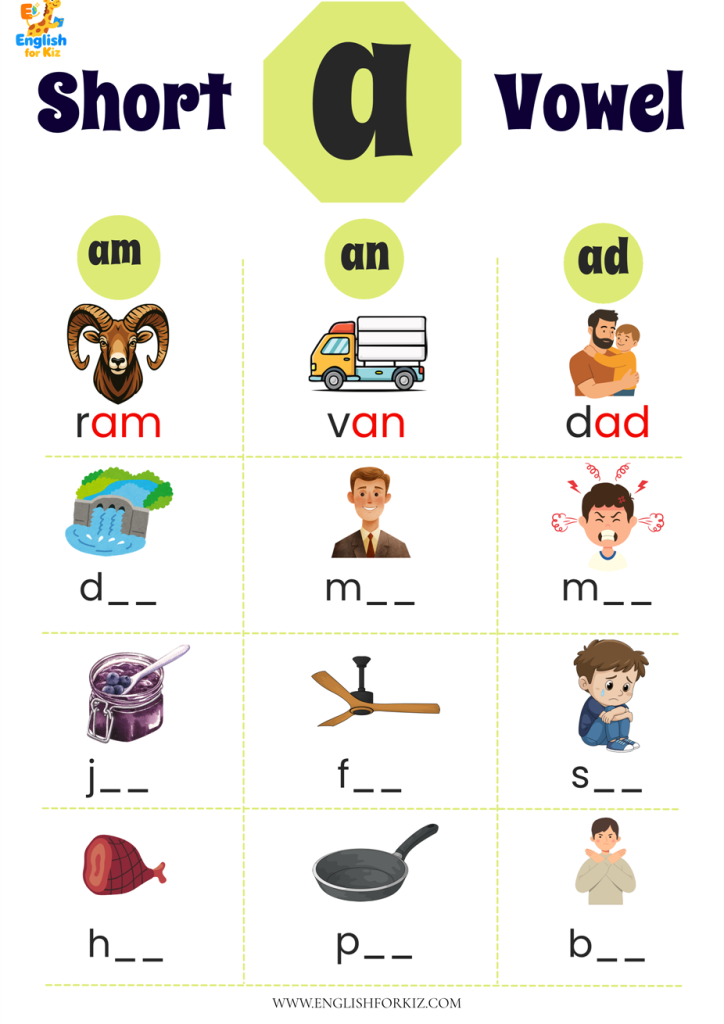
Try the Three-Pass Method on a Focused CVC Page
A page with one short-vowel pattern is easier to reuse than a mixed worksheet containing several unfamiliar rules. This short a example keeps the spelling family visible and gives clear words that can later be hidden for reconstruction.
The EnglishForKiz Kindergarten phonics worksheet collection includes short-vowel and CVC word-family pages. Choose the page that matches the current skill instead of printing a random mixed packet.
Explore Kindergarten WorksheetsThird Pass: Use the Worksheet for Dictation Without the Printed Model
Dictation removes the strongest visual support. The adult supplies the spoken word or short sentence, and the child has to listen, retrieve the spelling and write it independently.
Turn the worksheet face down, place it out of sight or keep it as the adult’s prompt sheet. The child can write on the back, in a notebook or on separate paper. What matters is that the original spelling is no longer available for copying.
For word-level worksheet dictation practice, say one target word naturally. Let the child repeat it, segment it if useful and write the full word. Only then reveal the worksheet and compare the two versions.
Example: The child reads ship correctly in Pass 1 and spells it correctly with the answer covered in Pass 2, but writes sip from dictation. The contrast suggests that sh is recognized with support but is less secure when it must be retrieved from speech alone.
A different pattern tells a different story. If ship is misread, misspelled with the answer hidden and missed again in dictation, the difficulty is not limited to memory during the final pass. The spelling pattern itself needs more direct review.
Sentence dictation can follow the same principle. Read a short controlled sentence naturally and repeat it when needed. Do not make the sentence unnecessarily long. The target is phonics and spelling, not a side competition in working memory.
Keep the dictated material inside the phonics patterns already practiced on the page. The useful challenge is the removal of the model, not the introduction of surprise vocabulary.
How to Reuse Phonics Worksheets Without Relying on Short-Term Memory
Do not automatically run reading, spelling and dictation back-to-back. Immediate repetition can make later attempts look stronger because the answer, picture order or spelling is still fresh.
A child who has just looked at cake may write it accurately two minutes later without independently retrieving the long-vowel spelling. The answer is correct, but it does not tell you as much about what remains available after the model is gone.
The interval does not need to become a rigid timetable. Reading might happen in one lesson and spelling after another activity. Dictation may happen later that day or at the next suitable practice time. The important feature is that the child has to retrieve the pattern again.
Avoid rehearsing the identical list in the identical order during the gap. If a change of pace is useful, change the response format while keeping the phonics target stable.
A delay is not a difficulty setting. If the sound-spelling relationship is still being taught, provide enough guided practice first. Delayed retrieval is useful after the child has something reasonable to retrieve.
Use a Short Game Between Worksheet Passes
A game can give the same phonics pattern another form of practice without showing the completed worksheet again. That makes it more useful between passes than simply rereading the same answer list.
EnglishForKiz phonics games include letter-sound, beginning-sound, CVC and blending practice. Match the game to the phonics target rather than choosing an unrelated activity simply because it looks engaging.
Review with Phonics Games
Compare the Same Error Across Decoding and Encoding
Using familiar words across the three passes makes differences easier to notice. The content remains stable while the amount of support changes.
You do not need a complicated assessment sheet. A small code beside a target word is enough to preserve the important observation.
Prompt in reading
The printed word was visible, but decoding still needed adult help.
Spelling error
The word changed when the printed answer was hidden.
Dictation error
The spelling could not yet be retrieved accurately from speech alone.
Delayed success
A previously difficult item is produced later without copying the model.
The combinations matter more than the total number of errors. A word marked P + S + D is difficult in both decoding and encoding. A word marked only D may be recognized and reconstructed with support but remain difficult to retrieve independently.
Look at the letters that changed. Writing mp for map removes the middle vowel. Writing nap for map changes the first sound. Writing sip for ship loses the digraph. Those responses should not receive identical correction simply because all three are technically incorrect.
Correct after the attempt. Ask the child to compare the response with the model, locate the difference and repair that part. Then choose one or two difficult items for delayed review rather than automatically repeating the complete page.
Which Worksheets Work Well for Reading, Spelling and Dictation?
A reusable page needs a clear phonics target, answers that can be hidden and prompts that still make sense after the original activity has been completed.
- CVC and short-vowel word pages
- Focused word-family practice
- Digraph or blend pages with familiar vocabulary
- Long-vowel pages after the pattern has been taught
- Short controlled sentences
- Picture-word pages where the word can be hidden
- Pages dominated by coloring or tracing
- One-time cut-and-paste puzzles
- Activities where the answer cannot be concealed
- Pages containing several untaught patterns
- Dense mixed review when one skill needs checking
- A page memorized by position rather than spelling
A CVC page can move naturally from reading map, ram and van to spelling them with the model hidden and then hearing a small selection in dictation. A long-vowel page can work the same way once its spelling pattern is familiar.
A tracing page is different. It may be useful for its original purpose, but forcing it into sentence dictation does not make it more educational. Reuse only works when the changed task still fits the content on the page.
When choosing a worksheet matched to the current reading skill, prefer a narrow phonics focus over a page mixing several new demands. The narrower target makes it easier to see whether the difficulty appears during reading, spelling or independent retrieval.
If CVC words and short vowels are the current focus, the Kindergarten phonics program provides the broader learning path around that stage, including blending, spelling, worksheets, games and decodable reading.
When to Stop Reusing the Worksheet and Move On
A reusable worksheet is a tool for changing the practice demand. It should not become an exercise in repeating familiar answers after they are secure.
The page has probably done its job when the child can read the target items, rebuild selected spellings with the answers hidden and handle a later dictation sample without depending on the order or position of the answers.
Stop earlier if layout memory takes over. If the child knows that the top-left picture is always map, shuffle several target words onto blank paper or choose a fresh page using the same pattern. Remembering worksheet geography is not the same thing as retrieving spelling.
Sometimes the page itself is the problem. Crowded formatting, unclear pictures or excessive handwriting can hide what the child knows. In that case, choose a cleaner page or change the response format instead of increasing the number of repetitions.
The best stopping question is simple: Will another use of this page require a meaningful new act of decoding, encoding or retrieval? If not, the child needs a new application rather than another lap around the worksheet.
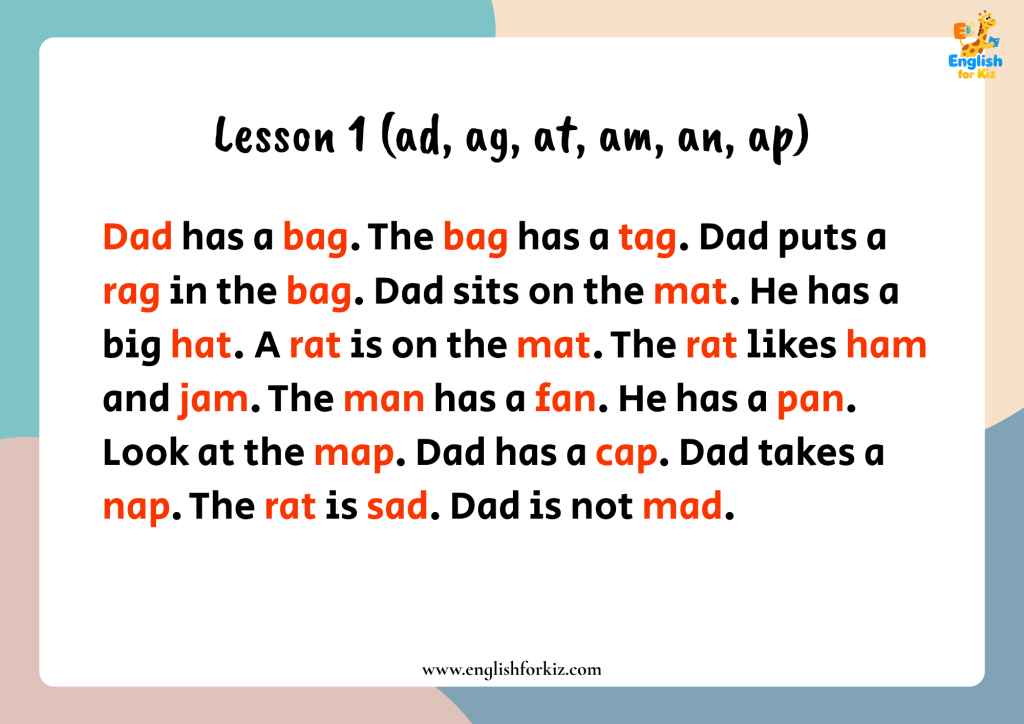
Move a Secure Pattern Into Connected Reading
Once the child can retrieve the target spelling with less support, another full worksheet cycle is not always the strongest next step. A short controlled passage can show whether the same pattern is used while reading sentences.
The EnglishForKiz Kindergarten CVC decodable stories include short-vowel word families such as -ad, -ag, -at, -am, -an and -ap. That makes them a logical follow-up after short a word-level practice.
Read CVC Decodable StoriesA Realistic Example: One Short-A Page Across All Three Passes
The method is easiest to understand when the three passes are treated as related observations rather than three assignments.
Imagine a child working with a short a page containing words such as map, ram, van and dad.
During the reading pass, map, ram and dad are read accurately. Van requires a prompt because the child first guesses from the picture. You mark that one item and continue.
Later, the printed words are covered. The child names the pictures, segments the sounds and writes each word. Van becomes vn. Now there is a clearer pattern: the word was uncertain during reading and the middle vowel disappears during independent spelling.
The original spelling attempt stays visible while the child compares it with van, notices the missing a and corrects the word.
During a later dictation check, you choose only three items rather than repeating the whole sheet. The child writes map, van and dad correctly. That delayed success is evidence that the short a mapping can now be retrieved with less support.
If van again appeared as vn, another complete worksheet round would not automatically solve the problem. A better response would be to return briefly to three-sound segmentation with a few short a examples and then check one new word.
Common Mistakes When Reusing a Phonics Page
The method loses its value when each pass is technically renamed but the child is still doing essentially the same thing.
- Reading becomes adult reading. Supplying every difficult word immediately leaves little decoding to observe.
- Spelling becomes copying. A partly visible answer may provide exactly the letter pattern the child is meant to retrieve.
- Dictation becomes a memory marathon. Keep words and sentences short enough that the phonics target remains the main challenge.
- Correction destroys the evidence. Preserve the first attempt when possible before showing the corrected form.
- One weak item triggers a full-page repeat. Review the words that need another check rather than automatically repeating everything.
- All three passes happen immediately. Back-to-back success can reflect fresh visual memory rather than delayed retrieval.
- The page mixes too many new patterns. A focused worksheet gives clearer information than a crowded mixed-skills page.
The goal is transfer. Eventually the child should use the same phonics pattern in a fresh word, a new page or connected text. Mastering the location of answers on one worksheet is not the finish line.
Frequently Asked Questions
Can every phonics worksheet be reused for dictation?
No. Dictation works best when the page contains clear words or short sentences based on a phonics pattern the child has already practiced. Coloring pages, tracing-heavy activities, mazes and one-time visual puzzles may not convert into meaningful dictation.
Should the three activities happen on the same day?
They can, but they do not have to. Some separation is useful because it reduces dependence on immediate visual memory. Reading and spelling may happen in separate short sessions, with dictation later that day or during another suitable review period.
How can answers be hidden for spelling practice?
Use plain paper, a removable sticky note or another simple cover that blocks the complete spelling while leaving the necessary picture or prompt visible. The child should finish the word before the model is uncovered.
What if reading is accurate but dictation is weak?
Treat the difference as useful information. The child may recognize the pattern when it is visible but find it harder to retrieve and encode from speech. Compare the exact letters or sounds that change, review that feature with a small set of examples, and check again later.
When should a fresh worksheet be introduced?
Move to a fresh page when the child can use the target pattern with reduced support, when the old page has been memorized by layout, or when another pass no longer gives useful information. Fresh examples also help show whether the skill transfers beyond one familiar worksheet.