
Teaching five short vowels becomes more manageable when each sound has a clear place in the lesson. This guide uses short vowel worksheets within an A–E–I–O–U sequence that moves from listening to word families, spelling, and sentence reading.
The sequence is a practical route, not a rule that every child must follow at the same speed. Parents, teachers, and homeschool families can pause, repeat, or separate similar sounds whenever middle-vowel confusion appears.
Before Short Vowels: Letter Sounds and Oral Blending
Printed vowel work should not be the first place where a child meets blending. Before opening a practice page, check whether several common consonant sounds can be recalled and joined into spoken words.
A complete alphabet review is not necessary. A working set such as m, s, t, p, n, c, b, and r already supports useful words including mat, sat, tap, pan, cat, and ram.
Recall useful sounds
Show five familiar consonants. Most sounds should be recalled without relying on a picture or alphabet song.
Blend without print
Say /m/ /a/ /p/ with small pauses. The child should attempt to join the sounds into map.
Pull words apart
Say sun and listen for /s/ /u/ /n/. Segmenting prepares the same sound sequence for spelling.
If the middle sound disappears, return to oral work for several short sessions. Stretch the vowel slightly in mmm-aa-t, then shorten the pronunciation as blending becomes easier.
Pictures can confirm meaning, but they should not provide the answer. Ask for the sounds in a printed word before matching it to an image. This keeps attention on every letter instead of encouraging first-letter guesses.
Teaching Short A with Simple CVC Word Families
Short A offers a useful entry point because familiar word families can be built with a small consonant set. Begin with one ending, such as -at, and change only the first consonant to form mat, sat, pat, cat, and bat.
The stable ending reduces the number of changes the child must manage. However, the words should soon appear in a mixed order so the row does not become a memorized chant.
One focused short A lesson
- Listen for /a/ in three spoken words.
- Build at and add different first consonants.
- Read five words after the order has been changed.
- Spell two words from dictation without copying.
- Read one short line, such as “Sam sat.”
Add a second family only when the first one is becoming reliable. A two-column activity with -at and -an can include mat, man, sat, Sam, cat, and can. Every word still contains short A, so attention remains on one medial vowel.
Watch for a child who reads the first and last consonants but changes the vowel. When mat becomes met, point beneath the middle letter and blend again. A short correction preserves the lesson better than restarting the entire page.
Teaching Short E and Comparing It with Short A
Short E may require extra listening because its sound can feel less distinct in some speech patterns. Start with clear words such as bed, red, hen, pen, ten, net, and pet, while avoiding unfamiliar vocabulary.
Keep the first E practice separate from short A. Once the new vowel is stable in a small word bank, bring back A through a few controlled contrasts.
Compare through listening before spelling
Say pairs such as mat–met, pan–pen, and bad–bed. Ask whether the middle sounds match, then show the printed forms and identify the vowel that changed.
Two or three pairs are enough for one lesson. A large mixed list can turn a useful comparison into repeated correction, especially when the new sound is still forming.
Teaching Short I with Listen–Blend–Write Practice
Short I works well with an active listen–blend–write cycle. Useful early families include -it, -in, -ip, and -ig, with words such as sit, hit, pin, fin, lip, sip, pig, and dig.
Say a word such as pin. The child repeats it, separates the three sounds, builds the word with letters, blends it, and finally writes it without a visible model.
The listen–blend–write cycle
The cycle reveals the location of an error. Hearing /i/ but selecting e points to weak letter-sound retrieval, while writing pin correctly but reading it as pen points to a visual-checking problem.
Add sentence practice after several isolated words are steady. A line such as “Tim can sit” combines short I with familiar short A, but each word should already be readable before the sentence is introduced.
Teaching Short O and Short U Without Mixing Too Early
Short O and short U deserve separate teaching blocks because pronunciation varies across accents. The goal is a dependable match between the child’s natural speech and the printed vowel, not imitation of one artificial pronunciation.
Begin short O with familiar words such as hot, pot, top, hop, mop, log, and dog. Remove those words when short U begins, then use sun, run, mug, rug, cup, pup, cut, and hut.
Build a stable short O set
Work through -ot, -op, -og, or -od in small groups. Mix the word order before introducing a sentence.
Give short U its own space
Use familiar consonants with -un, -ug, -up, or -ut. New blends and digraphs can wait until the vowel is secure.
Compare the two vowels only after both can be read separately. Spoken pairs such as hot–hut, cop–cup, and not–nut can begin as a listening task before printed choices appear.
Replace any pair that sounds almost identical in everyday speech. A clear example builds stronger sound-symbol knowledge than a technically convenient word that does not fit the child’s accent.
Focused Pages Keep the Middle Sound Visible
Each example below keeps one vowel at the center of the task. This is more useful during initial teaching than a crowded page that mixes all five sounds before they are secure.
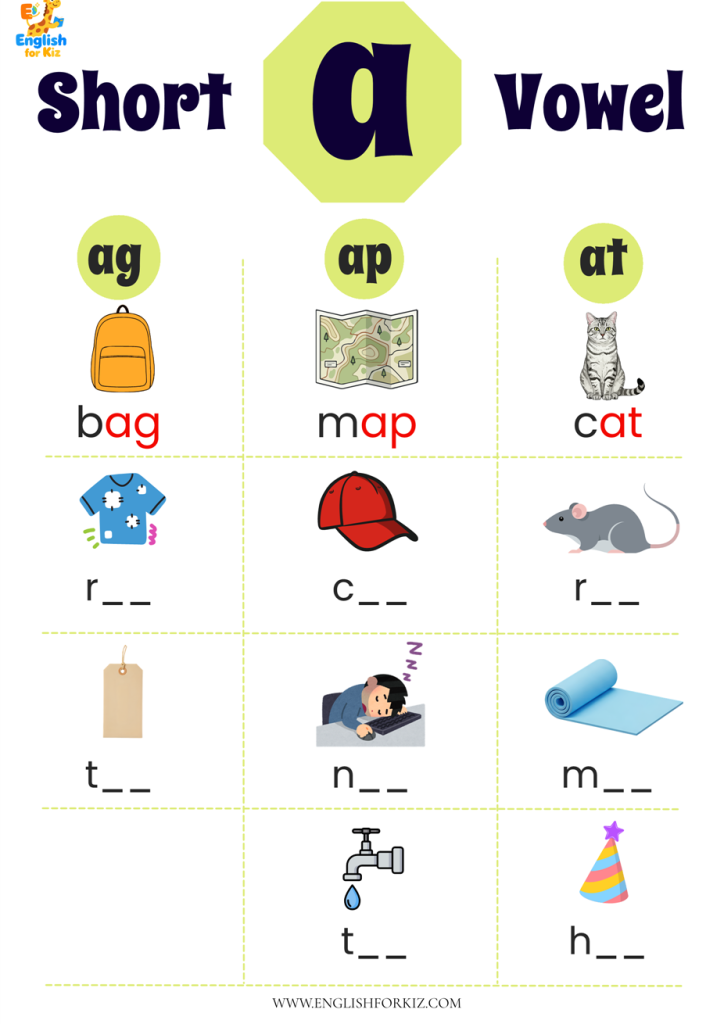 Short A -ag, -ap, -at
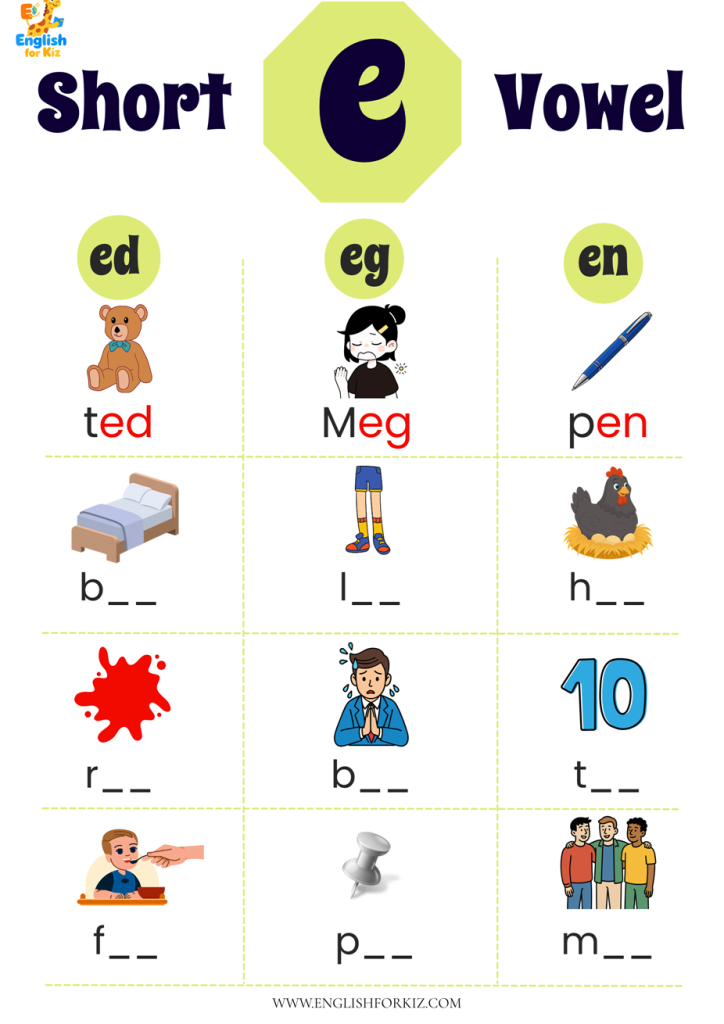 Short E -ed, -eg, -en
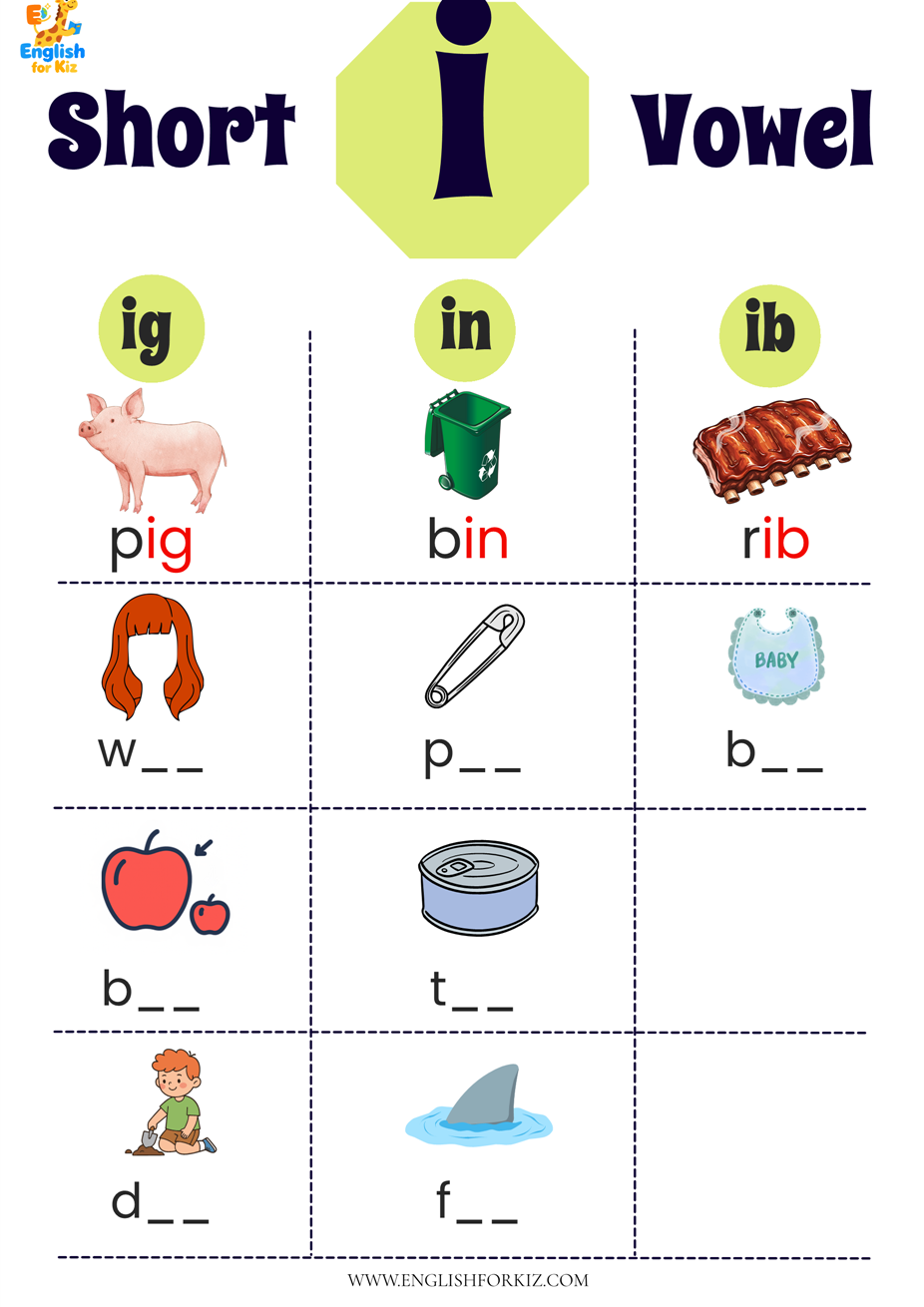 Short I -ig, -in, -ib
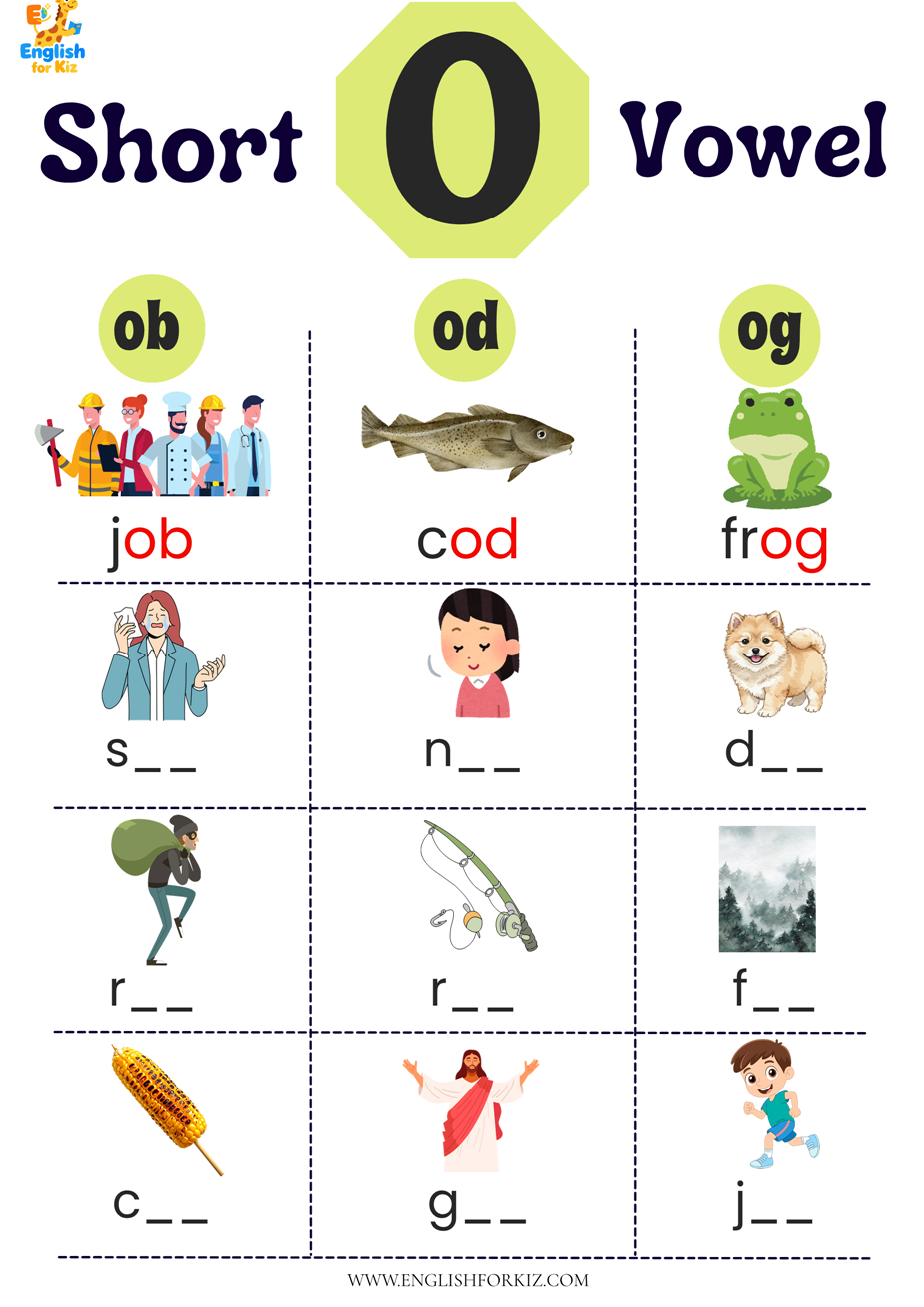 Short O -ob, -od, -og
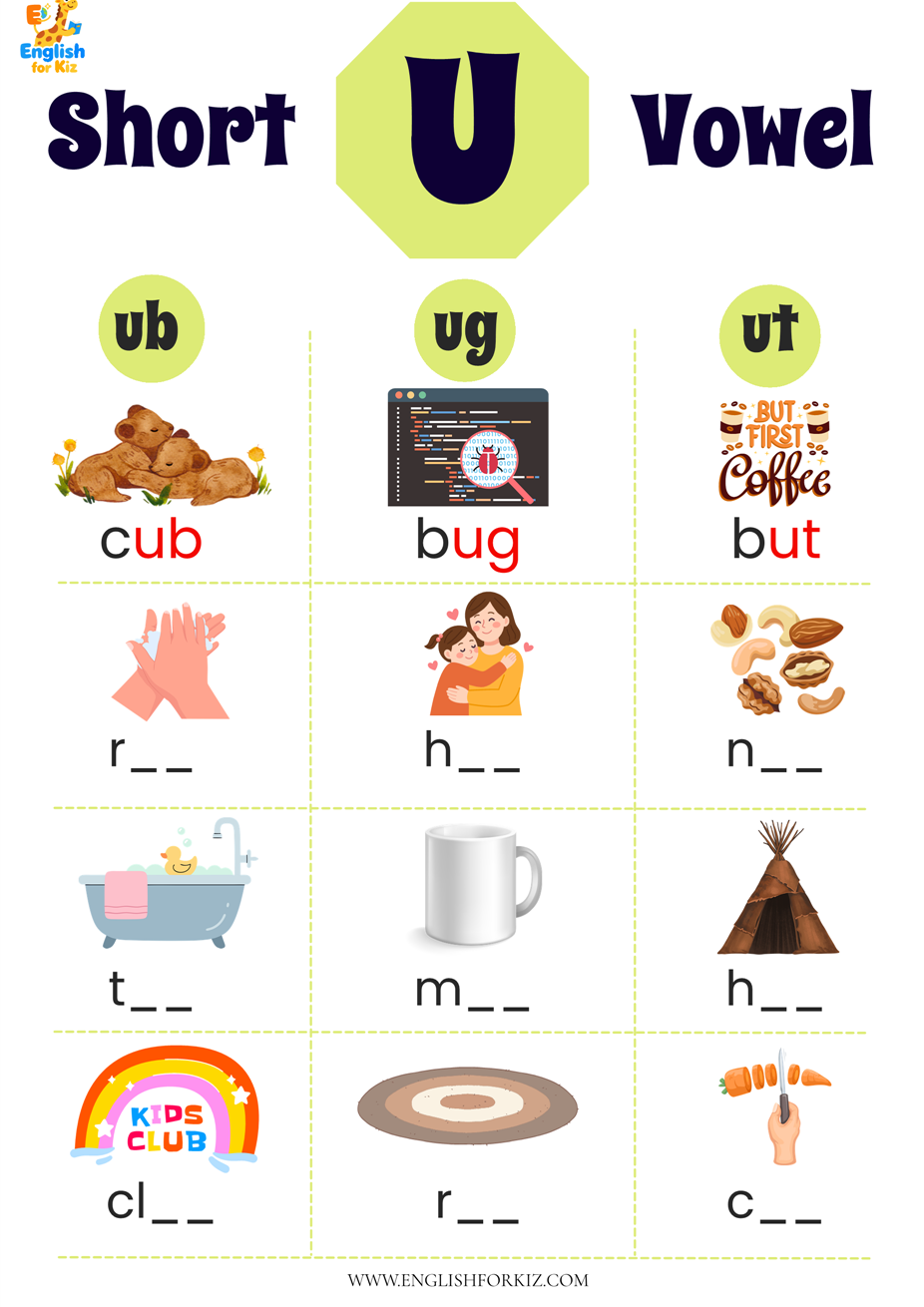 Short U -ub, -ug, -ut
A Worksheet Sequence for Each Vowel
Effective short-vowel practice pages should change the kind of thinking required. A dependable progression moves through four stages: match, build, spell, and sentence.
Match
Identify the target vowel, sort spoken words, or connect a decoded word with its meaning.
Build
Use letter tiles or sound boxes to map each phoneme, or speech sound, to a written letter.
Spell
Cover the model and dictate two or three words. The written response reveals whether the middle sound is secure.
Sentence
Read a controlled line using familiar patterns and only a small number of known high-frequency words.
Choose the next page by the error
A completed page does not automatically signal readiness to move on. The next task should address the behavior that still needs support.
Well-designed CVC worksheets connect word families with blending, spelling, and simple reading. Page count matters less than a visible shift from supported recognition toward independent use.
Decorative variety can keep practice fresh, but the reading demand must remain clear. A maze, spinner, or cut-and-paste page only adds value when the child still has to hear, build, spell, or decode the target pattern.
Cumulative Review and When to Introduce Mixed-Vowel Pages
Cumulative review keeps earlier vowels active while a new one receives most of the lesson time. When short I is the target, a small practice set might contain six I words and only two earlier A or E words.
Move from one vowel to a two-vowel comparison before presenting all five. This smaller contrast makes errors easier to identify and correct.
Mixed pages are useful when a child can:
- Hear the target vowel in a spoken CVC word.
- Read several single-vowel words without picture guessing.
- Spell two or three examples from dictation.
- Notice and repair some middle-vowel errors independently.
Mixed review should vary the task as well as the word list. A ten-minute review can include two oral contrasts, eight words to read, three dictated words, and one controlled sentence.
If accuracy falls sharply, return to the pair causing the problem. Repeating a focused contrast is more productive than completing several all-vowel pages with the same unresolved error.
Move from Vowel Pages into Short Connected Reading
Isolated words show whether a pattern can be decoded, but connected text reveals whether that skill survives across a line. After mixed CVC reading becomes more stable, decodable readers provide a logical transfer step.
The text should match the code already taught. A beginning reader focused on short A should not meet a page crowded with advanced blends, vowel teams, and silent-e words.
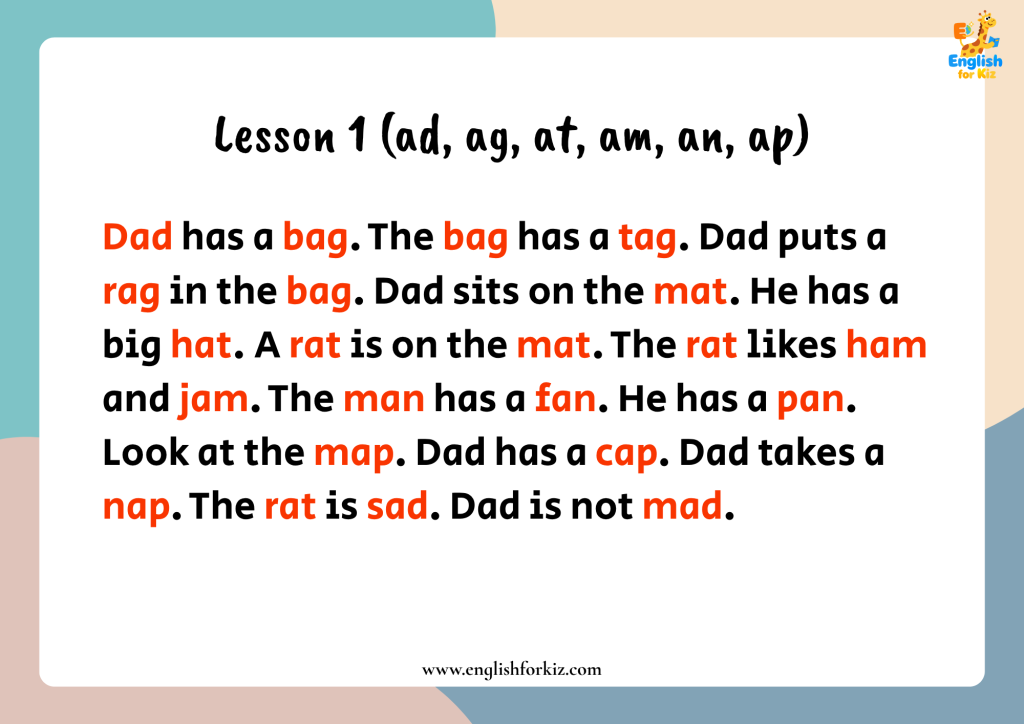
Use the same vowel families in sentences
During the first read, focus on accurate decoding and left-to-right tracking. A later reread can develop smoother phrasing without replacing careful word reading.
Practice with Decodable ReadersContinue with Kindergarten Resources
The five-vowel sequence is one part of a wider early reading path. After focused vowel practice, children still need mixed CVC decoding, spelling, sentence tracking, and controlled text before harder spelling patterns take over.
The Kindergarten phonics program provides a continuous route when separate practice pages need to connect with a broader lesson order. Earlier vowel work can still be repeated whenever accuracy becomes less stable.
Continue after single-vowel practice
Use a connected Kindergarten sequence for mixed CVC reading, spelling, sentences, and the next appropriate phonics step.
Related Reading
FAQ
What order should short vowels be taught in?
A–E–I–O–U is a clear working sequence, although it is not the only suitable order. The best route keeps each new sound distinct, creates enough simple CVC words, and allows extra time for any vowel pair that remains difficult to hear.
Should one vowel be completely mastered before the next begins?
Perfect performance is unnecessary. Before adding another vowel, the child should usually identify the sound, read a small bank of words, and spell a few examples. The earlier vowel should then remain in light cumulative review.
When are mixed short-vowel pages appropriate?
Begin with a two-vowel contrast after both sounds have been practised separately. All-five-vowel pages are more useful when the child can read and spell several examples while paying attention to the medial letter.
How do CVC activities support vowel learning?
A consonant-vowel-consonant word places the vowel in a clear middle position. The pattern lets children hear, build, spell, and read the target sound inside a complete word rather than treating the vowel as an isolated symbol.
What should come after all five short vowels?
Continue with mixed CVC decoding, short dictation, controlled sentences, and matched decodable text. Move into harder spelling patterns only when the earlier vowel system remains stable across both isolated words and connected reading.