
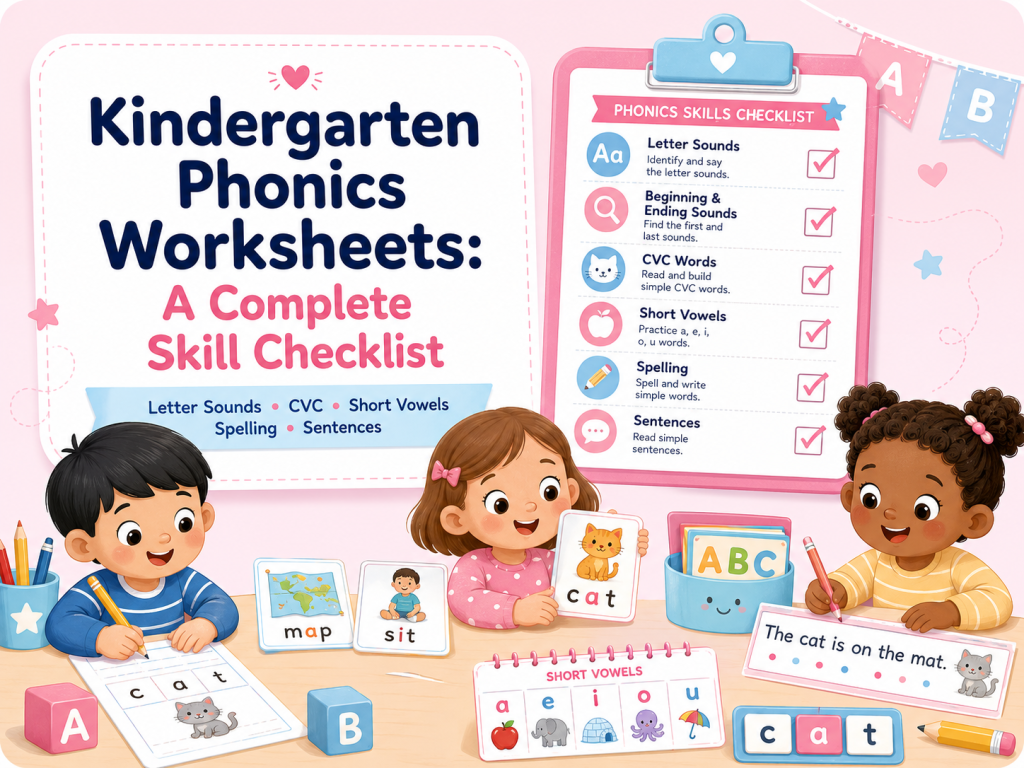
A strong set of kindergarten phonics worksheets should do more than keep children busy with tracing and coloring. It should show whether early readers can hear sounds, connect sounds to letters, blend simple words, spell taught patterns, and read controlled sentences. This checklist helps parents, teachers, and homeschool families review the full skill path, identify missing practice, and choose a useful next step. It is not a race or a fixed schedule because children may secure one skill quickly while needing more time with another.
Letter-Sound Review and Beginning/Ending Sounds
Alphabet recall is not the same as usable sound knowledge. A child may name the letter m but hesitate when asked for /m/ in map. For that reason, a complete worksheet collection should check letter names and letter sounds through separate tasks.
Mixed-order review gives more useful evidence than an A-to-Z page. It prevents the alphabet song from carrying the answer and reveals which lowercase letters are truly secure.
Recognize
Match a printed letter to a familiar picture or select a letter after hearing its sound.
Produce
Look at a lowercase letter and say the sound without picture clues or alphabet order.
Transfer
Find the same sound at the beginning or ending of a new spoken word.
Check Beginning and Ending Sounds Separately
Beginning-sound pages should use familiar vocabulary and clear pictures. Ending-sound practice should begin with words that have easy final consonants, such as map, sun, leg, and fish. These tasks reveal whether attention continues across the whole word.
A child who notices only the first sound may later guess cat for cap. In that case, additional final-sound listening is more helpful than another alphabet worksheet.
- Show six lowercase letters in mixed order.
- Ask for the sound rather than the letter name.
- Say three words and identify each beginning sound.
- Say three more words and identify each ending sound.
- Record repeated errors instead of isolated mistakes.
Match the Response to the Error
Confusion between b and d may involve visual direction, sound recall, or rushed scanning. A short comparison task can isolate the cause. Meanwhile, an added vowel sound, such as /buh/, needs clear oral modeling because it makes later blending more difficult.
CVC Blending and Segmenting
CVC words contain a consonant, vowel, and consonant, as in map, sit, and log. They give early readers a clear way to track every sound from left to right. However, recognizing three sounds separately does not always lead to a successful blend.
A complete CVC section should check reading and spelling from opposite directions. Blending turns printed sounds into a spoken word, while segmenting separates a spoken word into sounds for spelling.
Use a Consistent Blending Routine
- Point under each letter and say the sound.
- Slide through the sounds without long pauses.
- Repeat the complete word at a natural pace.
- Confirm the meaning after the word is decoded.
- Read the word again without a picture clue.
Useful CVC worksheets keep print at the center of the task. Pictures can confirm meaning after decoding, yet they should not make the word easy to guess beforehand.
Check Segmenting with Sound Boxes
For spelling, say a word such as sun and use three sound boxes. A counter moves into each box for /s/, /u/, and /n/. Letters replace the counters only after all three sounds are clear.
This order separates listening from handwriting. A child may copy sun correctly while still struggling to hear the middle vowel during independent spelling.
Example: Change One Sound
- Build map.
- Change /m/ to /t/ and read tap.
- Change /a/ to /o/ and read top.
- Change /p/ to /g/ and read tog.
The silly word checks whether letters are being decoded instead of recalled from memory.
What Common Errors Reveal
- Picture guessing: cover the image until reading is complete.
- Dropped final sound: return to ending-sound tracking.
- Sound-by-sound only: ask for one smooth reread.
- Wrong middle sound: narrow the vowel comparison.
Short Vowels and Word Families
Short vowels often reveal the difference between memorizing a pattern and reading every sound. A worksheet set may contain many vowel pages yet still lack mixed review, listening contrasts, or independent spelling. The complete collection should include each of those forms of practice.
Move from One Vowel to Mixed Decisions
Focused practice is useful when a vowel is new. Short a may begin with map, cat, jam, and van. After another vowel has been taught, mixed rows such as map, mop, and mug show whether the middle sound is being heard.
Hear
Identify the target vowel in spoken words before adding print.
Read
Blend CVC words that use one familiar vowel pattern.
Spell
Build and write selected words from spoken sounds.
Mix
Compare two or more taught vowels without picture clues.
Use Word Families Without Creating Dependence
Families such as cat, hat, mat, and sat make a shared ending visible. Still, repeated success may come from saying “-at” instead of checking every letter. Mixing in cap, can, and cab tests attention to the final consonant.
Choose the Smallest Useful Contrast
If short e and short i are confused, a five-vowel review page may add unnecessary load. A smaller comparison using pig, peg, sit, and set gives clearer feedback. Broader mixed review becomes useful after that contrast improves.
Early Spelling, Sight Words and Controlled Sentences
Reading and spelling share sound-letter knowledge, but they do not develop at exactly the same pace. Copying a printed word may produce a neat answer without showing whether the sounds were mapped independently. A complete worksheet set should include word building, short dictation, and connected reading.
Move from Sounds to Tiles to Pencil
- Say the word and repeat it naturally.
- Stretch the word without adding extra sounds.
- Move one counter for each sound.
- Replace the counters with letter tiles.
- Read the completed word.
- Cover the model and write the word once.
- Compare the spelling sound by sound.
This sequence separates phonics knowledge from fine-motor demands. A child who builds sun correctly but writes sn needs a different next step from a child who cannot hear /u/ in the word.
Sort Spelling Errors Before Choosing More Practice
Initial sound change: compare the first sounds orally.
Missing middle vowel: return to three sound boxes.
Final sound change: add ending-sound contrasts.
Letter reversal: separate formation from spelling practice.
Copied but unreadable: ask for an oral reread.
Memory guess: include one new decodable word.
Keep Sentence Text Controlled
Sight words should unlock simple sentences rather than replace phonics. A small number of useful high-frequency words can appear with decodable CVC words. For example, “The cat can nap” allows a short a pattern to appear inside meaningful text.
Pictures should confirm meaning after reading, not reveal the sentence before decoding. Clear spacing also matters because early readers may skip small words or repeat a word from the line above.
Add Short Sentence Dictation
Two or three words and one controlled sentence provide enough evidence for an early spelling check. “The cat is on the mat” tests CVC spelling, familiar high-frequency words, spacing, and punctuation without adding an unrelated spelling pattern.
After writing, the sentence should be read aloud. Any correction should be followed by one complete reread so meaning and print remain connected.
Handwriting, Read-Aloud and Error Review
A completed page shows the final marks, but it does not show how much support was needed. Brief observation makes each worksheet more useful. Adults should note whether answers were independent, prompted, copied, or corrected after rereading.
Keep Handwriting Proportionate
Early writers need clear models, roomy lines, and short independent responses. Dense copying can reduce accuracy through fatigue. When phonics is the lesson goal, readable letters matter more than perfect size and spacing.
If handwriting hides sound knowledge, letter tiles can carry part of the task. Formation can receive a separate short activity rather than controlling the entire reading lesson.
Add a Read-Aloud Check
Completed words and sentences should be read aloud. This confirms that written answers connect back to spoken language. Useful prompts direct attention to print rather than meaning alone.
- “Check the middle sound.”
- “Look at the last letter.”
- “Blend through the whole word.”
- “What changed at the beginning?”
- “Read the complete sentence again.”
Use a Calm Correction Routine
- Ask for a reread before giving the answer.
- Locate the sound position that changed.
- Say or stretch the word again.
- Correct only the necessary letter or word.
- Read the complete item once more.
- Return later with a new example.
Printable Checklist: What to Look for in a Worksheet Set
Review the full collection rather than judging it by one attractive page. Mark each area as covered, limited, or missing. Then focus on the gap that most affects the next reading step.
Sound Foundations
Can printed letters be connected with spoken sounds?
CVC Blending and Segmenting
Does practice include reading and spelling from sound?
Short Vowels and Word Families
Does the set move from focused vowels to mixed choices?
Spelling and Word Building
Can sounds be mapped independently instead of copied?
Sight Words and Connected Reading
Do taught phonics patterns appear inside readable sentences?
Page Design and Learning Evidence
Does the layout reveal the skill rather than hide it?
How to Read the Results
A collection may be strong overall and still miss the one task needed next. Avoid turning the boxes into a simple percentage score. Instead, identify the missing skill that blocks later reading, such as blending, vowel recognition, segmenting, or sentence tracking.
Choose no more than three gaps. Pair one short oral activity with one matching worksheet and one new transfer example.
Which Resource Fits the Result?
Choose Worksheets
Best when a skill has already been taught and needs focused written practice, visible error evidence, or brief review.
Choose the Kindergarten Program
Best when several connected skills are missing or the correct teaching order is unclear.
Choose Connected Reading
Best when single words are accurate but the same patterns are not secure in sentences or short passages.
Find Practice That Matches the Missing Skill
Use the worksheet library to select the category marked limited or missing. This avoids repeating secure work and keeps each lesson focused on one useful next step.
Browse Kindergarten WorksheetsBuild a Kindergarten Lesson Sequence
A worksheet set becomes easier to use when every page has a clear job inside a lesson. The sequence below begins with sound knowledge and ends with connected reading. Review stays active throughout, so moving forward does not mean abandoning earlier skills.
A Six-Stage Kindergarten Path
- Confirm sound foundations: review lowercase letters, consonant sounds, and beginning or ending sounds.
- Begin oral blending: combine known sounds before increasing writing demands.
- Teach one short vowel: connect listening, reading, building, and spelling.
- Mix taught vowels: add contrasts, word chains, and picture-free word rows.
- Connect words to sentences: use short dictation and controlled text.
- Review and transfer: return later with a new word, sentence, or passage.
A Focused 15-Minute Lesson
- 3 minutes: sound recall and oral blending
- 4 minutes: one focused worksheet section
- 4 minutes: word building or short dictation
- 3 minutes: phrase or sentence reading
- 1 minute: correction and rereading
- Later: one delayed transfer check
Plan Small Groups by Error Pattern
Page numbers do not create useful groups, but repeated errors do. One group may compare short e and short i, while another works on final sounds, continuous blending, or accurate sentence tracking.
The Kindergarten phonics program is a stronger next step when the checklist shows several connected gaps or when a consistent teaching order is needed. It provides a broader path beyond isolated printable practice.
Use a Full Path When Random Pages Are Not Enough
A structured program helps connect sound review, blending, spelling, and sentence reading. It is most useful when lesson planning needs a dependable sequence rather than one isolated worksheet.
Explore the Kindergarten ProgramRelated EnglishForKiz Resources
FAQ
What skills should kindergarten phonics worksheets cover?
A complete collection should cover letter sounds, beginning and ending sounds, blending, segmenting, short vowels, word families, spelling, handwriting, sight words, and controlled sentence reading. It should also include mixed review and at least one new example that checks transfer.
Are CVC worksheets enough for kindergarten?
CVC practice is central, but it is only one part of early reading. Children also need oral sound work, vowel contrasts, spelling, handwriting, high-frequency word support, sentence tracking, and opportunities to apply familiar patterns in connected text.
When should short vowel worksheets be introduced?
Short vowel pages can begin after enough consonant sounds are known to build simple words and oral blending has started. One vowel should usually receive focused practice before several vowels appear together on the same page.
How can teachers use the checklist for small groups?
Mark each area as covered, limited, or missing, then group children by the repeated error. A group may work on vowel contrasts, final-sound attention, blending, spelling, or sentence tracking instead of completing the same page as every other group.
How many worksheet items are useful in one lesson?
The amount depends on attention and task difficulty. Five carefully observed items may provide better evidence than a crowded full page. Shorten the assignment when accuracy falls because of fatigue rather than the target phonics skill.
Use the Checklist to Plan the Next Lesson
The value of a worksheet comes from the decision it supports. A finished page should show whether a child can recognize a pattern, produce it independently, and apply it in a new word or sentence. When one form of evidence is missing, the next activity becomes easier to choose.
- Mark each checklist area as covered, limited, or missing.
- Select one blocking gap and pair an oral task with one matching page.
- Recheck the skill later through a new word, spelling item, or sentence.
When a routine needs access to several learning formats, the EnglishForKiz membership provides a broader route through the site’s available resources. The checklist can still guide which type of activity should come next, so additional materials do not become random practice.
View EnglishForKiz Membership