
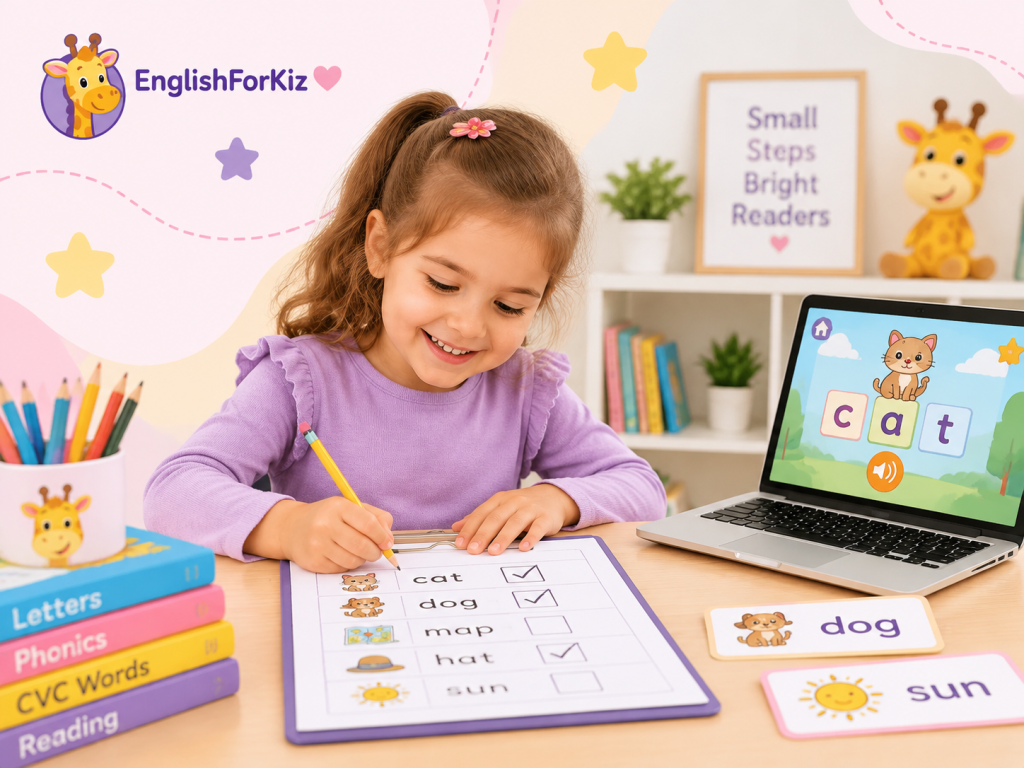
A useful CVC reading accuracy checklist records four things: the child’s first read, the sound position where an error occurs, any adult prompt, and whether the child self-corrects. Those observations tell parents, teachers, tutors, and homeschool families much more than a simple right-or-wrong score.
This guide shows how to run a short, low-pressure CVC check, identify patterns such as short-vowel confusion or final-sound guessing, choose practice that matches the error, and decide when to retest or move into connected reading. A ready-to-use 10-word checklist is included below so the same observations can be recorded consistently.
1. Prepare CVC Words That Show What the Child Can Really Decode
Start with a short set of consonant-vowel-consonant words using letter sounds the child has already met. Include different short vowels and several beginning and ending consonants so the list can reveal whether difficulty appears at the initial consonant, medial vowel, final consonant, or blending stage.
A simple mixed list might include map, cat, hen, red, sit, pig, log, hop, sun, and cup. Adjust the words to match what has already been taught, but avoid filling the check with words the child has practiced so often that they may simply remember them.
Include some unfamiliar words built from familiar sound patterns. A child who has memorized cat may recognize it immediately, while a less-practiced word such as map or fin shows more clearly whether the child can work from left to right through the print.
A picture can be useful during teaching, but it can also give away the answer. If the goal is to observe decoding, show the printed word without a picture and save visual clues for the later practice session.
The list should also stay manageable. A brief set that the child can finish while still attentive gives cleaner information than a long page completed after guessing or fatigue begins.
If the child is still working across letter sounds, short vowels, blending, and early word reading rather than one narrow CVC pattern, use the Kindergarten phonics program as the broader learning path. The assessment can then help identify which part of that sequence needs more attention.
2. Run a Short One-to-One CVC Reading Check
Use the same calm instruction for each item. Show one word at a time and say something simple such as, “Read this word.” Give the child time to look through the letters before deciding whether support is needed.
If the word is map and the child says “/m/ … /a/ … /p/ … map,” the first read is accurate even though blending is still slow. Record that difference rather than treating slow but correct decoding as an error.
If the child immediately reads map as man, write down man before giving help. The first response shows that the beginning and vowel may have been processed correctly while the final consonant was not.
Record the response before helping
Suppose the target is cat. The child says cap, looks back at the letters, and changes the answer to cat without adult help. Record “cap → cat” and mark it as a self-correction rather than replacing the first response with a simple check mark.
If the child changes the answer only after an adult says, “Look at the last letter,” the final word may be correct, but the result is not independent. Record the prompt because that information matters when the same skill is checked again later.
Use consistent prompts when support is necessary
When a child becomes stuck, keep the support predictable. A neutral reminder such as “Look at all the letters and try again” preserves more information than supplying the missing sound or telling the child the word.
During normal instruction, adults should model, explain, and correct. During a short kindergarten CVC reading assessment, however, teaching through every item makes it difficult to tell which words the child could decode independently.
The aim is not to make a child finish every word. If several items become frustrating, stop and use the pattern already observed to choose easier or more focused practice.
3. Record the First Read, Error Position, Prompt, and Self-Correction
A CVC reading accuracy checklist is most useful when it shows not only whether a word was correct, but also where decoding broke down. For each word, record the first response, the error position or pattern, any adult support, and whether the child corrected the word independently.
Keep first-attempt accuracy separate from independent self-corrections and prompted corrections. That distinction makes later comparisons more meaningful and prevents adult support from being mistaken for independent reading.
Blank CVC Reading Accuracy Checklist
Use only words built from letter-sound patterns the child has already been taught. The 10-word example below samples all five short vowels; replace individual words when needed to match instruction.
| Word | First Read | Error Position / Pattern | Self-Correction | Adult Prompt | Retest Notes |
|---|---|---|---|---|---|
| map | □ Initial □ Vowel □ Final □ Blend / Guess | □ Yes □ No | □ None □ Neutral □ Specific | ||
| cat | □ Initial □ Vowel □ Final □ Blend / Guess | □ Yes □ No | □ None □ Neutral □ Specific | ||
| hen | □ Initial □ Vowel □ Final □ Blend / Guess | □ Yes □ No | □ None □ Neutral □ Specific | ||
| red | □ Initial □ Vowel □ Final □ Blend / Guess | □ Yes □ No | □ None □ Neutral □ Specific | ||
| sit | □ Initial □ Vowel □ Final □ Blend / Guess | □ Yes □ No | □ None □ Neutral □ Specific | ||
| pig | □ Initial □ Vowel □ Final □ Blend / Guess | □ Yes □ No | □ None □ Neutral □ Specific | ||
| log | □ Initial □ Vowel □ Final □ Blend / Guess | □ Yes □ No | □ None □ Neutral □ Specific | ||
| hop | □ Initial □ Vowel □ Final □ Blend / Guess | □ Yes □ No | □ None □ Neutral □ Specific | ||
| sun | □ Initial □ Vowel □ Final □ Blend / Guess | □ Yes □ No | □ None □ Neutral □ Specific | ||
| cup | □ Initial □ Vowel □ Final □ Blend / Guess | □ Yes □ No | □ None □ Neutral □ Specific |
Calculate Accuracy Without Inventing a Universal Cutoff
If a simple progress number is useful, keep first-attempt accuracy separate from words that become correct after an independent self-correction. Adult-prompted corrections should be recorded, but they should not be counted as independent reading.
On a 10-word list, if 7 words are correct on the first read and 1 more is corrected without a prompt, record 70% first-attempt accuracy and 80% independent final accuracy. If another word becomes correct only after an adult cue, note the prompt but do not add that word to the independent final score.
Use these percentages to compare the child’s performance across similar checks, not as a universal kindergarten pass/fail standard. The word list, taught patterns, difficulty, and purpose of the check all affect the result.
Initial or Onset Errors
If log becomes dog, record the beginning sound as the error position. Do not reduce the observation to “wrong,” because the child may have decoded the vowel and final consonant correctly.
Medial-Vowel Errors
If hen becomes hin, write the spoken response and note “medial vowel.” Repeated confusion in the middle of CVC words points toward short-vowel comparison practice rather than general CVC review.
Final-Consonant Errors
If sit becomes sip, the child may be reading most of the word but not attending carefully to the ending. Record the final position so later practice can require reading all the way through the word.
Blending Difficulty and Whole-Word Guessing
A child may accurately say /s/, /u/, and /n/ but struggle to combine them into sun. Another child may look at the first letter of sun and quickly say sit. The first pattern suggests a blending issue; the second suggests guessing before enough print has been processed.
4. Interpret the Error Pattern, Not Just the Accuracy Score
Two children can read the same number of words correctly and still need different next steps. Look at how the answer was produced, not only at the final total.
Accurate but Slow
The child says the correct sounds and blends the correct word, but the process takes time. Keep practicing known CVC patterns rather than assuming that slow reading means the child has forgotten the letter sounds.
Fast but Guessing
The child answers quickly but substitutes similar-looking words. Use practice that makes the middle and final sounds matter instead of rewarding speed alone.
Correct After a Prompt
The child can reach the answer after attention is redirected to the print. Record the success and the prompt so a later check can show whether the same support is still necessary.
Independent Self-Correction
The first attempt contains an error, but the child notices the mismatch and fixes it without adult help. Keep both responses because they show decoding accuracy and monitoring separately.
Speed should never hide an inaccurate reading pattern. A quick man for map does not demonstrate stronger decoding than a slower but accurate /m/ /a/ /p/ → map.
Slow reading does not automatically mean the child needs to return to the alphabet either. When each sound is accurate and blending succeeds, repeated practice with the same taught pattern may be the better next step.
After instruction, phonics games can provide active review of CVC blending and short-vowel patterns. Use them for practice rather than as a substitute for the later print-only retest.
5. Choose CVC Practice That Matches the Recorded Error
The checklist becomes useful when the result changes what happens next. Avoid automatically assigning another broad mixed-CVC page. Select practice that targets the repeated behavior in the reading record.
When the Medial Vowel Causes Most Errors
Narrow the vowel range. If short e and short i are repeatedly confused, practice small, controlled groups such as hen, red, bed and sit, pig, fin before mixing several short vowels again.
The goal is not to memorize the list. It is to make the middle sound easier to hear and notice in print. Once the contrast becomes more reliable, introduce unfamiliar words using the same vowel patterns.
When Final Consonants Are Changed or Dropped
Use word contrasts in which the ending changes the answer: map/man, cat/cap, or sit/sip. During practice, a child can slide a finger from left to right under the word and say each sound before blending.
Remove that support during the next reading check. The important change is not simply completing a worksheet correctly; it is reading the final consonant independently when the adult is no longer guiding attention.
When Sounds Are Accurate but Blending Is Slow
Keep the spelling patterns familiar and increase successful blending opportunities. Small sets of five or six words work well because the child can focus on joining sounds without turning the activity into a speed test.
For example, practice sat, mat, cat, map, tap, and cap. Change one letter at a time and have the child read the new word, noticing how the change affects the whole word.
When Several Required Letter Sounds Are Not Secure
If the child cannot reliably produce several individual sounds needed for the list, step back from whole-word decoding. Review those letter-sound connections, then return to CVC words built only from sounds the child can identify.
This is different from knowing /m/, /a/, and /p/ individually but struggling to combine them. The error log prevents those two learning needs from being treated as the same problem.
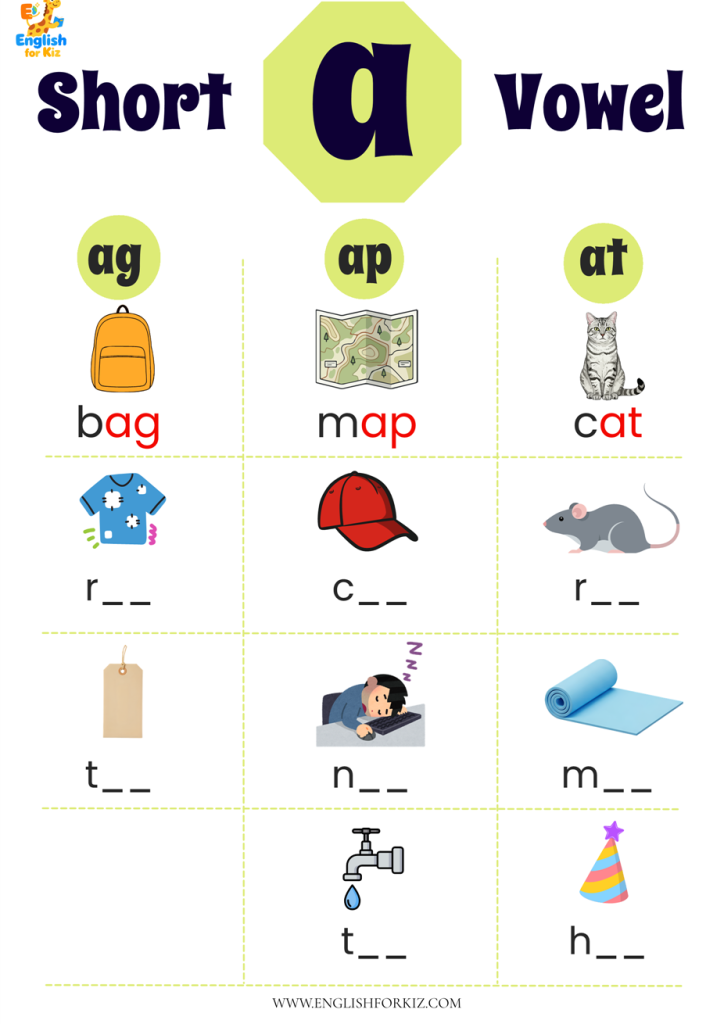
EnglishForKiz organizes kindergarten practice around short-vowel CVC patterns and word families. Choose the page that most closely matches the vowel or word pattern that caused difficulty during the reading check.
If the checklist shows one clear pattern, stay with that skill for several short practice sessions. Use the CVC worksheets for kindergarten so practice responds to the observed error, then retest with new words using the same taught pattern.
Choose Kindergarten CVC Practice by Error Pattern6. Retest the Same Skill with New CVC Words
A single check is only a snapshot. After focused practice, run another short reading check and compare the error pattern rather than looking only at the number of words read correctly.
Use some new words that test the same skill. If the child practiced short e and short i, the retest should include unfamiliar examples containing those vowels rather than simply repeating every word from the first list.
If you compare accuracy percentages across checks, keep the lists similar in length and difficulty. A harder word set can lower the percentage even when the child’s underlying decoding has improved.
For example, the first error log may contain several short e versus short i substitutions. After practice, the child may still blend slowly but make fewer vowel substitutions. That change matters even if automaticity is still developing.
A different pattern can appear too. If vowel errors become uncommon but final consonants are now being dropped, the next target has simply become clearer. The purpose of retesting is to update the instructional decision.
Use Practical Decision Rules Instead of a Universal Cutoff
There is no need to create one percentage and treat it as a universal kindergarten standard for a homemade CVC list. The exact words selected, what the child has already been taught, familiarity with the patterns, and the purpose of the check all affect how a result should be interpreted.
Use simple instructional decisions instead. Continue the same skill while one error pattern remains frequent. Narrow the vowel range when several vowel contrasts create confusion. Return to individual letter sounds when the sounds needed for the word list are not yet reliable.
Move forward when the child reads taught CVC patterns independently across different examples, recurring error types become less common, and prompts are rarely needed. Reading does not have to be unusually fast before the child can begin applying familiar CVC words in phrases and short sentences.
If the child needs practice across several stages, not only one CVC error, the Kindergarten program connects letter sounds, short vowels, CVC blending, worksheets, games, and early reading.
Continue with the Kindergarten Phonics ProgramWhen Is a Child Ready to Move from CVC Words into Simple Reading?
Connected reading becomes useful when familiar CVC patterns can be decoded without constant adult rescue. Look for attention to all three sound positions, successful blending of some unfamiliar examples, less guessing from the first consonant, and reduced dependence on prompts.
The next step does not need to be a long storybook. Begin with short, controlled sentences that contain the CVC patterns the child already knows. This lets the child use decoding in real text while keeping the reading demand manageable.
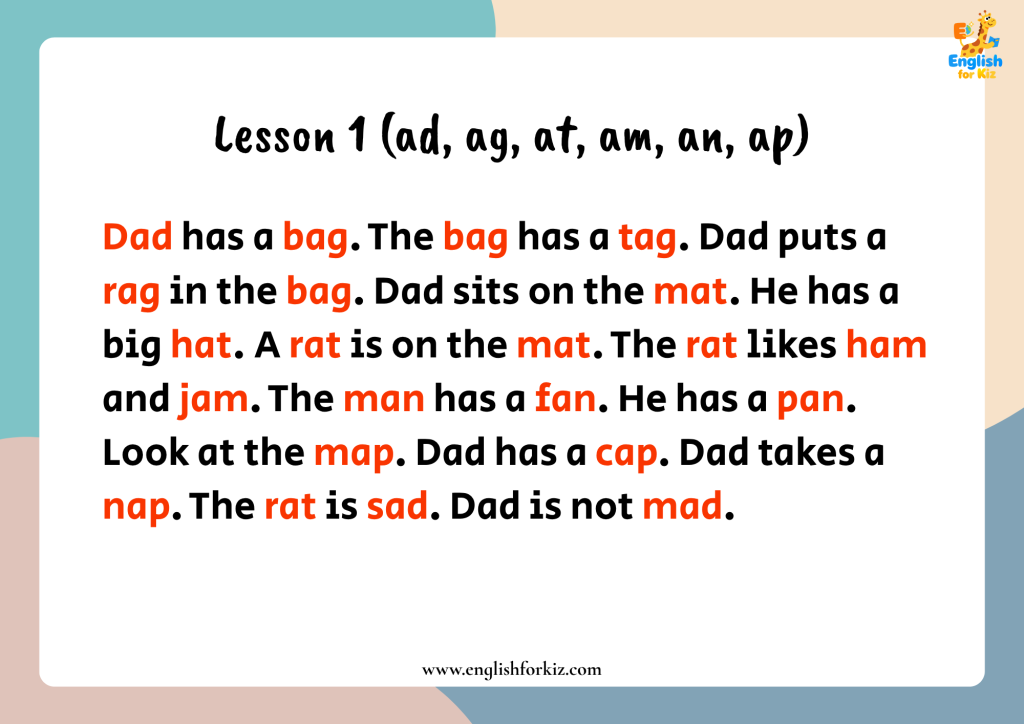
When single-word reading becomes dependable, use a text that contains already-taught phonics patterns. EnglishForKiz organizes its decodable readers by level, including Kindergarten CVC and short-vowel reading.
Keep the assessment logic the same: notice which words still require prompting, record recurring errors, and return to focused word practice when a pattern breaks down repeatedly.
Explore CVC and Short-Vowel ReadersUse it to describe observable reading behavior and plan practice. It is not designed to diagnose a learning disability or establish a universal grade-level judgment.
A practical CVC reading accuracy checklist for kindergarten stays simple: capture the first read, locate the error, note adult help, record self-correction, practice the specific weakness, and check the same skill again with new words. The value comes from seeing how the error pattern changes over time.
Continue Reading
Frequently Asked Questions
How many CVC words should be checked at one time?
Use a short set that gives enough variety to reveal a pattern without letting tiredness take over. The useful number depends on the child and the purpose of the check, so end the session when attention begins to affect the responses.
Should children see pictures during the check?
Usually not when the goal is to observe decoding from print. Pictures can return during teaching or worksheet practice, but removing them from the check makes it easier to see whether the letters themselves led to the answer.
What counts as a self-correction?
Count a self-correction when the child changes an incorrect first response to the correct word without an adult supplying a clue. Write down both responses. It remains incorrect for first-attempt accuracy, but it can count as correct in the independent final accuracy because the child fixed the word without prompting.
How do I calculate CVC reading accuracy?
For first-attempt accuracy, divide the number of words read correctly on the first try by the number of words attempted and multiply by 100. If you also track independent final accuracy, add words the child self-corrected without a prompt before calculating that second percentage. Keep prompted corrections separate.
When should the checklist be repeated?
Repeat it after enough focused practice has happened for a comparison to be useful. Include some new words using the same taught pattern and compare independence, error type, self-correction, and prompt dependence instead of relying only on a total score.