
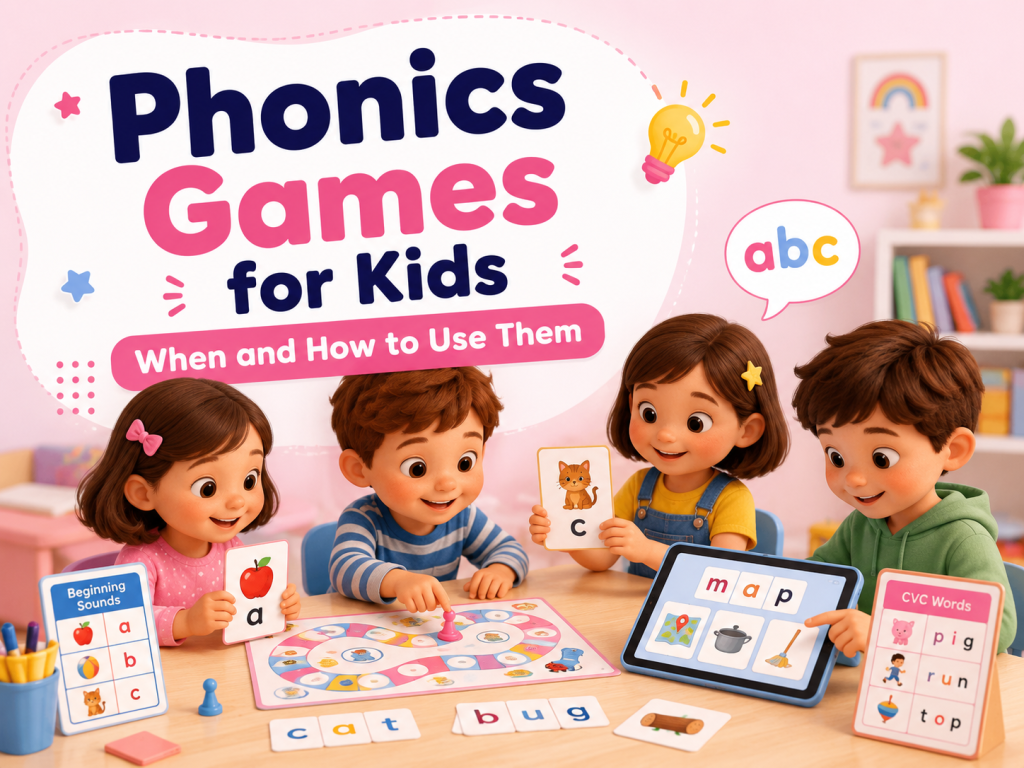
Phonics games are most useful when they check a skill that has already been taught. They should help a child hear, blend, segment, spell, or read more accurately—not hide confusion behind pictures, points, or repeated clicking.
This guide is designed for parents, teachers, and homeschool families deciding when an online activity belongs in a reading lesson. It explains how to match practice to letter sounds, CVC words, and later spelling patterns, then connect the same skill to print and real reading.
The main decision is simple: identify the reading behavior that needs practice, choose one activity that requires that behavior, and check the result away from the screen. The EnglishForKiz phonics games page provides the main practice destination once the correct learning stage is clear.
When Phonics Games Help Most
Game-based practice works best after a child has met the target in a clear lesson. By then, the sound or spelling pattern should be familiar enough for the activity to strengthen recall rather than introduce the idea through trial and error.
A short game can also provide a useful check several days later. For example, a child who practiced short a earlier in the week can review map, fan, and sat. The response shows whether the middle vowel is still secure or whether pictures and memorized positions are doing most of the work.
After direct instruction
The adult has modeled the sound, shown the printed pattern, and guided at least one correct response. The game now provides extra repetitions with less support.
During planned review
A familiar activity can reactivate a skill before spelling or reading. Keep the target narrow, such as one short vowel or one digraph contrast.
At an independent center
A child can review known material while an adult teaches another group. Later, a brief print check confirms whether the activity supported actual decoding.
When repetition feels heavy
A different response format can refresh attention. However, the format may change while the learning target stays the same.
A useful activity should answer one clear question: Can the learner identify the sound, read the word, segment the sounds, choose the spelling, or apply the pattern without the full teaching model?
Games are less useful when the target is completely new, the same error keeps returning, or handwriting is the main concern. They are also not the final step when a child can read isolated words but struggles in a sentence. Cards, letter tiles, written practice, and connected text are better tools for those needs.
In other words, the game is a checkpoint inside the lesson. It adds practice and gives information, but it does not replace teaching or reading.
Use Games After Introducing the Target Sound or Pattern
A reliable sequence keeps the activity tied to instruction. Teach the pattern, guide a small number of responses, assign one matched game, and finish with a new example away from the screen.
Name and model the target
Show the letter or pattern and say the sound clearly. For sh, an adult might read ship and shop, then explain that the two letters work together as one sound.
Guide two or three responses
Ask the child to repeat the sound, build a word, or blend with support. If every answer still needs modeling, continue teaching before opening an independent activity.
Choose the same response type
A listening lesson should lead to listening practice. A CVC blending lesson should require the child to blend the whole word, not only match a picture by its first letter.
Check the skill off-screen
Present two new words, one spelling item, or one short sentence. This step shows whether the child learned the pattern or simply remembered the game screen.
Example flow: a short-a checkpoint
Begin by showing a and modeling /a/ in map. Build and blend three words with letter cards, then assign an activity that asks the child to distinguish short a from a close vowel choice.
After the round, remove the screen and present jam and cap. If either word changes to jim or cup, return to the middle sound before assigning another level.
Move forward when most new examples are read accurately with no more than one brief prompt.
Corrections should remain short while the activity is running. Name the exact feature, allow one retry, and continue only if the response improves. When the same mistake repeats, pause the round and reteach with a smaller set.
Choose Games by Learning Stage
Grade and age labels offer a starting point, but the current reading behavior should make the final decision. Children in the same class can need different tasks because one is still connecting letters to sounds while another is reading short-vowel words.
Before choosing, write the goal as something observable. “Practice phonics” is too broad. “Hear /m/ at the beginning,” “blend three sounds,” or “distinguish sh from ch” makes the right activity easier to recognize.
Hear and connect sounds to letters
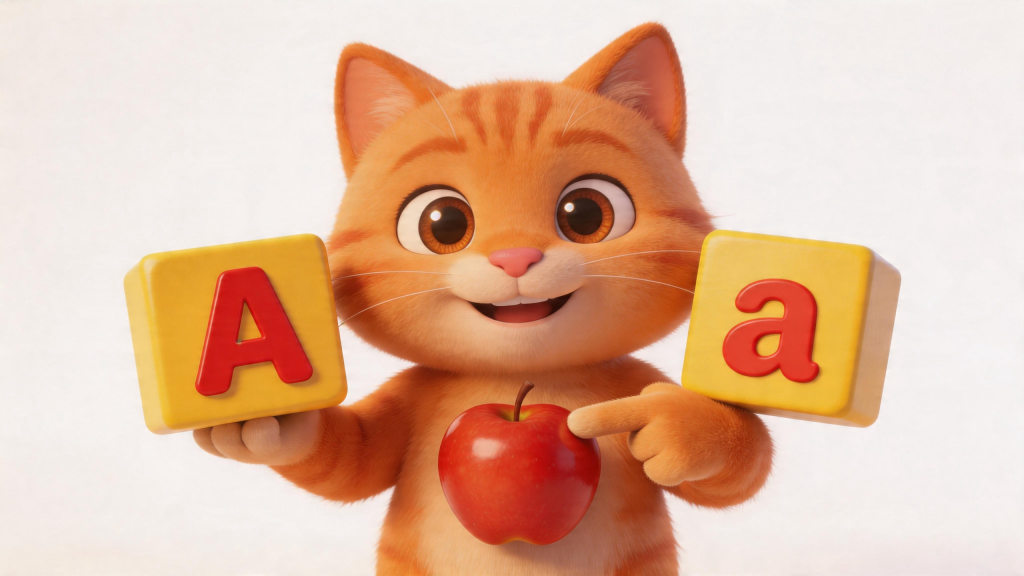
Choose tasks with a small number of letters or familiar pictures. The child should say the picture name, isolate the first sound, and connect it with print.
- Suitable targets: /m/, /s/, /t/, uppercase and lowercase matching
- Avoid fast timers and crowded choice sets
- Move on when familiar sounds are identified without position guessing
Blend short-vowel words
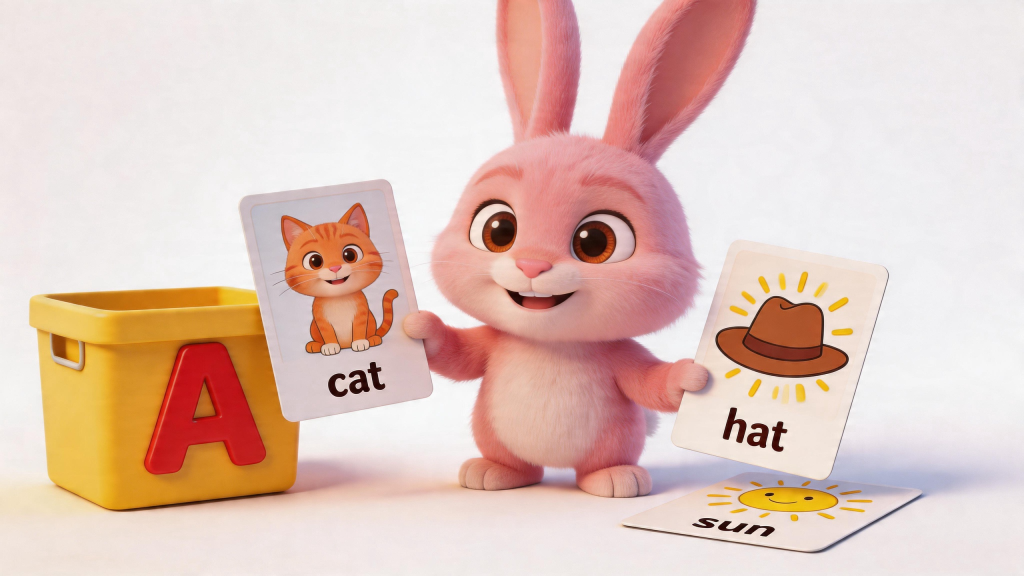
Choose activities that require attention to all three sounds. Reading the printed word before seeing the picture reduces guessing from meaning alone.
- Suitable targets: map, sit, hen, log, and sun
- Teach one vowel securely before mixing close contrasts
- Move on when new words are blended from left to right

Review blends, digraphs, and vowel patterns
Choose one specific contrast rather than a broad advanced level. A child may practice sh versus ch, initial blends, silent-e words, or one vowel team.
- Suitable targets: stop, flag, ship, chip, cap, and cape
- Avoid mixing several new rules in one round
- Move on when the pattern transfers into phrases and sentences
Check the distractors before assigning the activity. Useful choices reflect a likely reading confusion, such as map versus mop. Randomly different options can make the answer obvious without requiring the target skill.
Children working on CVC blending may benefit from a continuous sequence rather than isolated activities. The Kindergarten phonics program provides the relevant next destination when short vowels, word building, early sentences, and beginner reading need to stay connected.
Before, During and After the Game: Adult Prompts That Support Learning
Helpful prompts direct attention to sound or print. They do not give away every answer, repeat the same question several times, or turn a short practice round into a long explanation.
Name the exact target and demonstrate one complete response. Also preview the controls so dragging or clicking does not interfere with the reading check.
“Listen for short a in the middle.”
Use one short cue, then allow several seconds for thinking. Watch how the answer is reached rather than watching only the score.
“Touch each letter and blend smoothly.”
Present a new word or sentence away from the screen. Record the error pattern or the amount of help needed.
“Read these two new words with the same pattern.”
Specific feedback is more useful than broad praise. “The middle vowel was checked” or “That blend stayed smooth” identifies the reading behavior worth repeating. A calm correction can follow the same pattern: notice, direct attention, retry, and transfer.
Example correction: ship read as chip
Notice: “The first sound changed.”
Direct attention: “These letters are sh. Say /sh/.”
Retry: “Blend /sh/ /i/ /p/ and read the whole word.”
Transfer: After the round, read shop and fish from paper.
If the corrected response holds, continue for a few items. If the same error returns, end the round and reteach. More clicking will not solve a sound or spelling pattern that still lacks a clear mental connection.
Screen-Time Boundaries and Short Session Design
A useful online session ends while attention and accuracy remain strong. One focused round is usually more valuable than open-ended play because the adult can remember what happened and choose the next step.
Many early tasks fit into a three-to-eight-minute window. However, behavior matters more than the clock. Guessing, rushing, leaving the activity, or ignoring print signals that the productive part of the session has ended.
Review
Say the target sound and complete one guided example.
Play
Complete one assigned activity with the same skill.
Write
Correct one error or spell two matching words.
Read
Apply the pattern in a sentence or short passage.
This routine can be shortened for preschool learners or divided across classroom centers. The important feature is not the exact minute count. Every part should serve one target and lead toward print.
Audio and visual load also affect performance. Background effects, crowded screens, and rapid transitions can hide subtle sound contrasts or distract from the word. When that happens, a calmer activity or an off-screen alternative gives a more accurate reading picture.
Use a planned stopping point: one assigned round, ten careful responses, or one completed skill set. Ending at a clear point prevents the activity from becoming an unrelated reward session.
Signs a Game Is Too Easy, Too Hard or Off-Target
Difficulty is not simply the number of correct answers. A high score may come from memorized layouts, while a low score may reflect unfamiliar pictures, unclear controls, or several new patterns appearing together.
Too easy
Answers appear instantly, the child never says the sound or word, and repeated screens make the choices predictable. The first letter or picture may be enough to succeed.
- Use unfamiliar words with the same pattern
- Reduce one source of picture support
- Add a short spelling or sentence response
Too hard
Random clicking begins, every item needs help, or frustration rises quickly. The target set may contain too many vowels, patterns, or unfamiliar words.
- Reduce the number of choices
- Return to one vowel or one spelling rule
- Model one item and retry a smaller set
Off-target
The activity appears relevant, but it does not require the intended reading behavior. A decoding task may reveal the answer through audio, or a vowel task may be solved from pictures alone.
- Name the exact response the child must make
- Check whether the printed word can be ignored
- Choose a format that tests the actual skill
When the task is too easy or too hard, change only one demand. Add a closer vowel contrast, reduce the choice set, remove audio support, or introduce new words. Changing the target, vocabulary, timer, and controls at the same time makes the result difficult to interpret.
Stay at the current level when
- The same prompt is still needed on several items
- Middle vowels or final sounds are regularly skipped
- Correct answers do not transfer to paper
Move to the next level when
- New examples are mostly accurate
- The child self-corrects after noticing print
- The pattern appears in spelling and short reading
A well-matched task creates effort without confusion. The child should need to think, yet still have a reliable strategy for reaching the answer.
Connect Games with Worksheets and Decodable Readers
The complete lesson moves the same target through sound, print, writing, quick review, and connected text. Each format shows something different, so the sequence should not stop after a successful game score.
Teach
Model the sound or spelling pattern and guide a correct response.
Write
Map sounds, form letters, build words, or spell a focused set.
Review
Use one matched online activity as a short retrieval check.
Read
Apply the pattern in phrases, sentences, or controlled text.
A short-i lesson, for example, may begin with sit, pin, and lip. The child maps each word into three sound boxes, completes a brief interactive review, and then reads a sentence containing the same vowel.
Use print for sound mapping and spelling
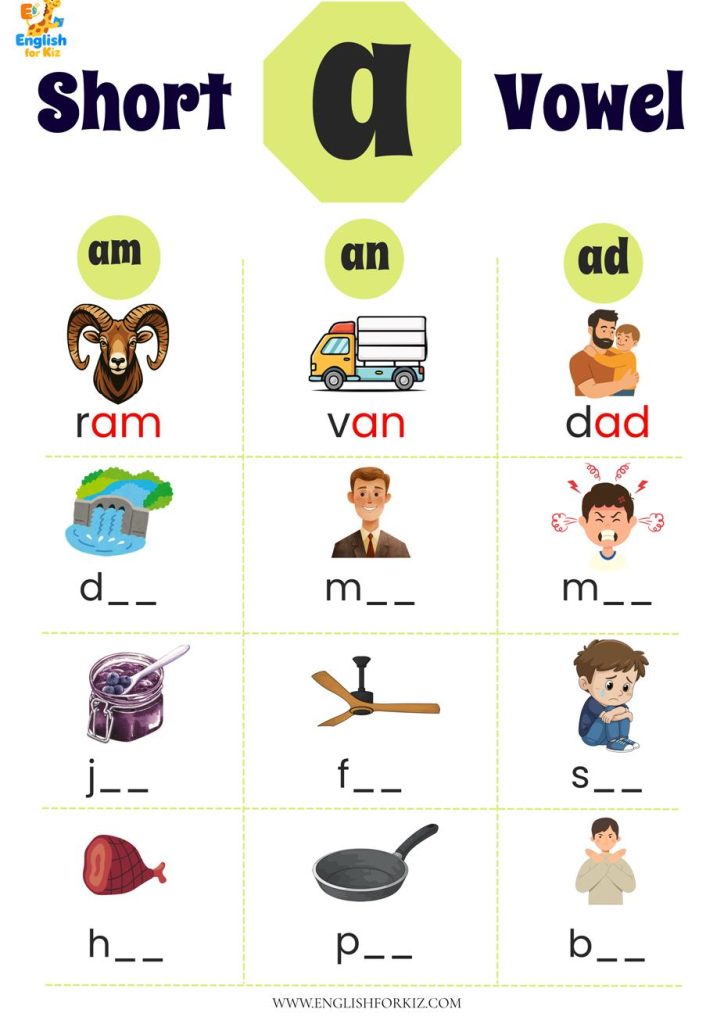
Written work reveals missing sounds, vowel confusion, handwriting needs, and impulsive guessing. Choose a short page that uses the same target as the lesson rather than assigning an unrelated packet.
The EnglishForKiz phonics worksheets page is the correct next step when the learner needs tracing, word building, spelling, or quieter review.
Browse Printable Practice
Move from isolated words into connected text
Sentence reading requires the child to track print, decode several words, remember meaning, and continue through the line. Strong performance in a matching activity does not always transfer automatically.
Use level-matched decodable readers after the target words are reasonably secure. Keep the same decoding prompt, then reread the full sentence after a correction.
Explore Decodable ReadingWhen game performance is strong but story reading is weak: do not move to a harder game. Shorten the passage, preview only unfamiliar words, and spend more time transferring the known pattern into sentences.
Resource selection should follow the learning gap. Choose a worksheet when print and spelling need attention. Choose a short game when the target is known but retrieval needs more repetition. Choose a reader when isolated words are accurate and the next challenge is connected reading.
Choose a Game for the Skill Already Being Taught
Start with the current reading stage, select one target, and use one short activity as a practice checkpoint. Then confirm the same skill with print.
Explore Phonics Games by Learning StageFor the same-skill follow-up, continue with printable practice or a level-matched reader.
Need a structured CVC learning path?
The kindergarten level is the more suitable destination when short vowels, blending, spelling, simple sentences, and early reading need to progress together.
FAQ
When should children use phonics games?
Use them after the sound, word pattern, or decoding process has been introduced clearly. They also work well as short review later in the week. A completely unfamiliar pattern still needs direct teaching before independent play.
Can phonics games replace worksheets?
No single format covers every early reading need. Games support listening, quick recognition, blending, and repeated responses. Worksheets add handwriting, sound mapping, spelling, and a visible record of errors, so both formats are useful when they focus on the same target.
How long should an online phonics game session last?
One focused round often takes three to eight minutes. Stop sooner when guessing, rushing, or frustration replaces careful reading. Follow the activity with one short off-screen check rather than opening several unrelated levels.
How can an adult choose a game that matches the current skill?
Name the exact response first. Examples include hearing /s/, blending a three-sound word, distinguishing short a from short i, or reading silent-e words. Then check whether the activity truly requires that response and whether its choices, vocabulary, and support match the learner’s stage.
What should happen when the child keeps guessing?
Pause the activity before guessing becomes the normal strategy. Reduce the word set, model the target once, and use one short cue such as “check the middle vowel.” Retry only a few items, then return to direct instruction if the confusion remains.
Three Actions That Keep Practice on Target
A useful game sits between teaching and real reading. It strengthens a known skill, reveals what still needs attention, and points toward the correct next resource.