
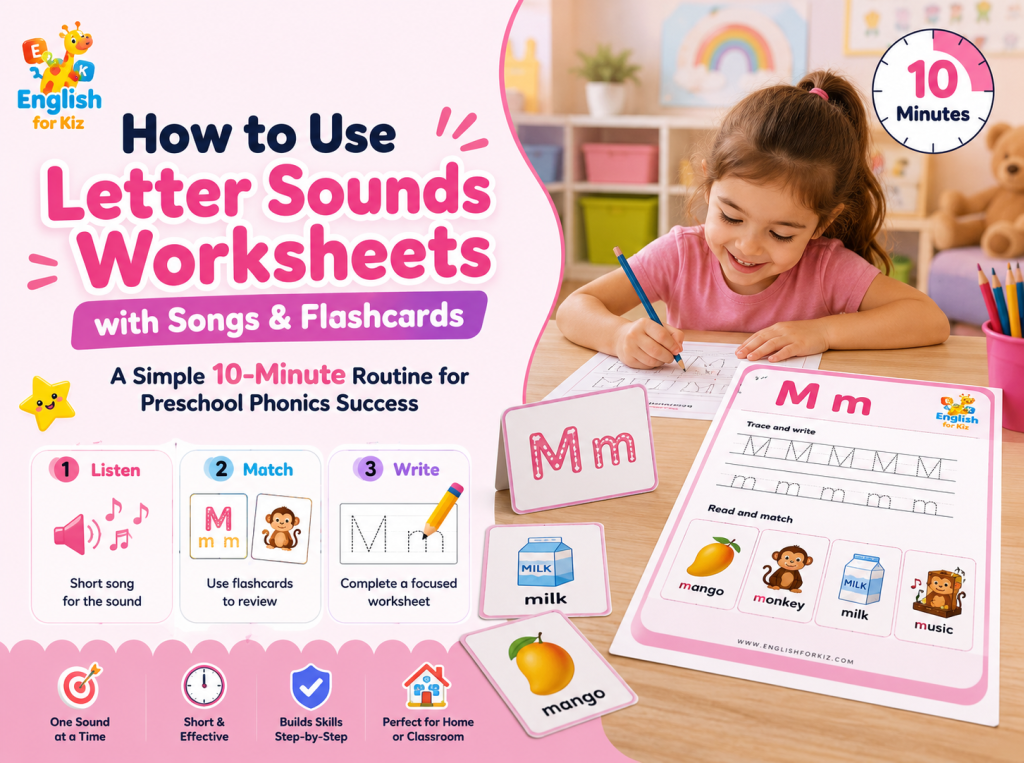
Phonics songs, flashcards, and worksheets work best as one lesson when they repeat the same target sound. This guide shows parents, preschool teachers, and homeschool families how to connect a short audio cue, a small card review, and letter sounds worksheets in one focused learning loop. The routine keeps listening, speaking, matching, and early writing connected without filling the session with unrelated resources.
Choose One Letter Sound and One Clear Outcome
The first decision is not which activity looks most colorful. It is which sound the child needs to notice and what the child should do with it. A lesson centered on /m/ should not quietly expand into six letters, an alphabet review, and a long handwriting page.
A clear outcome makes every later choice easier. One learner may need to hear /m/ at the beginning of spoken words. Another may already recognize the sound and need to connect it with uppercase M and lowercase m.
Set a Goal That Can Be Seen or Heard
“Practice letter M” is too broad for a short session. A more useful goal is, “The child can identify three pictures that begin with /m/.” This wording shows what the adult should model and what successful learning will look like.
Early goals do not always need a pencil. A child may tap when the sound appears, repeat it clearly, or place a picture next to the correct letter. Tracing becomes useful after the learner understands what the letter represents.
Listening Stage
Use spoken words and one physical response. Keep print out of view until the sound becomes easier to notice.
Matching Stage
Show one target letter and a few familiar pictures. The child connects the heard sound with the visible symbol.
Marking Stage
Add tracing, circling, or covering when the sound decision can be made with light support.
Choose the Learning Order Before the Resources
When several letters seem possible, the Preschool phonics program provides a clearer starting point than choosing randomly. Its early learning path brings together letter recognition, phonemic awareness, songs, flashcards, printable activities, and games.
Once the target is selected, each resource should answer the same question: does it help the child hear, say, recognize, or respond to this sound? Materials that introduce another letter or a different skill should stay out of the session.
Song words: sun, sand, and soap. Cards: s, sun, sock, seal, and moon. Printable task: trace s and select the /s/ pictures. New-word check: decide whether sandwich begins with the same sound.
Start with a Short Song or Audio Cue
The opening audio should prepare the sound rather than occupy the full lesson. A short individual letter track is usually more useful than a complete alphabet song when only one target is being taught. Thirty to ninety seconds can provide enough repetition before the child moves into a visible response.
Choose a track with a clear sound, an unhurried pace, and familiar examples. A lively song may still be a poor match when fast lyrics or background effects make the target difficult to hear.
Preview the Pronunciation and Vocabulary
Continuous sounds such as /m/, /s/, and /f/ can be held briefly. Stop sounds such as /p/, /t/, and /k/ should remain short and crisp. Adding an extra “uh” can make later blending less accurate, so /m/ should not become “muh.”
Vocabulary matters as well. A child cannot listen for the beginning of a word that is not understood. When the song contains an unfamiliar example, explain the word before expecting a sound response.
Give One Listening Job
Before the audio begins, provide one simple action. A child might tap the table when /m/ appears, touch the lips when /p/ is heard, or hold up the target letter during a matching word. One task keeps attention active without creating a complicated performance.
Allow the audio to continue without stopping after every example. Once it ends, repeat one useful word and move directly into the card activity. A short bridge such as “That was /m/. Now find the pictures that begin with /m/” keeps the learning target stable.
Keep the audio step visually quiet. After starting the track, move the device away from the working area when possible. The child should listen for the sound rather than focus on buttons, animations, or the progress bar.
Use Flashcards for Hear–Say–Match Review
Flashcards make the sound visible and movable. However, a large deck can turn the activity into visual searching instead of phonics practice. A focused working set usually needs one target letter, two or three matching pictures, and one clear contrast picture.
For /f/, the set might include f, fish, fan, foot, and moon. Moon gives the child a real comparison without making the task too difficult. More cards can be added later, but only after the matching rule is understood.
Keep the Review in Three Clear Moves
Hear
Say the sound clearly before showing several choices. Listening should come before guessing from the card design.
Say
Invite one accurate repetition, then repeat the sound naturally within familiar picture words.
Match
Place each target picture beside the letter and leave the contrast picture outside the group.
Ask for a short explanation after a match. “Fish begins with /f/” shows more understanding than moving a card silently. When a full sentence is difficult, the learner can say “fish, /f/” while pointing to the beginning.
Use the Cards to Prepare Worksheet Vocabulary
A picture error may be a vocabulary problem rather than a sound problem. Before opening the printable page, name any image that may be unclear. Then return the picture to the set without showing where it belongs.
Real objects can also replace picture cards. A sock, mug, cup, spoon, or toy car makes the word concrete. The sound decision should still come from listening rather than from the object’s color or category.
Choose Cards That Match the Lesson Goal
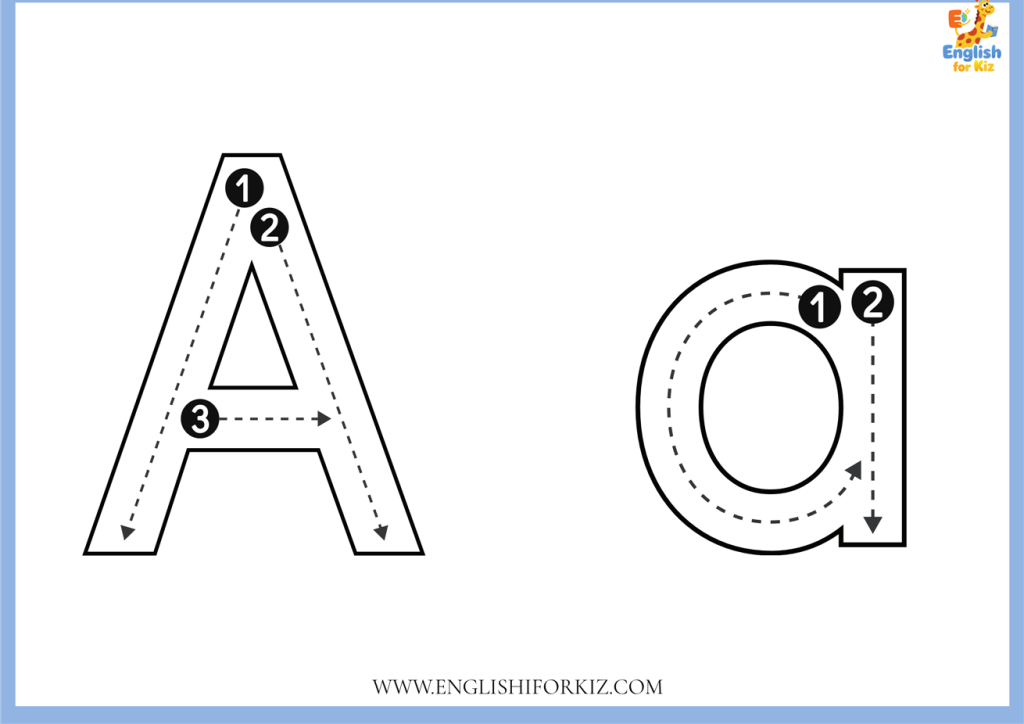
The phonics flashcards and printable materials can support letter recognition, picture matching, tracing, and quick sound review. Only the cards needed for the selected sound should appear on the table.
Letter cards fit a sound-to-symbol goal. Picture cards fit a beginning-sound listening goal. A small mixed set works when both skills are ready to be connected.
Explore Matching Phonics MaterialsMove to Letter Sounds Worksheets for a Focused Paper Response
The printable step should feel familiar because its sound and example words have already appeared. Begin by pointing to the target letter and naming the sound once. Then explain only the first action instead of reading every direction on the page.
The most suitable page depends on the outcome. Tracing supports letter formation, matching connects the sound with print, and picture choice checks beginning-sound discrimination. A child does not need to complete every type of task during one sitting.
Choose One Main Paper Task
When letter shape is the priority, select large forms and a short tracing row. When listening is the priority, spend more time naming and selecting pictures. A learner who already forms the letter may gain more from a beginning-sound choice than another full line of handwriting.
Name each picture naturally before isolating its first sound. A useful model is, “Map. /m/. Map begins with /m/.” This keeps the word recognizable while drawing attention to the opening phoneme.
Use This Format for Sound, Shape, and Vocabulary
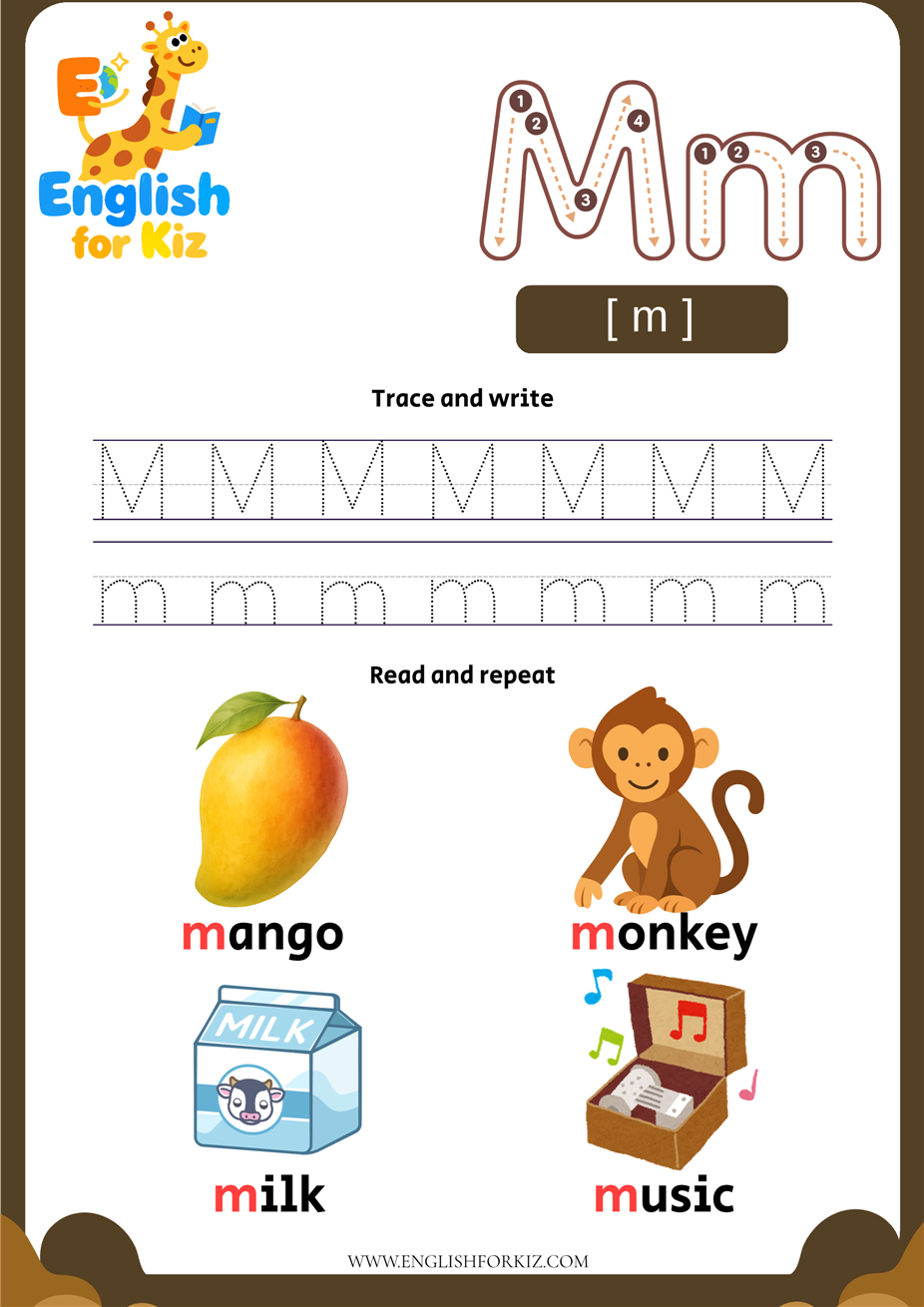
This Letter M page fits a session that has already introduced /m/ through a short audio cue and a few familiar cards. The child can connect the sound with uppercase M, lowercase m, and four clear examples.
- Use tracing when letter formation is part of the goal.
- Use mango, monkey, milk, and music for oral sound review.
- Complete one section only when attention or pencil control is limited.
Use This Format for Listening and Sound Review
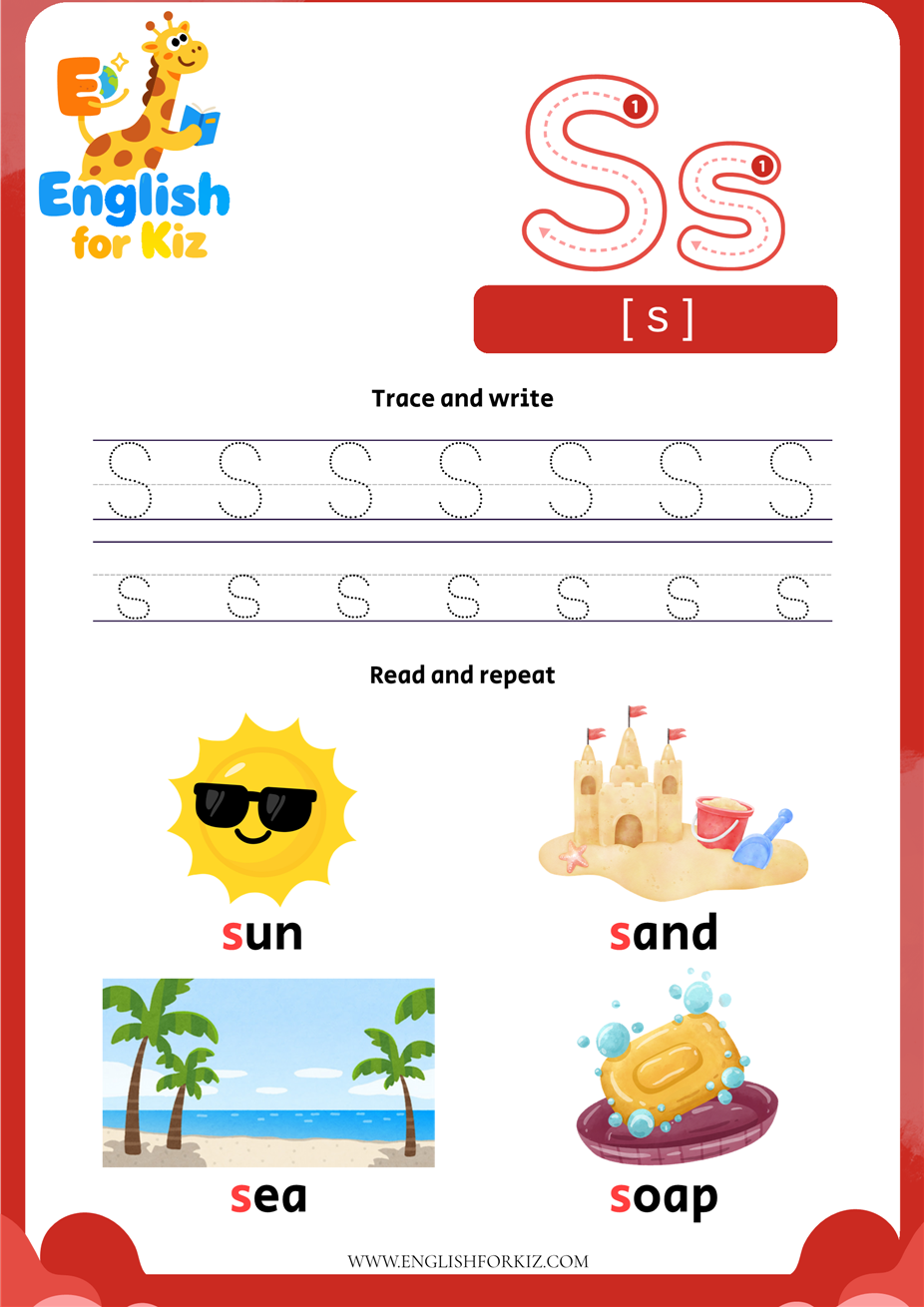
This Letter S page works after the learner has heard /s/ in a song or oral activity. Sun, sand, sea, and soap provide a consistent word group for repetition and beginning-sound checking.
- Name every picture before asking for a sound decision.
- Use pointing or counters when handwriting is not the goal.
- Finish with a new word such as sock or sandwich.
Selection tip: the M and S pages show two suitable formats, but they should not be taught together in this routine. One session needs one target sound, one matching audio cue, one small card set, and one printable page.
Reduce the Writing Demand When Needed
Pencil control and phonics knowledge do not always develop at the same rate. A child may hear /s/ accurately but struggle to stay on a narrow tracing line. In that case, replace writing with pointing, counters, stickers, stamps, or clothespins.
The adult can record the answer while the child names the picture and makes the sound decision. Handwriting can return in a separate two-minute activity. This keeps motor difficulty from hiding real phonics understanding.
Correct the Cause of the Error
A wrong answer may come from an unknown picture, a confused sound, a forgotten direction, or rushing. Ask the child to name the image before correcting the sound. When the word is known, compare one target word with one contrast word and offer another attempt.
“Sun begins with /s/. Moon begins with /m/. Listen again: which picture belongs with s?” This response provides useful information and returns the decision to the learner.
A 10-Minute Phonics Song, Flashcard, and Worksheet Routine
A short routine works because the response changes while the learning target remains stable. The example below uses /m/, but the same sequence can support other early consonants after suitable words and materials have been selected.
Play a brief /m/ cue. The child taps, hums, or makes one simple movement whenever the sound appears.
Show m and say, “We are finding words that begin with /m/.”
Sort mango, monkey, milk, and sun. Mix the cards once and repeat the decision.
Finger-trace m, complete two pencil traces, and select the matching pictures.
Show or say “map.” Ask whether it begins with the sound practiced in the session.
Remove the materials and ask for the sound, the letter, and one matching word.
Adjust the Minutes Without Changing the Learning Path
A learner who needs more oral practice may spend less time tracing. Another child may identify the sound quickly but need a slower finger-tracing model. The exact timing can change, yet the sequence should continue from hearing to matching and then to independent application.
Stop after a strong response rather than forcing the last row of a page. One new example identified with little support is often a better ending than several rushed answers.
Use a true transfer check. The final word should not appear in the song, card set, or worksheet examples. Recognizing the sound in a new word shows that the child is applying the idea rather than remembering the prepared materials.
Five Variations for Home, Preschool, and Small Groups
The learning loop can stay consistent across several teaching settings. Only the amount of support, the response style, and the number of children need to change. A predictable order also reduces the time spent explaining what happens next.
1. Kitchen-Table Practice
Use one short track, four cards, and half a printable page. End by finding one household object that begins with the same sound.
2. Preschool Circle-Time Launch
Introduce the sound with one group movement and three large picture cards. Save the worksheet for a later table or center activity.
3. Teacher-Led Small Group
Give each child one picture while the target letter stays in the center. Children decide who holds a match, then exchange cards.
4. Independent Learning Center
Display a familiar sequence: listen, match, mark, check. Keep the card tray small and reveal only one worksheet row at a time.
5. Two-Minute Review on Another Day
Skip the full printable page. Replay the sound cue, show two cards, and ask for one new example. A related activity from the phonics games page can follow after the sound has been taught clearly.
Avoid Overloading Children with Too Many Cards or Instructions
Random guessing, repeated questions, leaving the seat, and refusing the pencil do not always mean the sound is too difficult. The setup may contain too many visible choices, too much print, or several instructions delivered at once.
Simplify the task before repeating the teaching. A smaller activity often reveals that the child understands more than the original setup suggested.
Know When Another Sound Can Enter the Routine
Perfect handwriting is not the deciding factor. Look for flexible recognition across several examples. The child should hear the sound in familiar words, connect it with the letter, and identify one new example with light support.
If success depends on the original card order, repeat the sound with a different layout. When the letter is recognized but the sound cannot be heard in spoken words, return to the song and oral comparison stage.
- Recognizes the target in at least three familiar words.
- Matches the sound with the correct letter form.
- Explains one picture match orally or by pointing.
- Identifies one new example outside the prepared set.
Choose the Next EnglishForKiz Resource
Efficient preparation begins with the teaching sequence rather than the printable library. Select the target sound, gather only the matching audio and cards, and finish with one suitable paper response. Games can support later retrieval after the sound has been introduced and practiced.
Select the Sound
Use the Preschool program when a structured order is needed for letter recognition and beginning sounds.
Prepare Audio and Cards
Visit the Materials library to locate supporting songs, printable cards, and quick review formats.
Select the Paper Task
Choose a printable with the same letter, sound examples, and response level as the earlier activities.
Prepare the Matching Printable Practice
After the target sound, audio cue, and card examples are clear, select a page that continues the same skill. Choose tracing for letter formation, matching for symbol recognition, or picture choice for beginning-sound listening.
Explore Printable Phonics PracticeBuild the Routine Around a Clear Preschool Sequence
When daily sound selection feels uncertain, begin with the preschool learning path. Then use the worksheet and materials pages to prepare the supporting activities for that lesson.
View the Preschool Phonics ProgramFrequently Asked Questions
Should songs come before letter sounds worksheets?
Usually, yes. A short audio cue gives the child a clear sound model before a printed choice appears. The song should stay brief and lead directly into the card or paper task rather than becoming a separate entertainment activity.
How many flashcards should preschoolers review at once?
Begin with one target letter, two or three matching pictures, and one contrast picture. Add more cards only after the child understands the matching rule and can explain at least one decision.
Can worksheet practice work without handwriting?
Yes. Pointing, clipping, stamping, covering, and oral answers can all show sound recognition. These options are useful when phonics understanding is developing faster than pencil control.
How can all three activities stay focused on the same sound?
Write the target sound and three example words before selecting resources. Check the audio, card set, and printable page against that short plan, then remove anything that introduces another sound or a different learning goal.
What helps when a child knows the letter name but not its sound?
Return to an ears-first activity. Say two familiar words, model the sound without showing print, and ask for a listening response. Introduce the letter card after the child begins to notice the shared sound.
Keep the Lesson Small Enough to Stay Connected
A useful multisensory phonics lesson does not need many materials. It needs one sound repeated through several meaningful actions. The child hears it in a song, says it during card review, matches it with pictures, and applies it on paper.
- Select one target sound and write one observable outcome.
- Prepare no more than four or five working cards.
- Finish with one new spoken word before adding another sound.
Used in this order, letter sound practice becomes a connected learning experience rather than isolated paper work. The next session can briefly revisit the same target or move forward once the sound appears across both familiar and new examples.