
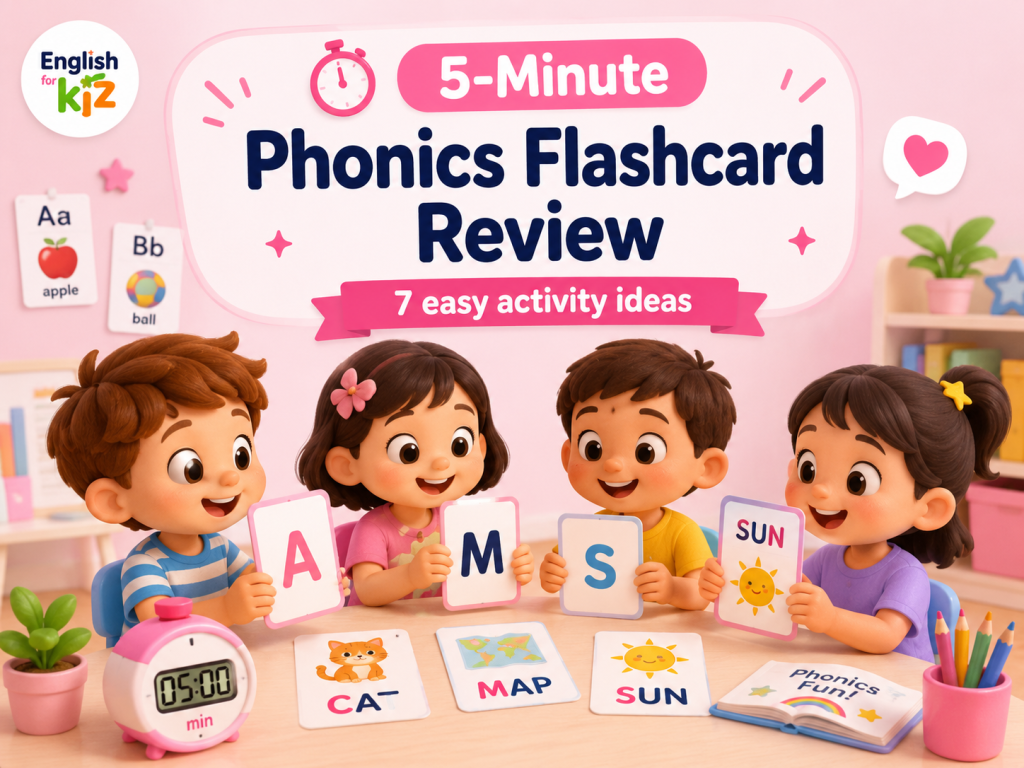
Five-minute practice works best when it repeats one useful skill instead of racing through a large stack. This guide shows parents, teachers, and homeschool families how to use phonics flashcards for letter sounds, CVC blending, word comparison, memory, and simple sentence reading without adding another long lesson.
Set Up a Small Review Deck
A five-minute review should answer one clear question. Does the child recall the target sounds? Can those sounds be blended into a word? Can a familiar word still be read after the cards are shuffled?
A thick stack makes those questions harder to answer. Children may rush, guess from pictures, or lose attention before difficult cards receive a second attempt. A smaller deck creates enough time for accurate responses, one calm correction, and a successful repeat.
Choose the Deck Size by Task
Letter-sound recall moves quickly, so six to ten cards usually fit a short review. CVC blending requires more time because each word must be sounded out, blended, checked, and sometimes rebuilt. Three to six word cards are often enough.
Sentence practice needs an even smaller set. Two or three cards can fill five minutes when each word is read, discussed, and used in a short sentence.
| Current learning stage | Best card type | Useful deck size | What the review should check |
|---|---|---|---|
| Preschool or early beginner | Single letters and clear picture cards | 6–8 cards | Sound recall and beginning-sound listening |
| Beginning CVC reader | Short-vowel word cards | 3–6 cards | Left-to-right blending and sound order |
| Developing early reader | Word families, digraphs, or sight words | 4–7 cards | Pattern recognition and reading transfer |
Keep One Main Goal
A sound deck might contain m, s, t, p, a, and n. A short-a deck might contain map, mat, sat, man, and tap. Both sets have a clear relationship between the cards.
Avoid combining isolated sounds, CVC words, long vowels, sight words, and digraphs in one short review. When too many skills appear together, a mistake may come from the reading pattern, the changing instructions, or simple overload.
Use a Known, Learning, and New Mix
Most cards should feel familiar. In an eight-card deck, five may be secure, two may still need practice, and one may be recently taught. This balance gives enough success to keep the routine calm while still showing what needs attention.
New cards should not appear as surprise tests. Teach the sound or pattern first, model it clearly, and then place it into a familiar review routine.
Choose Cards That Support Decoding
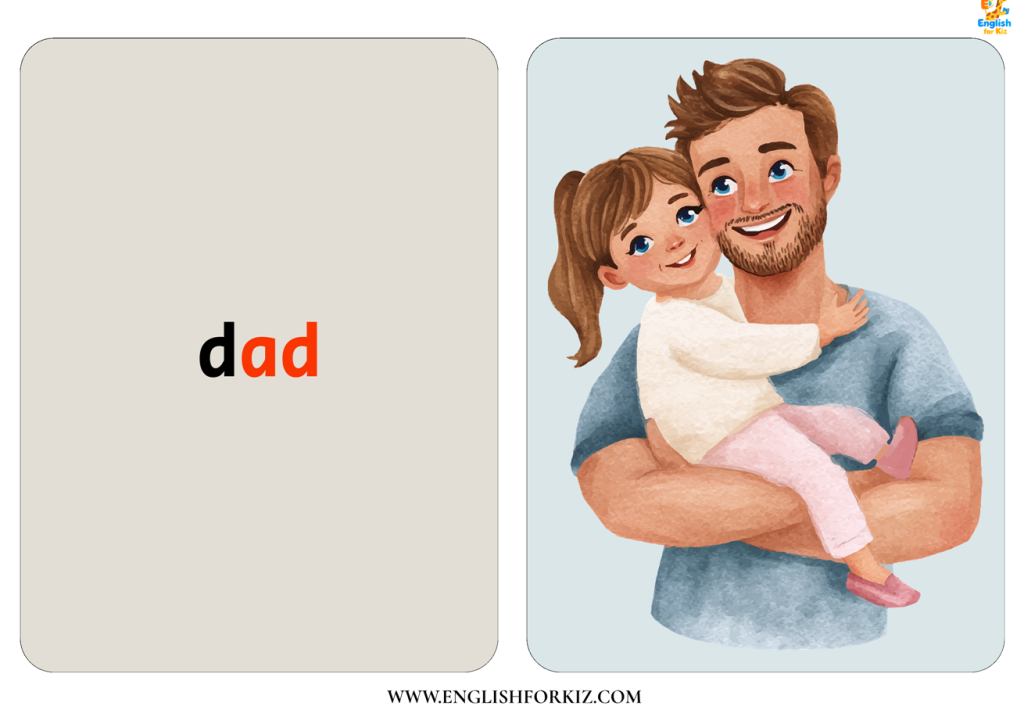
Clear word-and-picture cards can serve several purposes. The printed word supports blending, while the image can confirm meaning after the word has been decoded.
Look for sets that can be separated by learning stage. Letter cards suit sound recall, CVC cards suit blending, and later sets can support long vowels or advanced patterns.
Explore Flashcard MaterialsWays 1–2: Quick Sound Recall and Picture/Letter Match
These two activities suit children who are still connecting spoken sounds with printed letters. The first checks whether a letter triggers its sound. The second checks whether that sound can be heard at the beginning of a familiar word.
Quick Sound Recall
Place six to ten letter cards face down. Turn over one card at a time and ask for the sound rather than the letter name. Keep the rhythm steady, but leave enough time for genuine recall.
Five-minute flow- Read every card once.
- Place hesitant cards in a small review pile.
- Model each missed sound cleanly.
- Repeat only the review pile.
A child who answers correctly does not need a long explanation. A brief response such as “Yes, /m/” confirms the sound and keeps attention on the next card.
Make it activePlace three letters on the table and say one sound. The child taps the matching card and repeats it. Move the cards between turns so location does not become the answer.
Common problemSome children add an extra vowel, such as “muh” for /m/. Model the clean sound, invite one repeat, and continue instead of turning the correction into a speech.
Move forward whenMost target sounds can be recalled in a shuffled order without a picture cue. Those sounds can then enter simple word-building work.
Picture and Letter Match
Set out three letter cards and prepare several pictures with clear names. Say one picture name naturally, emphasize the first sound, and place it under the matching letter. For example, sun belongs under s, while map belongs under m.
Five-minute flow- Model one complete match.
- Ask for three independent matches.
- Change the letter positions.
- Repeat any picture that caused confusion.
Start with sounds that are easy to distinguish. A group such as m, s, and t is usually more useful for a beginner than several visually similar letters.
Increase the challengeOnce the routine feels familiar, allow the child to name the picture before identifying the sound. This adds vocabulary recall without changing the phonics goal.
Common problemA picture may have more than one reasonable name. A rabbit may be called a bunny, which changes the expected first sound. Preview the picture set and remove unclear examples.
Move forward whenThe child can name familiar pictures, isolate their first sounds, and connect those sounds with printed letters.
After oral review, matching letter sounds worksheets can add tracing, circling, and beginning-sound practice. Keep the same letter group so the paper task reinforces the card activity rather than introducing another lesson.
Ways 3–4: CVC Blend-and-Build and Word Sorting
CVC means consonant-vowel-consonant, as in map, sit, and log. These short words help children move from isolated sounds into left-to-right decoding.
CVC Blend-and-Build
Choose three to five cards that share one short vowel. Reveal one card, point beneath each letter, and say the sounds in order. Then blend them closely enough for the whole word to remain easy to hear.
Example with map- Show the printed word map.
- Touch m, a, and p from left to right.
- Blend the three sounds into map.
- Build the same word with separate letter cards.
- Change one sound to make tap or mat.
Changing one letter makes sound position visible. It also shows that a word is not a picture to memorize; each grapheme contributes to the pronunciation.
Support levelKeep the vowel fixed for children who are new to blending. A sequence such as sat, mat, pat, and cat lets attention remain on the changing first sound.
Common problemIf the child guesses from the first letter, cover the picture and return to every sound. Avoid saying the answer too quickly, because waiting for an adult model can replace independent blending.
Move forward whenSeveral words with the same short vowel can be blended without adult modeling. The next deck can then include a second vowel for careful comparison.
Word Sorting
Place two heading cards on the table, such as short a and short i. Read one word, listen to its middle sound, and place it under the correct heading.
Useful sorting sets- map, bag, cat versus sit, pin, lip
- -at words versus -an words
- Words beginning with m versus words beginning with s
- Words ending in t versus words ending in p
Ask for a brief reason after selected cards. “Pin has short i” is enough to show that the spelling feature has been noticed.
Check flexible readingAfter sorting, mix every card again and read the words in a new order. A child may read a predictable word-family column correctly but hesitate when the visual pattern disappears.
Common problemPicture cards may encourage sorting by animals, foods, or objects. During phonics review, the categories should reflect sounds, word families, or spelling structure.
Move forward whenThe same words can be read accurately after the groups are mixed. That result shows that the pattern supports reading rather than only sorting.
Follow the card review with matching CVC worksheets when spelling, writing, or sentence-level practice is needed. Choose the same short vowel or word family so the next task feels connected.
Ways 5–6: Odd-One-Out and Memory Match
These activities add comparison and retrieval without requiring a long game. Odd-one-out asks children to explain one sound or spelling difference. Memory match creates repeated reading through hidden cards and turn-taking.
Odd-One-Out
Place three cards in a row. Two should share the target feature, while one should differ clearly. For example, cat, map, and sit create a short-vowel comparison.
How to run the activity- Read all three cards.
- Choose the different word.
- Give one short reason.
- Read the two matching words again.
Beginning learners can compare first sounds using pictures or letters. Developing readers can compare short vowels, word families, blends, or digraphs.
Useful language supportA sentence frame such as “___ is different because…” can help when the phonics idea is understood but the explanation is difficult to organize.
Common problemA poorly chosen set may have several unrelated differences. Keep the contrast narrow, but accept another answer when the explanation is accurate and sensible.
Memory Match
Select three to five matching pairs and place them face down. Pairs may contain two identical letters, a letter and a picture, two copies of one word, or a word and its matching image.
The reading ruleEvery card must be named or decoded when it turns over. Without this rule, the activity becomes a visual memory challenge rather than phonics practice.
Possible pair types- m paired with a moon picture
- Two copies of the word map
- cat paired with a cat picture
- A sight word paired with a short phrase
When time is nearly finished, turn the remaining cards face up and complete the pairs together. This protects the five-minute limit and allows the review to finish successfully.
Common problemToo many pairs reduce the amount of reading. Three pairs often provide better practice for beginners than a large grid that cannot be completed calmly.
Way 7: Read a Word and Use It in a Simple Sentence
The final activity checks whether a decoded word carries meaning. Choose two or three familiar cards. The child reads one word and uses it in a short spoken sentence.
Concrete words work well at the beginning. After reading cat, a child might say, “The cat is soft.” After reading jump, the sentence might be, “I can jump.”
Use Sentence Frames Without Giving the Answer
Simple frames reduce language pressure while keeping the target word active. Useful choices include “I see a ___,” “The ___ is big,” “I can ___,” and “The ___ can ___.”
A two-card variation can combine one noun and one action. Cards such as dog and run may lead to “The dog can run.” This small change connects decoding, grammar, and meaning.
Add sight words carefullyA familiar high-frequency word can support a short sentence. The card can may lead to “I can hop,” while the may lead to “The dog is wet.” Keep the sentence short enough for the target word to remain easy to notice.
Optional writing stepWrite the spoken sentence on a small board and ask the child to point to the target word. This connects oral language with sentence print without turning five minutes into a full writing lesson.
Common problemDo not correct every minor grammar error when the word has been read accurately. Respond to meaning first, then offer a simple model if the sentence is difficult to understand.
Move forward whenWords can be decoded accurately and used with clear meaning. The next stage is reading the same pattern in short phrases, sentences, or controlled text.
Three Five-Minute Templates by Learning Stage
The activity mix should change as reading develops. Preschool learners need more listening and sound matching. Kindergarten readers need blending and word comparison, while developing readers need practice applying patterns in sentences.
Letter-Sound Review
- 1 minute: Recall four familiar sounds.
- 2 minutes: Match pictures to three letters.
- 1 minute: Try one odd-one-out set.
- 1 minute: Repeat the least secure sounds.
Remove one activity when attention begins to fade. Accuracy and listening matter more than completing every step.
CVC Blending Review
- 1 minute: Review sounds needed for the words.
- 2 minutes: Blend three CVC cards.
- 1 minute: Build one word and change a sound.
- 1 minute: Sort or use one word in a sentence.
Watch for missing vowels and first-letter guessing. Those errors should shape the next review deck.
Pattern and Sentence Review
- 1 minute: Read four words with one pattern.
- 1 minute: Sort by the target feature.
- 1 minute: Complete an odd-one-out comparison.
- 2 minutes: Use two words in sentences.
Use one blend, digraph, vowel pattern, or sight-word group. Several unrelated patterns weaken the review.
How to Rotate Known and New Cards
Use three practical groups: new, learning, and known. New cards have just been taught. Learning cards receive some correct responses but still cause pauses, while known cards remain accurate across several review formats.
Build the Daily Mix
An eight-card deck may contain five known cards, two learning cards, and one new card. A child who is finding the current pattern difficult may need six known cards and only two learning cards with no new addition.
After the review, move cards according to what happened. A new card can enter the learning group after supported success. A learning card can move into known after accurate recall across several days and more than one activity.
Space Secure Cards Instead of Removing Them
Known cards do not need daily attention forever. Bring them back every few days, then once a week. This leaves room for current learning while checking that older sounds and words remain available.
A secure card may return to the learning group after a break or when a similar spelling pattern creates confusion. That movement is normal and provides useful teaching information.
Measure More Than Speed
A fast answer does not always show flexible reading. A letter sound should also work in picture matching and word building. A CVC word should still be read after the word-family cards are mixed.
Sentence use adds another check. When a child can decode the word, explain its meaning, and recognize it in connected text, the card can appear less often.
Connect Flashcards with Worksheets and Games
Cards are useful for quick retrieval, but they do not provide every kind of reading practice. A complete sequence should move from clear teaching into card review, written practice, interactive repetition, and connected reading.
Choose the Next Resource from the Error
A sound-recall problem calls for more oral work. A letter-formation problem calls for tracing or writing. A blending problem needs careful sound-by-sound word practice.
When isolated words are accurate but sentence reading is difficult, the next step should be short connected text rather than more rapid card flipping. The review should reveal the next action, not simply produce a score.
Continue with a Matching Worksheet
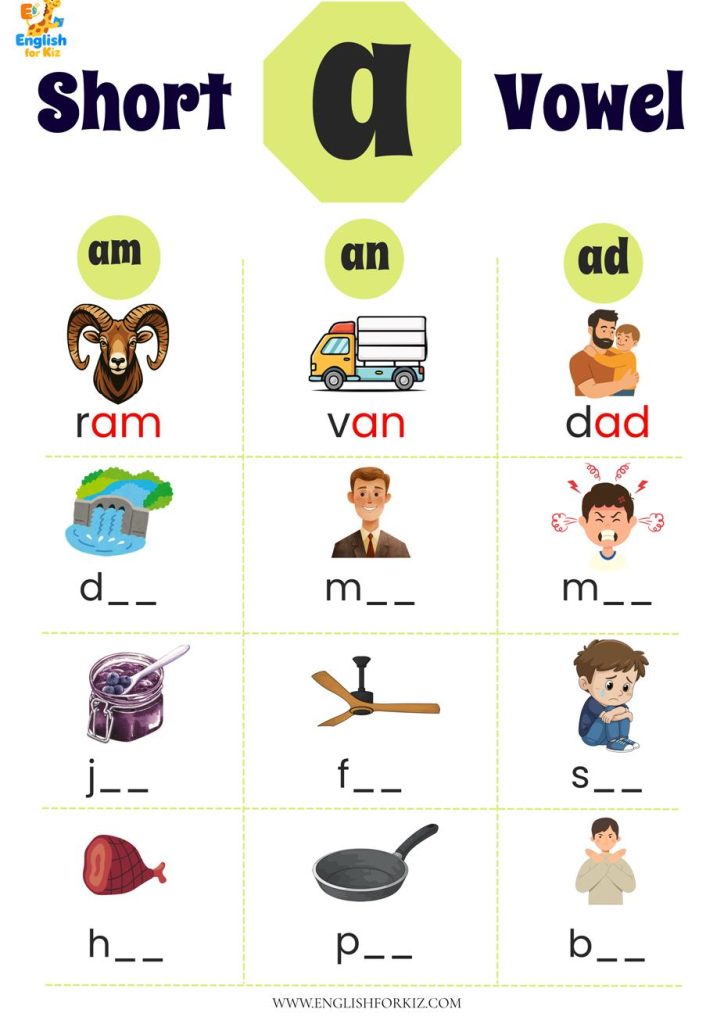
Use paper practice when the review shows a need for letter formation, spelling, word-family sorting, or written sentence work. Select the same vowel or sound pattern used in the card deck.
Browse Phonics Worksheets
Add a Game Without Changing the Skill
Use phonics games when the same target needs listening, movement, choice, or quick feedback. A short-a deck should lead to short-a practice rather than an unrelated advanced game.
Explore Phonics GamesBuild the Right Five-Minute Review Deck
Start with cards that match the current learning stage, then use the seven activities above to review sounds, CVC words, sight words, and early reading patterns with a clear purpose.
Explore Phonics Flashcard MaterialsFAQ
How many phonics flashcards should be used in five minutes?
Should known and new cards be mixed?
When should a card leave the daily deck?
A Clear Plan for the Next Five Minutes
A useful review needs one narrow target, a small deck, calm correction, and a next step based on the errors that appear. The activity may change, but the sound or spelling pattern should remain stable until it works across several formats.
- Choose six to ten sound cards or three to six word cards.
- Repeat uncertain cards once and place them in the next review deck.
- Continue the same skill through one matching worksheet, game, or short reading task.