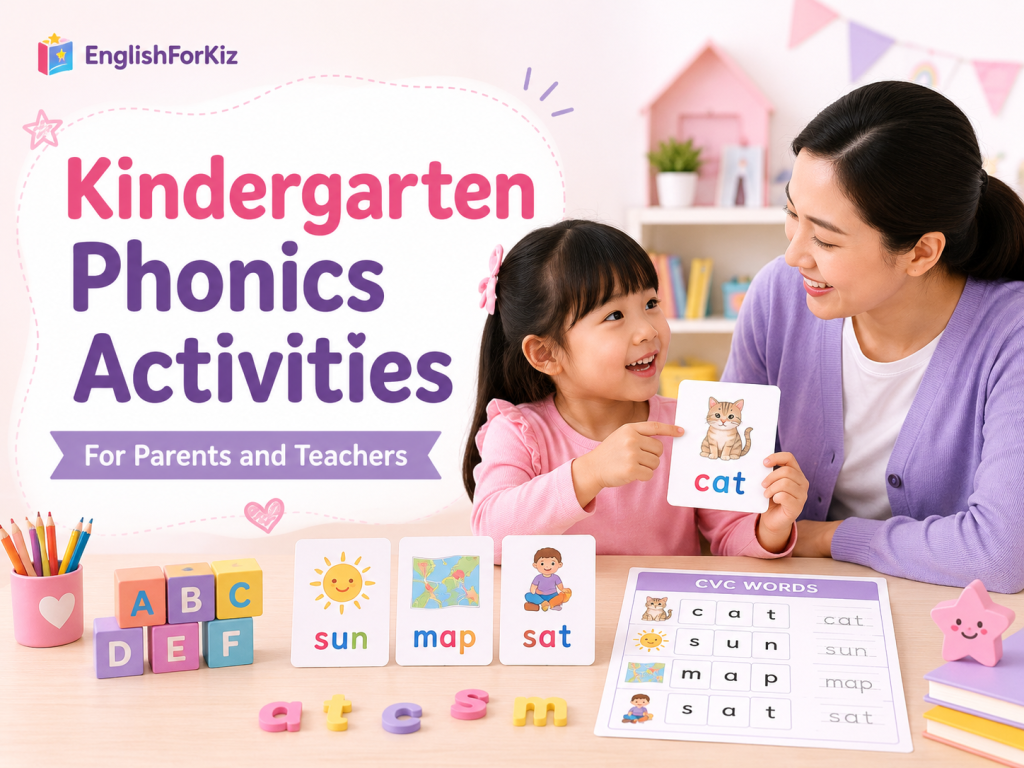
Kindergarten phonics works best when children practice one clear skill at a time. At this stage, many early readers are learning how sounds, letters, simple words, writing, and short reading passages fit together. However, parents and teachers often face the same problem: there are many activity ideas online, but not enough guidance on what to do first, what to repeat, and which resource fits each learning need.
Therefore, this guide organizes practical phonics activities by skill: listening, letter sounds, CVC blending, worksheet practice, flashcard review, games, writing, and decodable reading. It also shows when to use EnglishForKiz resources naturally, so a home lesson, classroom center, or homeschool routine can become easier to plan.
Start with a Complete Kindergarten Path
First, children need a sequence that moves from letter-sound awareness to blending, spelling, and reading simple sentences. For families and classrooms that need a full learning path, the EnglishForKiz phonics for kindergarten program is the strongest starting point.
It is especially useful when daily practice needs more structure than random worksheets or one-time games. In addition, it helps adults choose activities that match the child’s current reading stage.
Article Navigation
Good Activity Letter Sounds CVC Blending Choose Resources Weekly Plan FAQ
What Makes a Good Kindergarten Phonics Activity?
First, a strong activity has one small goal. For example, the goal may be hearing the /m/ sound, matching the letter m to its sound, or blending m-a-t into mat. When the goal is clear, children know what to listen for and what to try.
Next, a good activity connects sound, print, and meaning. A child should hear the sound, say the sound, see the letter, build a word, and use the word in a simple reading task. As a result, phonics practice becomes part of real reading instead of a disconnected drill.
In addition, activities should stay short. Five to ten focused minutes can work well for a home lesson, a small group, or a classroom center. After that, a game, worksheet, flashcard review, or short reader can keep the routine fresh.
For broader teaching alignment, the U.S. Department of Education’s What Works Clearinghouse recommends foundational reading instruction for kindergarten through Grade 3, including sound awareness, links between speech sounds and letters, decoding, word recognition, and daily connected text reading. The full foundational reading skills practice guide is a useful reference for teachers and families who want structured support.
A Practical Skill Order
- First, listen for rhymes, beginning sounds, ending sounds, and spoken word parts.
- Next, match letters to sounds and sort pictures by sound.
- Then, blend simple CVC words such as sat, pin, dog, and cup.
- After that, add handwriting, spelling, and short decodable reading.
- Finally, review old sounds often before adding too many new patterns.
Letter Sound Activities for Home and Class
Letter sound practice should feel active. Instead of only repeating sounds, children can listen, sort, point, move, draw, and explain. Therefore, the same skill can work in a classroom center, a homeschool lesson, or a short parent-led review.
1. Sound Hunt
First, choose one target sound, such as /s/. Then, ask children to find objects or pictures that begin with that sound. For example, they may choose sock, sun, sandwich, or snake.
During the activity, the adult says each word slowly. The child listens for the first sound and decides whether it matches. As a result, the activity builds sound awareness before the lesson moves into printed words.
2. Letter-Sound Match
Next, place four to six letter cards on the table. Say a sound aloud, then ask the child to tap the matching letter. After a few rounds, reverse the task and ask for the sound when the letter appears.
This small switch matters. Children need to move from sound to print and from print to sound. In addition, a small card set prevents overload and makes success easier to notice.
3. Beginning Sound Picture Sort
For this task, choose two or three sounds. Then, give children picture cards and ask them to sort each card under the matching letter. However, the most important step is not placing the card; it is saying the word and explaining the sound.
In class, children can work with partners. At home, a parent can use toys, food labels, or simple drawings. Either way, the activity keeps attention on sound, letter, and spoken language.
CVC Blending Activities That Build Early Reading
CVC words give early readers a clear bridge into decoding. These words have a consonant, a vowel, and another consonant. For example, cat, mop, sit, and run are simple enough for children to hear, tap, blend, and read.
1. Build and Blend
First, place three letter cards in a row, such as s, a, and t. Children say each sound from left to right. Then, they sweep a finger under the word and blend the sounds into sat.
Next, change one letter. Replace s with m to make mat. This simple change helps children see how one letter can change the whole word.
2. Slide the Sounds
For this activity, write a CVC word on a card. Children slide a finger under each letter while saying the sounds. After that, they slide under the full word and read it smoothly.
This movement supports left-to-right tracking. In addition, it reminds children that letters in a word work together. Over time, the routine helps children move from slow sounding-out to smoother word reading.
3. Blend, Read, Act
Some CVC words can become tiny actions. For example, children can read sit and sit down, or read hop and hop once. Therefore, the word connects to meaning right away. However, the activity still needs a reading goal: read first, then act.
Which EnglishForKiz Resource Should Start First?
After the activity goal is clear, the next step is choosing the right practice format. Some children need a complete kindergarten path. Others need printable CVC review, interactive sound practice, or full access to worksheets, games, flashcards, stories, and video lessons.
 Kindergarten Program
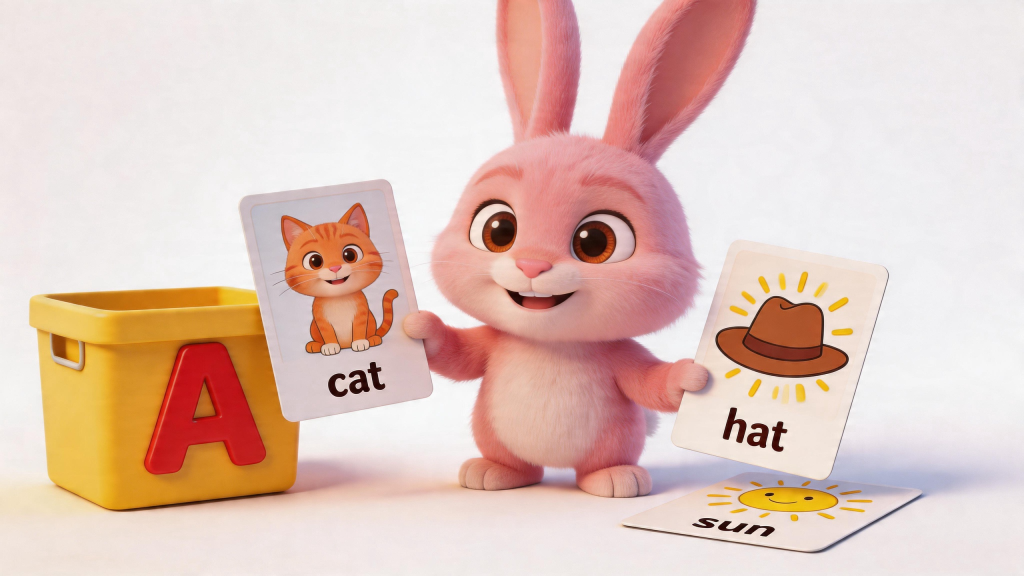
Best for children who need a complete path from letter sounds to CVC blending, spelling, sight words, and early reading.
Start Kindergarten Program
Kindergarten Program
Best for children who need a complete path from letter sounds to CVC blending, spelling, sight words, and early reading.
Start Kindergarten Program
 Printable Worksheets
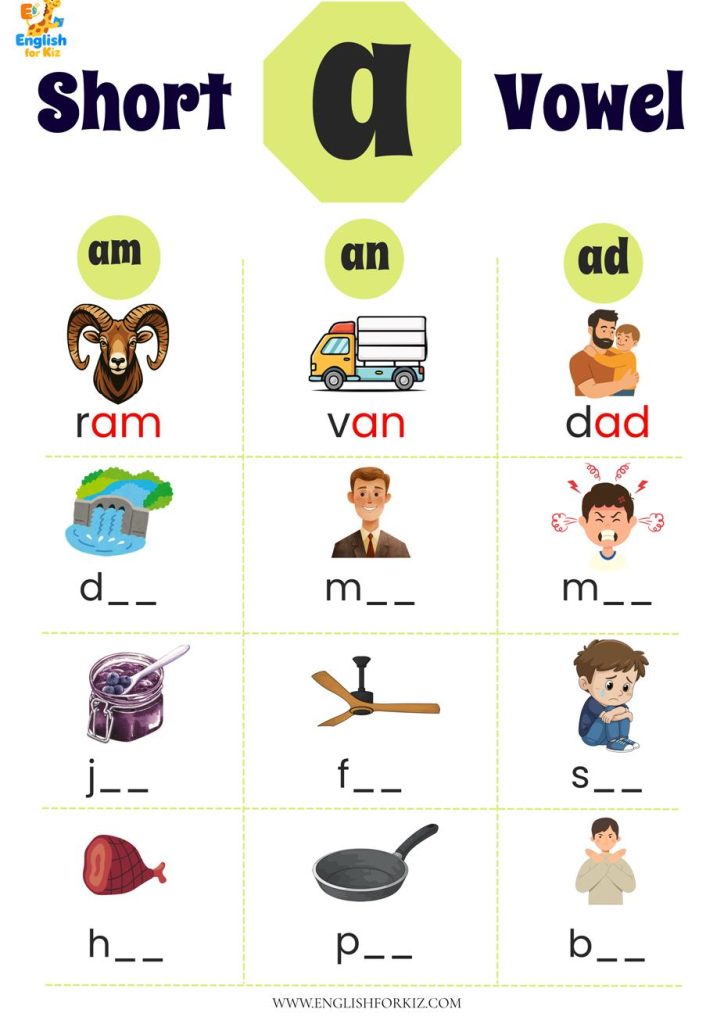
Best for short vowel practice, CVC word families, handwriting, spelling review, homework folders, and quiet table work.
Use Printable Worksheets
Printable Worksheets
Best for short vowel practice, CVC word families, handwriting, spelling review, homework folders, and quiet table work.
Use Printable Worksheets
 Phonics Games
Best for first letter sounds, listening practice, CVC review, and active reinforcement after direct teaching.
Try Phonics Games
Phonics Games
Best for first letter sounds, listening practice, CVC review, and active reinforcement after direct teaching.
Try Phonics Games
 Full Access
Best for families, teachers, and homeschool users who want worksheets, games, flashcards, videos, and stories in one place.
View Full Access
Full Access
Best for families, teachers, and homeschool users who want worksheets, games, flashcards, videos, and stories in one place.
View Full Access
Worksheet and Flashcard Review Ideas
Worksheets and flashcards are most useful when they support a taught skill. They should not replace listening, speaking, blending, or reading. Instead, they give children a visible way to practice and review.
For example, after learning the short a sound, children can trace the letter, read simple word families, and circle matching pictures. Meanwhile, flashcards can review sounds quickly before a worksheet begins.
Trace, Say, Circle
First, children trace a target letter. Then, they say the sound aloud. After that, they circle pictures or words that match the sound. This routine connects handwriting, sound recall, and sound identification.
Read, Match, Check
Next, children read a short word, match it to a picture, and check the word by saying each sound again. This prevents simple guessing from pictures. In addition, it builds the habit of looking back at the print.
Fast Flashcard Review
Flashcards work best in short sessions. Choose five to eight cards, review them for two or three minutes, and stop while attention is still strong. Later, the same cards can return during a game, worksheet, or reading task.
Classroom, Home, and Homeschool Practice
The same activity can work in different settings, but the format should change. In a classroom, teachers often need centers, small groups, and partner routines. At home, practice may happen in shorter moments after school or before reading time.
For classroom practice, a teacher can introduce the sound, model the activity, and rotate children through a review center. Meanwhile, one group may sort pictures, another may build CVC words, and another may complete a short worksheet.
For home practice, a simple routine is often enough. A child can review five sound cards, blend three words, and read one short sentence. Therefore, progress does not require a long lesson every day.
For homeschool learning, a planned weekly sequence can help. Start with listening and sound review. Then, add blending, writing, games, and decodable reading. This keeps practice balanced without feeling rushed.
Reading Activities That Connect Phonics to Meaning
Phonics practice should lead toward real reading. Children need to see that sounds and letters help them read words, sentences, and stories. Therefore, reading practice should appear often, even when it is short.
Read a Decodable Line
First, choose a line that uses taught sounds. For example, a child who knows short a and several consonants may read “Sam sat.” The line is short, but the reading is meaningful.
Read, Draw, Tell
Next, children read a simple word or sentence, draw what it means, and tell about the picture. This activity checks comprehension without turning the lesson into a test.
Word to Sentence
After a child reads a word such as dog, the adult can help build a short sentence: “The dog ran.” In this way, word reading grows into sentence reading while still staying manageable.
A Simple Weekly Practice Plan
- Monday: Introduce or review one target sound with picture cards and a short sound hunt.
- Tuesday: Sort beginning sounds and review old letter cards.
- Wednesday: Build and blend CVC words with letter cards or magnetic letters.
- Thursday: Add writing with tracing, word copying, or a short spelling task.
- Friday: Read a decodable line, play a short review game, and revisit any difficult sounds.
Start Here: Choose the Right Next Step
If a child needs a complete learning path, begin with the Kindergarten Program. If the main need is handwriting, spelling, or CVC review, start with printable worksheets. If attention drops during review, add a short game after direct teaching.
In addition, EnglishForKiz offers broader phonics for kids resources across early levels. For families or teachers who want videos, worksheets, games, flashcards, stories, and review materials together, the EnglishForKiz membership is the clearest next step.
FAQ
What are good kindergarten phonics activities?
Good activities include sound hunts, letter-sound matching, picture sorting, CVC blending, worksheet review, flashcard games, spelling practice, and short decodable reading. Most importantly, each activity should focus on one clear skill.
Can parents use the same activities as teachers?
Yes. However, the format may be shorter at home. A teacher may use a small-group center, while a parent may use three cards, one blending task, and one short reading line.
How do games support phonics learning?
Games give repeated practice while keeping attention high. For example, sound bingo, roll-and-read, and interactive games can help children review sounds, blend words, and check understanding.
Should kindergarten activities include writing?
Yes. Writing helps children connect sounds to letters. Still, the task should stay short. Tracing one letter, writing one CVC word, or copying one simple sentence can be enough.
How often should children review sounds?
Daily mini-review often works well. A short routine may include five sound cards, three CVC words, one sound sort, or one decodable sentence. Over time, repeated review helps children read with more confidence.
Conclusion
Overall, strong phonics instruction is not about doing every activity at once. It is about choosing the right activity for the right skill. Listening, letter sounds, blending, writing, review, games, and reading all have a place in the routine.
For parents, teachers, and homeschool families, kindergarten phonics becomes easier when practice is structured, short, and connected to real reading. Start with one skill, repeat it in more than one format, and use resources that match the child’s current stage.
- First, choose one clear skill for each short lesson.
- Next, connect sound practice with worksheets, games, flashcards, and reading.
- Finally, use the Kindergarten Program or full access when a more complete path is needed.