
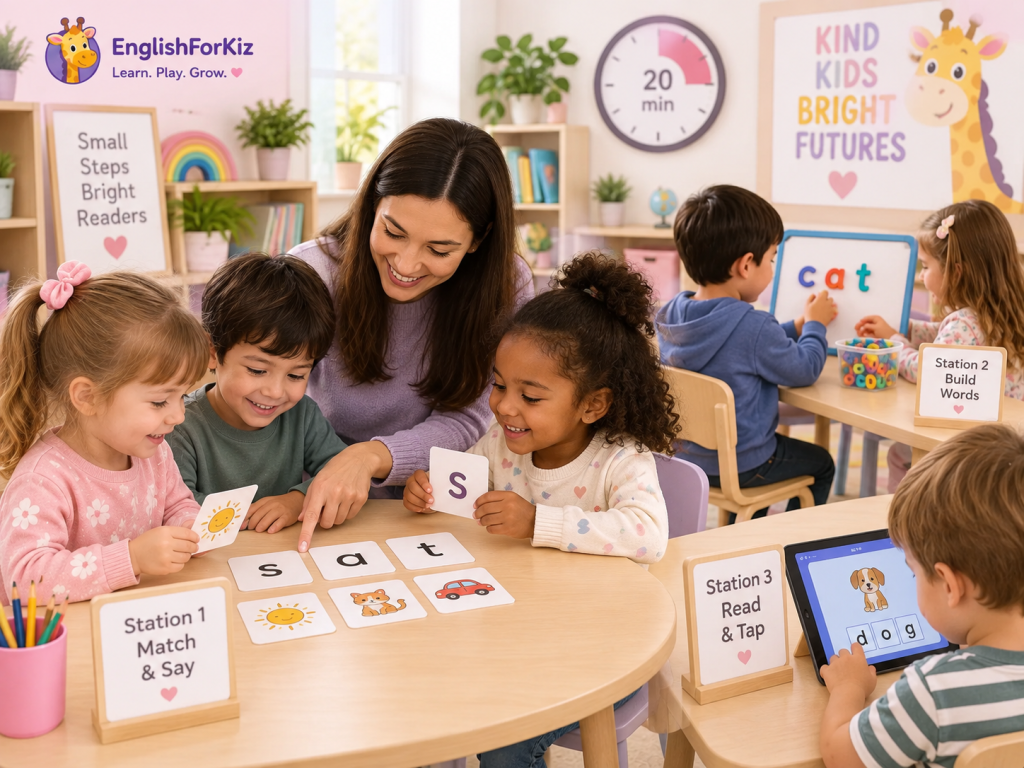
Small group phonics games can fit into a 20-minute literacy block with a simple routine: a one-minute sound review, three five-minute practice rounds, two one-minute transitions, and a two-minute exit check. Group students by the phonics skill they need now, give each station one clear job, and prepare materials before the clock starts. That leaves more time for children to practice and for the teacher to listen to their responses.
Start With a Practical 20-Minute Rotation Framework
The main scheduling decision is not how many activities can technically fit into 20 minutes. It is how much of those 20 minutes students can spend actually hearing, blending, reading, or writing the target pattern.
Use the timebar below as a starting point, not a fixed rule. This practice block supports feedback and review; it does not replace explicit phonics instruction. If children are still learning how to move between stations, try two longer rounds. If a group needs more modeling or correction, give it more teacher time instead of rushing through three activities.
Where each group goes: In this example, every group visits the teacher, online-game, and paper station once.
Round 1 · 1–6 min: Group A — Teacher; Group B — Online Game; Group C — Paper.
Round 2 · 7–12 min: Group A — Online Game; Group B — Paper; Group C — Teacher.
Round 3 · 13–18 min: Group A — Paper; Group B — Teacher; Group C — Online Game.
This route assumes enough devices and one short teacher session per group. On another day, oral or reading practice can replace an independent station.
Three active stations are often easier to manage than forcing every group through four tasks. A fourth activity can become a next-day station, an alternate practice option, or a replacement when one group does not need the digital station.
The rotation succeeds even when every child does not visit every possible station in one session. One group may need teacher instruction plus paper practice. Another may be ready for independent game review plus connected reading. The schedule serves the skill rather than requiring identical journeys around the room.
Group Students by Their Current Skill, Not a Permanent Ability Label
The most useful answer to how to group students for phonics centers is to group by the reading behavior that needs attention now.
Avoid building permanent “high,” “middle,” and “low” groups around one old assessment. A student may know most letter sounds but still confuse a small set. Another may recall every target sound but pause so long between phonemes that the sounds never become a word. A third may blend CVC words securely and need cumulative short-vowel or digraph review.
Students know some taught sounds but hesitate, confuse a small set, or depend heavily on picture cues.
Students can produce individual sounds but still need support joining three sounds into a complete word.
Students can read the current pattern and need to distinguish it from other patterns that were taught earlier.
The evidence can be brief. Listen to five letter sounds, ask for two or three CVC blends, review yesterday’s observation sheet, or hear a student read a short controlled line. The group can change as soon as the evidence changes.
This makes differentiation easier to manage because the room does not need a separate system for every child. The station structure stays familiar while students move to the group that fits the next instructional step.
How Small Group Phonics Games Fit Into Four Different Station Jobs
A strong classroom phonics station setup does not create four versions of the same activity. Each station should reveal or strengthen something different.
Teacher Station: Use Immediate Feedback Where It Matters Most
Keep direct teacher time for the responses that need careful listening. Students might produce target sounds, compare two patterns they confuse, blend a short word, segment a word for spelling, or read a small controlled word set.
Teacher-led phonics games are useful when the game lets the teacher hear the process. A student who reads map after attending to all three letters is showing something different from a student who sees m, glances at a picture, and guesses.
For a quick build-and-blend game, students make map with letter tiles, say the sounds, blend the word, then swap m for c and read cap. Five minutes can be enough for several focused responses when the word set and materials are already prepared. The goal is not to complete a large quantity. It is to hear enough to make the next decision.
Online Game Station: Review What Students Have Already Met
Use the digital station for a skill that has already been introduced clearly. Students should know what sound, word type, or response they are practicing before the teacher turns attention to another group.
EnglishForKiz organizes small-group phonics games around stages including letter sounds, beginning sounds, CVC blending, short vowels, and later phonics review. For example, a group reviewing initial consonants could use the First Letter Sounds game and say the first sound aloud before choosing an answer. Choose the activity by the group’s current skill rather than opening a broad menu and asking children to decide what looks entertaining.
Paper Station: Make the Response Visible
Paper practice provides a useful change of format. Depending on the target, students may match a sound, sort pictures, complete a CVC word, identify the middle vowel, build a word family, or write a small number of target words. For a short-vowel sorting game, ask students to read familiar words such as map, mop, and top before sorting them by vowel sound.
The finished response also gives the teacher something to review after the rotation. Use the main phonics worksheets library when the group needs a printable task that matches the lesson rather than a second unrelated objective.
Oral or Reading Station: Check Whether the Skill Travels
A student who succeeds in a matching activity still needs opportunities to use the pattern without the same cues. Oral blending cards, partner word reading, a short word hunt, or a controlled passage can provide that next step.
For early readers ready to move from isolated words into connected text, the EnglishForKiz decodable readers provide reading material organized by phonics level.

Give the Game One Clear Job
Decide the response before the station starts: identify the first sound, distinguish a vowel, blend a CVC word, or review another familiar pattern. One matched activity is easier for early readers to manage independently than a long choice screen.
The game can provide another round of practice while the teacher works elsewhere, but the next off-screen response is what shows whether the skill carries beyond that activity.
Explore Phonics Games by SkillPrepare Devices, Headphones, Materials, and Movement Before the Clock Starts
The easiest way to lose a 20-minute block is to solve the same tiny logistical problem three times.
Assign starting places before the lesson. Put paper materials at the station instead of across the room. Keep headphones with the devices. Open the required digital page in advance when practical. If students need a login routine, teach that routine outside the timed phonics rotation first.
For online games for a phonics station, plan the audio routine as carefully as the activity. Headphones can reduce competing classroom sound, but students must still notice the rotation cue. A visible timer or familiar hand signal can solve that problem without requiring the teacher to leave the small group repeatedly.
Transition directions should also be concrete. “Go to the next station” quietly contains several decisions: where to go, what to carry, where to sit, what to open, and how to begin. Teach those actions separately until they become routine.
Record What You Need for the Next Teaching Decision
The observation sheet should be short enough to use while teaching. If documenting the lesson prevents the teacher from hearing students read, the notes are taking time away from instruction.
Record the student, the current target, one observable response, and the next step. Listen for accuracy, hesitation, guessing from the first letter, vowel confusion, skipped final sounds, and whether one brief prompt changes the response.
A note such as “needs work” says very little about tomorrow. A note such as “reads final sound only after teacher points to it” tells the teacher what to watch and what kind of prompt may still be necessary.
Keep independence separate from phonics accuracy. A child who understands the sounds but repeatedly forgets the station directions has a routine problem. A child who starts independently but clicks or marks answers without attending to the word has a phonics-response problem. Those situations need different next steps.
Differentiate the Phonics Target Without Rebuilding Every Station
Differentiation becomes much more practical when the location and routine stay familiar while the sound or word set changes.
Letter-Sound Group
Work with a small set of known and nearly known correspondences. At the teacher station, listen for quick, clean recall. At independent stations, use identification, matching, or beginning-sound practice with the same set.
CVC Blending Group
Keep the letter patterns familiar enough that blending remains the main job. Listen to whether students hold the sounds, attend to the middle vowel, and reach the whole word rather than producing three isolated sounds and stopping.
Short-Vowel Review Group
Mix previously taught short-vowel patterns instead of simply assigning a longer list from one word family. The goal is to notice what is actually printed when the answer is less predictable.
Later Review Group
For students working beyond basic CVC patterns, keep the same station routine while changing the target to previously taught blends, digraphs, long-vowel patterns, or another appropriate review skill.
The same decision applies to digital practice: choose one game that matches each group’s current skill. A group that is still confusing a newly taught pattern may need another teacher-led round instead. A group using the pattern independently can spend that round reviewing through a game while the teacher focuses elsewhere.
Match the Worksheet to the Same Skill
This short-a worksheet is a useful example of how paper practice can keep the target visible. Students work with short-a word families and incomplete CVC words rather than switching to an unrelated literacy task.
For kindergarten groups working on CVC words and short vowels, use the Kindergarten Phonics Worksheets collection to choose paper practice that follows the group’s current pattern.
Browse Kindergarten Phonics Worksheets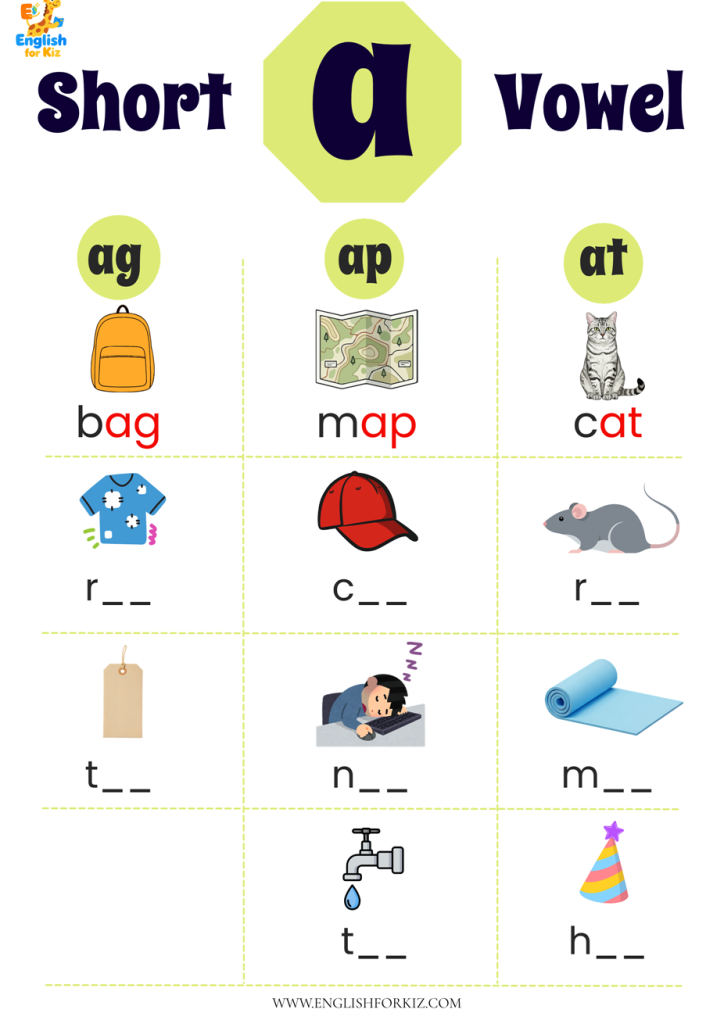
If the class needs a broader sequence beyond a single station target, the Kindergarten Phonics Program organizes early skills around letter-sound knowledge, CVC blending, short vowels, simple reading, games, worksheets, and decodable reading.
Use a Different Rotation When Devices Are Limited
A device shortage changes the schedule. It does not change the phonics goal.
Give One Group the Digital Slot
Let one group keep the device for the block while other groups use teacher, paper, oral, or reading stations. Give another group the digital slot during the next session.
Pair Only When Both Students Respond
Partners can alternate listening, saying, choosing, blending, or checking. Avoid a pair in which one child controls the screen while the other develops deep expertise in watching someone else tap things.
Keep the Skill and Swap the Format
Use word cards, a picture sort, oral blending, a worksheet, or partner reading. The instructional target can stay exactly the same.
One device does not need to travel around the room every five minutes. Moving hardware, reconnecting headphones, and reopening pages may consume more time than the digital practice provides. In that case, assign the device by session rather than by round.
Also avoid making the online station a prize for finishing early. Students should reach it because the practice matches their current instructional need, not because they completed paper faster than everyone else.
Check the Same Skill Again in a Different Format
A successful station response tells you what happened inside that station. A short transfer check tells you whether the phonics knowledge survives when the cues change.
A student who reviews short a successfully in a game might then read two new short-a words from a card. A student who completes a CVC worksheet might read three similar words without pictures. A student who handles isolated words securely can meet the same pattern in a short controlled passage.
Keep this follow-up small. Its job is not to create another lesson after the lesson. Two new words or one short line can offer a quick indication of whether students still need the original cues. Confirm progress across further responses and lessons before treating the skill as secure.
Move From the Station Into Connected Text
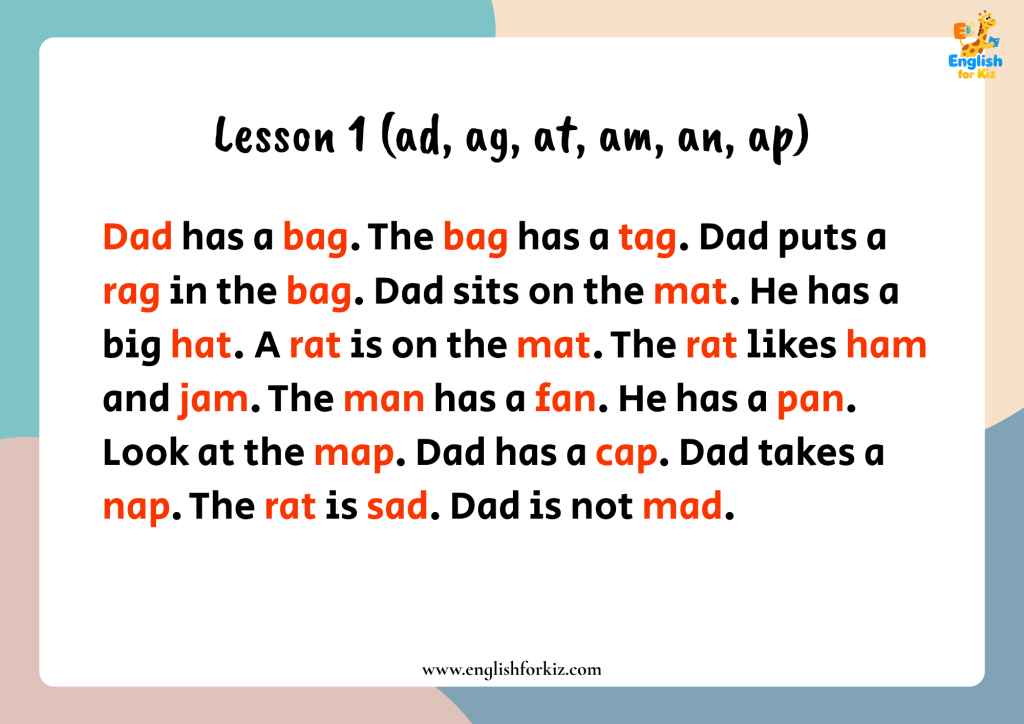
When students can blend the target words with reasonable independence, use a short passage to see whether they still notice the pattern inside sentences.
EnglishForKiz decodable stories are organized by phonics level, including kindergarten CVC and short-vowel reading. Choose text that uses patterns students have already learned rather than using the story to introduce several unfamiliar patterns at once.
Read Decodable StoriesIf performance drops when the format changes, note exactly what changed. A student who succeeds with picture support but struggles with plain print may need more decoding practice. A student who reads isolated words but loses the pattern in a sentence may need shorter connected-text practice. If the skill remains stable across formats, the group can move into cumulative review or the next taught pattern.
Make the Rotation More Independent Before Making It More Complicated
The best classroom rotation is not the one containing the largest number of centers. It is the one students can use while the teacher actually teaches.
Keep station locations and the movement signal familiar from day to day. For example, students who finish a CVC game early can reread their word cards instead of choosing a new activity or interrupting the teacher. Show them where to return materials when the timer sounds.
As those routines become automatic, the teacher can listen more closely at the teacher station instead of managing traffic. That is a more useful upgrade than adding another activity simply because the class has become capable of surviving three.
Keep the academic target just as clear. One group may spend the week strengthening beginning sounds. Another may need CVC blending. A third may be ready for mixed short-vowel review. Students can change groups while the station architecture remains familiar.
Used this way, small group phonics games become one part of a connected classroom loop: direct instruction where feedback matters, purposeful independent practice, a quick change of format, and a short check that tells the teacher what comes next.
Build the Next Station Around the Skill Students Need to Practice
Start with the target, then choose the format. Use the teacher station where students still need modeling or correction, printable practice when a visible response is useful, digital review when the pattern is familiar, and connected reading when students are ready to apply it beyond isolated items.
Frequently Asked Questions
How many phonics stations fit into 20 minutes?
Three active rounds are a practical starting point because they leave room for brief transitions and an exit check. Two longer rounds may work better while students are learning routines. Four stations can work later, but every group does not need to complete every possible station in one session.
How should students be grouped for phonics centers?
Group students by the skill they currently need, such as letter-sound recall, CVC blending, short-vowel discrimination, or cumulative review. Use recent classroom responses to regroup rather than keeping permanent ability groups.
What if the classroom has only one device?
Let one group use the device while other groups complete teacher-led, paper, oral, or reading tasks. If moving the device wastes too much time, rotate access across different sessions instead of passing the device around during the same 20-minute block.
Which skills work best for independent game practice?
Use previously introduced skills that students can attempt without continuous explanation. Letter-sound review, beginning sounds, familiar CVC blending, short-vowel review, and other taught patterns are better independent choices than a completely new or persistently confusing skill.
How can a teacher record progress during a short rotation?
Record the student, target skill, one observable response, and one next step. For example: “reads short-a CVC words but skips final sounds without a prompt; repeat with a new five-word set.” The note should help decide tomorrow’s teaching or grouping.