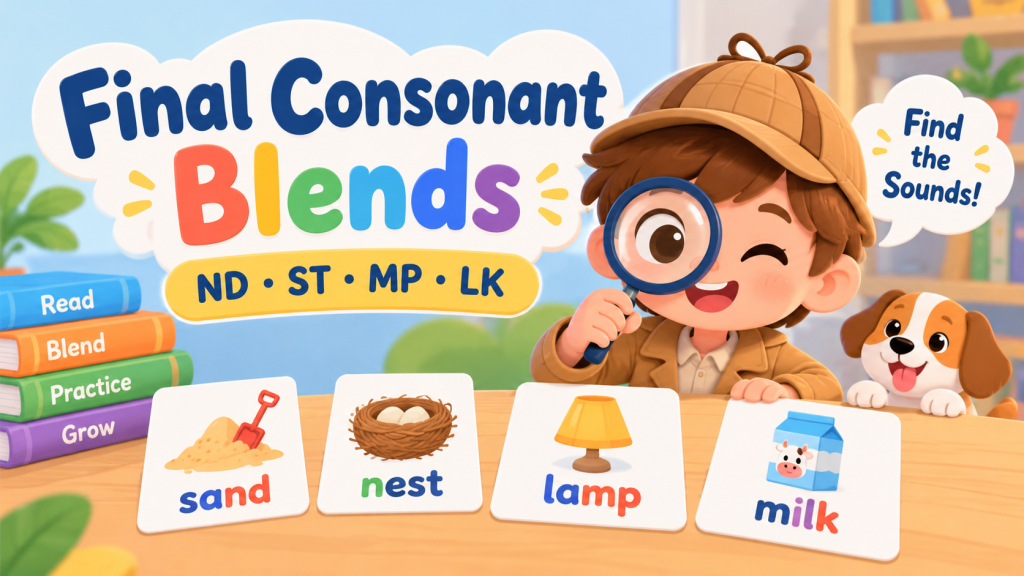
A child reads hand as “had,” nest as “net,” or lamp as “lap.” The vowel sounds right, but a final consonant has disappeared. In words with final consonant blends, children need to recognize both ending sounds and blend them into the whole word.
In hand, ND represents /n/ followed by /d/. The same applies to ST in nest, MP in lamp, and LK in milk. Find which sound is missing, then revisit that ending.
What happens in a final consonant blend?
A final consonant blend keeps two or more consonant sounds at the end of a word. In nest, /s/ comes before /t/; in milk, /l/ comes before /k/. Neither pair makes a new, single sound.
The symbols between slashes show speech sounds rather than letter names. For example, /æ/ is the short a sound in hand.
hand/n/ + /d/ND endingTap to reveal sounds
nest/s/ + /t/ST endingTap to reveal sounds
lamp/m/ + /p/MP endingTap to reveal sounds
milk/l/ + /k/LK endingTap to reveal sounds
All four are one-syllable words. A reader who says “lap” for lamp has missed /m/ before the final /p/.
Children who can read and blend familiar CVC words may be ready to try four-sound words such as hand and nest. If one ending keeps causing trouble, practise that group before mixing the different blends.
Hear the two ending sounds before reading the word
Say hand slowly: /h/ → /æ/ → /n/ → /d/. Let /n/ continue briefly before the final /d/, then blend all four sounds to say hand naturally. This phoneme segmentation helps the child notice the consonant that might otherwise be missed.
In nest, stretch /s/ briefly before /t/. In lamp, close the lips for /m/ before /p/. In milk, listen for /l/ before /k/; final /l/ may sound different from the /l/ in leaf.
Do not add an “uh” between consonants. “Lam-puh” and “mil-kuh” introduce a vowel and syllable that do not belong in lamp or milk.
If joining even three sounds is difficult, revisit moving from separate sounds to whole words before practising final blends.
Sort ND, ST, MP and LK endings
The words in each group share the same two ending consonant sounds, even when their beginning sounds or vowels are different.
Hand: part of the body
Sand: tiny grains
Bend: to curve
Nest: a bird’s home
Best: better than the others
Dust: fine, dry particles
Lamp: a source of light
Camp: an outdoor place to stay
Jump: to push off the ground
Milk: a familiar drink
Silk: a smooth fabric
Elk: a large deer-like animal
Say sand, dust, camp, and silk without showing the spellings. Ask the child to choose the ending group, then reveal the words. If that is difficult, compare just two endings with print visible.
Find the missing ending sound
Listen to the word the child actually says. If nest becomes “net,” /s/ was lost; if lamp becomes “lap,” /m/ was lost. Sometimes the very last consonant survives while the preceding one disappears.
Open the example that matches what you heard, then help the child say the full word again.
If “hand” sounds like “had”
Listen for /n/ between the short vowel and /d/. Hold /n/ briefly, move into /d/, and then say hand without an extra vowel.
If “nest” sounds like “net”
The /s/ before /t/ is missing. Stretch /s/ for a moment, add the short /t/, and return to a natural reading of nest.
If “lamp” sounds like “lap”
The /m/ is missing before /p/. Compare lap and lamp aloud so the child can hear what the additional consonant contributes.
If “milk” sounds like “mill”
The final /k/ is missing. Listen for the brief closing /k/ after /l/. The /k/ does not need an exaggerated puff of air to count as part of the word.
Read short phrases, then choose broader practice
Once the endings are familiar, try short phrases to see whether both consonants remain.
If a sound disappears, revisit the single word rather than adding more examples.
Which sound went missing?
Compare the target word with what the child said. Choose the missing consonant sound.
Sound Detective complete
You checked all six words.
Try reading any tricky word pairs aloud, keeping both ending sounds in the target word.
Four-word spelling and reading practice · Show activity
Which two letters complete the word?
Read each sentence, write the two missing letters, and say the completed word aloud before checking the answers.
- Hold my ha__.
- The bird sits in its ne__.
- Turn on the la__.
- Pour the mi__.
Show the answers and sound check
1. hand — /n/ + /d/
2. nest — /s/ + /t/
3. lamp — /m/ + /p/
4. milk — /l/ + /k/
The written answers only show letter recognition. Read the words back to check whether both ending sounds remain in the spoken word.
Once this task is comfortable, consider broader first-grade blending and reading practice matched to known skills rather than the grade label alone.

1st Grade Phonics Program
The program overview covers consonant blends, digraphs, and vowel patterns. Consider it when practice needs to extend beyond these four endings.
Explore the First-Grade ProgramFAQ
How is an ending blend different from a digraph?
A blend keeps separate consonant sounds, such as /n/ and /d/ in hand. A digraph uses two letters for one sound, as SH does in fish.
Should a vowel be added between the last two consonants?
No. Lamp and milk do not have an extra vowel between their final consonants. Adding “uh” changes the word’s sound pattern.
Does every written consonant sound equally strong in connected speech?
No. Speaking speed, neighboring sounds, and accent can make some consonants less noticeable. Careful word reading helps children identify the intended consonant sequence without overpronouncing every sound.
When a child drops a sound in a final consonant blend, practise that word again before returning to a short phrase.
Check the exercise answers first; revisit any uncertain ending before moving on.
Ready for more practice beyond these four endings? Explore the broader consonant blends and reading activities in the 1st Grade Phonics Program.
Explore 1st Grade Phonics Program