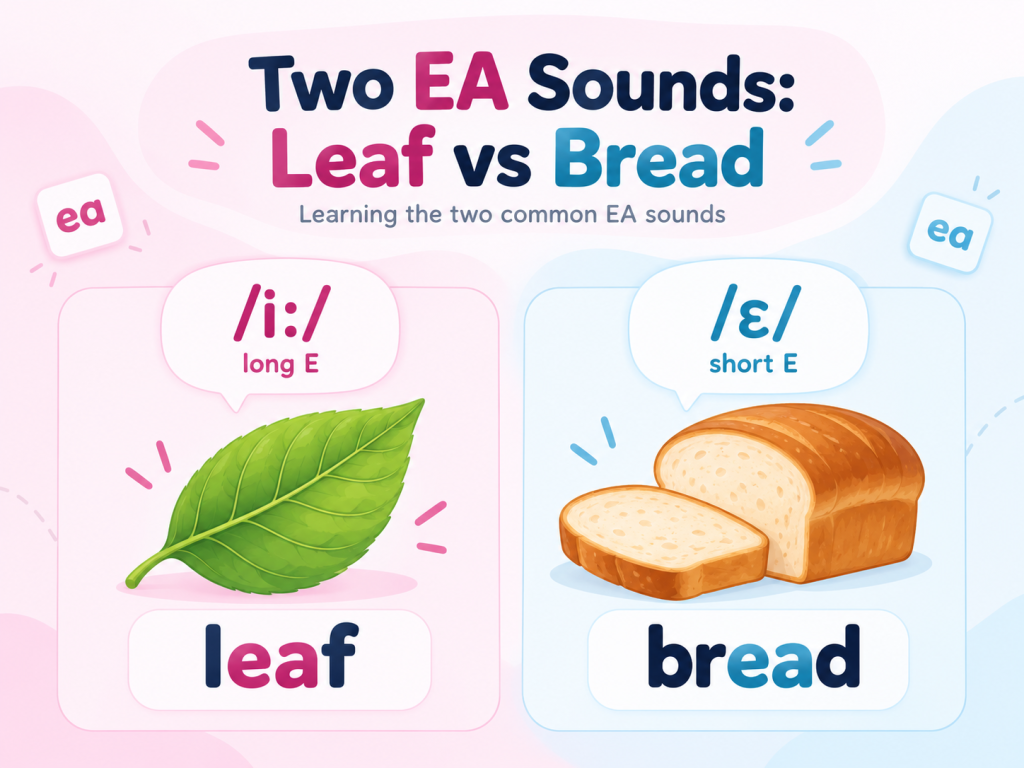
Why does leaf have a long E sound while bread sounds like bed? Both words contain EA, but the letters represent different vowels: leaf has /iː/, as in see, while bread has /ɛ/, as in bed.
Children who first learn EA through words like leaf and team may try that same long E sound in bread. Comparing a few familiar words side by side helps them notice the difference and check their first reading when a word sounds unfamiliar.
Why do leaf and bread sound different?
EA is a vowel team, a pair of letters that can work together to represent a vowel sound. Its pronunciation does not stay the same in every English word. Compare these two familiar examples:
QUICK SOUND CHECKDoes head sound more like leaf or bread?Say all three words, then reveal the answer.
Say leaf and bread aloud, then listen just to the middle vowel. The tongue is higher for /iː/ and lower for /ɛ/. Children do not need to master these phonetic symbols, but hearing the contrast gives them something concrete to notice.
It also helps to separate spelling from sound. The two letters EA do not tell us, by themselves, which pronunciation a child should use in an unfamiliar word.
Build two familiar EA word groups
Begin with words children can recognize in speech. Small groups make the difference easier to hear than a long mixed list, especially if bread keeps getting read with the vowel from leaf.
In the first group, leaf, team, and beach share /iː/ even though the surrounding consonants change. In the second, bread, head, and thread share /ɛ/. Add ready or heavy so children do not assume the short-E pronunciation occurs only before D.
If your child needs more long-E practice, the EnglishForKiz collection of 1st grade phonics worksheets includes EE/EA activities with words such as leaf.
One quick check is to say a word without showing its spelling. Ask which group it belongs to, then reveal the written word and point to EA. This connects the sound a child hears to the spelling on the page.
Can spelling alone predict the group?
Not reliably. EA often represents /iː/, but there is no exception-free visual rule that predicts the pronunciation of every EA word. Reading the sentence can help a child recognize a familiar spoken word, provided they also check the letters.
Please put the bread on the table.
If a child says bread with the long E sound, ask which familiar food word fits. Then return to the printed word and notice that EA makes /ɛ/ here.
Read offers an especially useful contrast once the two groups are secure. In “I read every day,” it is pronounced /riːd/. In “I read yesterday,” it is /rɛd/. The spelling is identical; the grammatical context tells us which pronunciation is intended.
SAME SPELLING, DIFFERENT SOUNDWhich read sounds like bread?Open to compare two short sentences.
Try a familiar pronunciation, check whether it forms a word that fits the sentence, and look back at the letters. When the word is unfamiliar, use a learner’s dictionary with audio rather than inventing a rule.
What about EA words outside these two groups?
The two groups above are common, not exhaustive. A smaller set of EA words has /eɪ/, the vowel heard in day. Examples include great, break, and steak.
Another EA pronunciation worth recognizing later, but not a third sorting group for this lesson.
Pronunciation may also vary with accent, especially in less familiar words. The main vowel contrast between leaf and bread is consistent in standard British and American English. For uncertain examples, compare the audio for the accent being taught.
Read, sort and explain the choice
Try eight familiar words. Say each one aloud before sorting; if a child cannot read it yet, an adult can say it first. Ask the child to compare the vowel sound with leaf or bread and explain the choice. Use the activity aloud, on paper, or with the interactive check below.
You sorted all eight words.
The best next step is to read any missed word aloud beside leaf or bread.
Try the word sort without a screen
Read the words aloud, then sort them into the two vowel groups.
When a word is placed, explain the sound: “Head goes with bread because the vowels sound alike.”
Now use the words in sentences
Choose the word that fits, say the complete sentence, and identify its EA sound.
- We sat on the ______. (seat / head)
- The ______ is warm and fresh. (bread / beach)
- Our ______ won the game. (team / thread)
- Are you ______ for school? (clean / ready)
Show the answer key and explanations
Leaf /iː/: beach, team, seat, clean.
Bread /ɛ/: head, heavy, thread, ready.
Sentences: 1. seat (/iː/); 2. bread (/ɛ/); 3. team (/iː/); 4. ready (/ɛ/).
If heavy or ready is confusing, read it next to bread again. Children who know both groups can continue with a few fresh sentences rather than repeating all eight words.
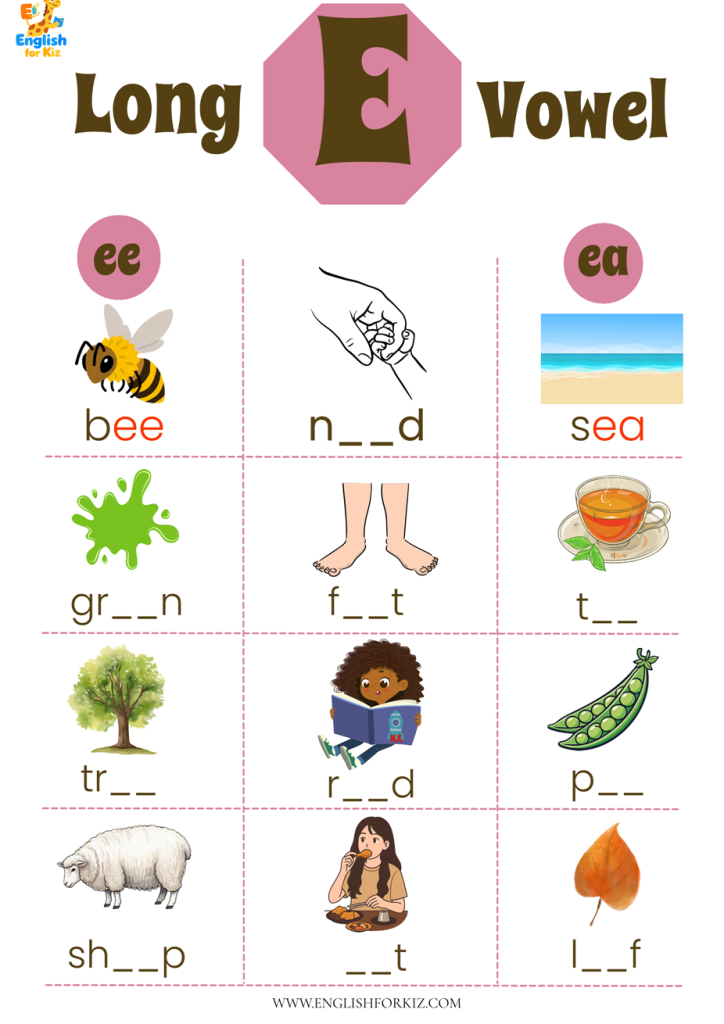
This real worksheet preview illustrates long-E vowel-team practice, with EA words such as sea and leaf. It is most relevant when the child needs to recognize EA as /iː/ in print.
If your child is still mixing up leaf and bread, use the two-sound sort above. This worksheet is a better fit when they need extra practice with long-E words.
Explore Worksheet Collection →FAQ
Can EA have a third pronunciation?
Yes. In great, break, and steak, EA represents /eɪ/, as in day. These are useful words to recognize after the two main groups are familiar.
Why do some dictionaries write /e/ instead of /ɛ/?
Dictionaries use different phonemic transcription conventions. Cambridge writes /e/ for the vowel in bread, while some systems use /ɛ/. Here they refer to the same familiar short-E vowel, not two sounds a beginning reader needs to distinguish.
Do EE and EA always behave the same way?
No. EE commonly represents /iː/, as in see and tree. EA can represent /iː/ in leaf or /ɛ/ in bread, so the spellings cannot be treated as interchangeable in every word.
When children meet a word with EA, encourage them to compare its vowel sound with leaf or bread and check whether the pronunciation fits the word and sentence. If a word is still difficult, practise it alongside a few familiar words from the same sound group.
For another round of practice, explore the first-grade phonics worksheets and choose an activity that matches the sound your child is working on.
Explore 1st Grade Phonics Worksheets →