
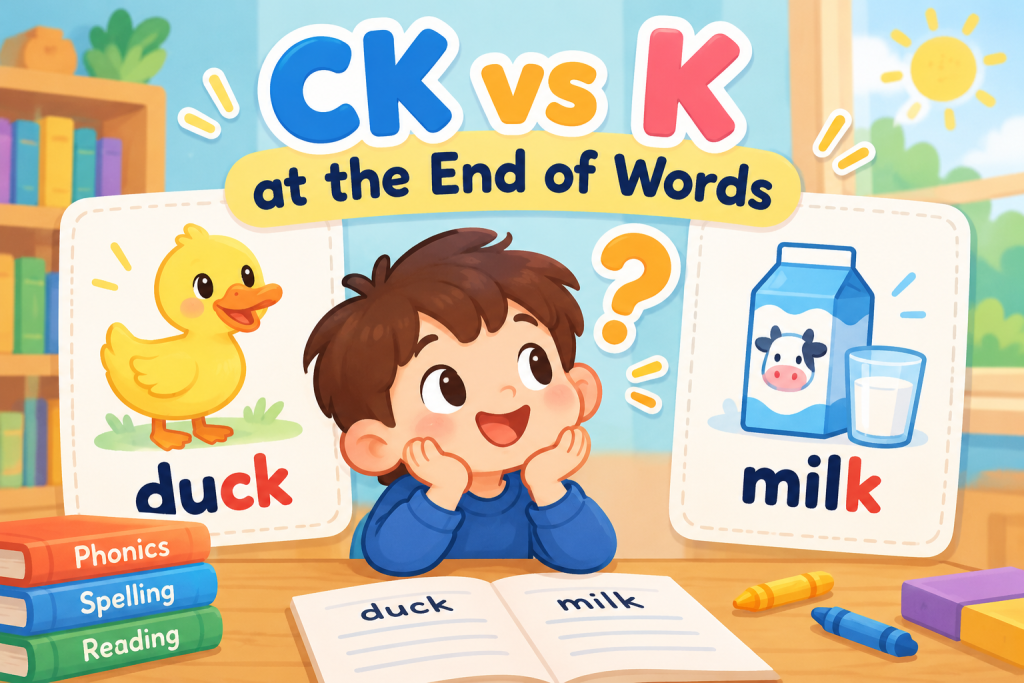
Why does duck end in CK while milk ends in K? Both words finish with the /k/ sound. The difference is the sound immediately before it: duck has a short vowel before /k/, while milk has /l/.
The ck vs k spelling rule is a useful starting point for one-syllable words. CK commonly follows a single short vowel directly, as in duck. K commonly follows another consonant, as in milk. These are patterns to check, not rules without exceptions.
CK or K: what should a child check first?
Start with the two words spoken aloud, not the letters on the page. In duck, the sounds are /d/ + /ʌ/ + /k/. In milk, they are /m/ + /ɪ/ + /l/ + /k/. The child may hear the same final sound in both words but overlook the extra consonant in milk.
Two ending letters, CK, represent one /k/ sound.
The /l/ is heard before /k/, so the ending uses K.
Ask, “What do you hear just before the last /k/?” This question tells the child where to listen. It also keeps the focus on spelling rather than treating CK and K as different pronunciations: both can represent the same /k/ sound.
Look immediately before final /k/
For many familiar one-syllable words, CK comes directly after one short vowel: back, neck, sick, and duck. There is no additional consonant sound between that vowel and /k/. In each case, the letters CK act together as a consonant digraph.
Now listen to desk, milk, and task. Each has a short vowel somewhere in the word, but /s/ or /l/ comes between the vowel and the final /k/. That is why “Does this word have a short vowel?” is not a useful question on its own. The position of the vowel is what matters.
If the child is still learning to hear short vowels, begin with a few familiar CVC words. EnglishForKiz has kindergarten phonics worksheets for short-vowel and early spelling practice. Once the child can hear the vowel clearly, return to the difference between duck and milk.
Compare small groups of CK and K words
Small word groups make the difference easier to hear. Say each word naturally, then cover the final spelling. Can the child identify the sound directly before /k/ without seeing the answer?
In this group, the vowel leads straight into /k/.
Here, another consonant sound comes immediately before /k/.
Once the simpler pairs feel familiar, pink offers a useful extra challenge. Its final sounds are /ŋ/ + /k/, so the /k/ does not follow the short vowel directly. Children who have not learned NK yet can stay with milk and desk.
Try alternating just two examples—back, milk, back, milk—and then change the order. The child should explain the clue, not merely recite which column the word belongs in. This is particularly helpful when a correct answer comes from remembering a familiar printed word rather than hearing its sounds.
Where does this useful pattern stop?
English spelling has exceptions, and the short-vowel clue does not settle every final /k/ word. Yak, for example, ends with K even though /k/ follows a short vowel directly. A child who writes yack is applying a reasonable pattern to a word that needs a different spelling.
Other spelling patterns can appear in words ending with /k/. In bike, K represents the final /k/ sound, while the silent E helps the earlier I represent a long vowel. In music, the final /k/ sound is spelled with C. These examples show why the CK-versus-K clue should not be applied to every word. For unfamiliar spellings, check the word rather than forcing it into one of the two groups.
Say duck slowly and tap once for the final /k/ sound, even though CK has two letters. Then say milk and tap separately for /l/ and /k/. This helps a child connect the sounds they hear with the letters they choose.
Try a short ending-choice task
Now try the idea with six words. Say each word aloud before the child chooses CK or K for the blank. After each answer, ask which sound gave the clue; that tells you whether the child heard the pattern or simply recognized the word.
The word detective gives feedback after each choice. The paper version below uses the same words and works without the interactive game.
Say the word, then listen just before the last /k/.
Word detective: complete!
All six endings are filled in. Read duck and milk once more, and explain the sound before /k/ in each word.
Prefer pencil-and-paper? Open the six-word check
Write CK or K in each blank. Say the complete word before looking at the answer key.
For an extra challenge, explain each answer before opening the answer key below.
Reveal the answers and reasons
duck — CK: /ʌ/ comes directly before /k/.
milk — K: /l/ comes immediately before /k/.
neck — CK: the short vowel comes directly before /k/.
desk — K: /s/ comes before /k/.
sick — CK: the short vowel comes directly before /k/.
tank — K: /ŋ/ comes before /k/.
If several endings are incorrect, go back to duck and milk and repeat the spoken comparison before writing more words.
A child who can hear the clue but hesitates over the spelling may benefit from short written practice. An activity that mixes words with familiar spellings is most useful after the CK examples have been introduced, not as a substitute for explaining why duck and milk differ.
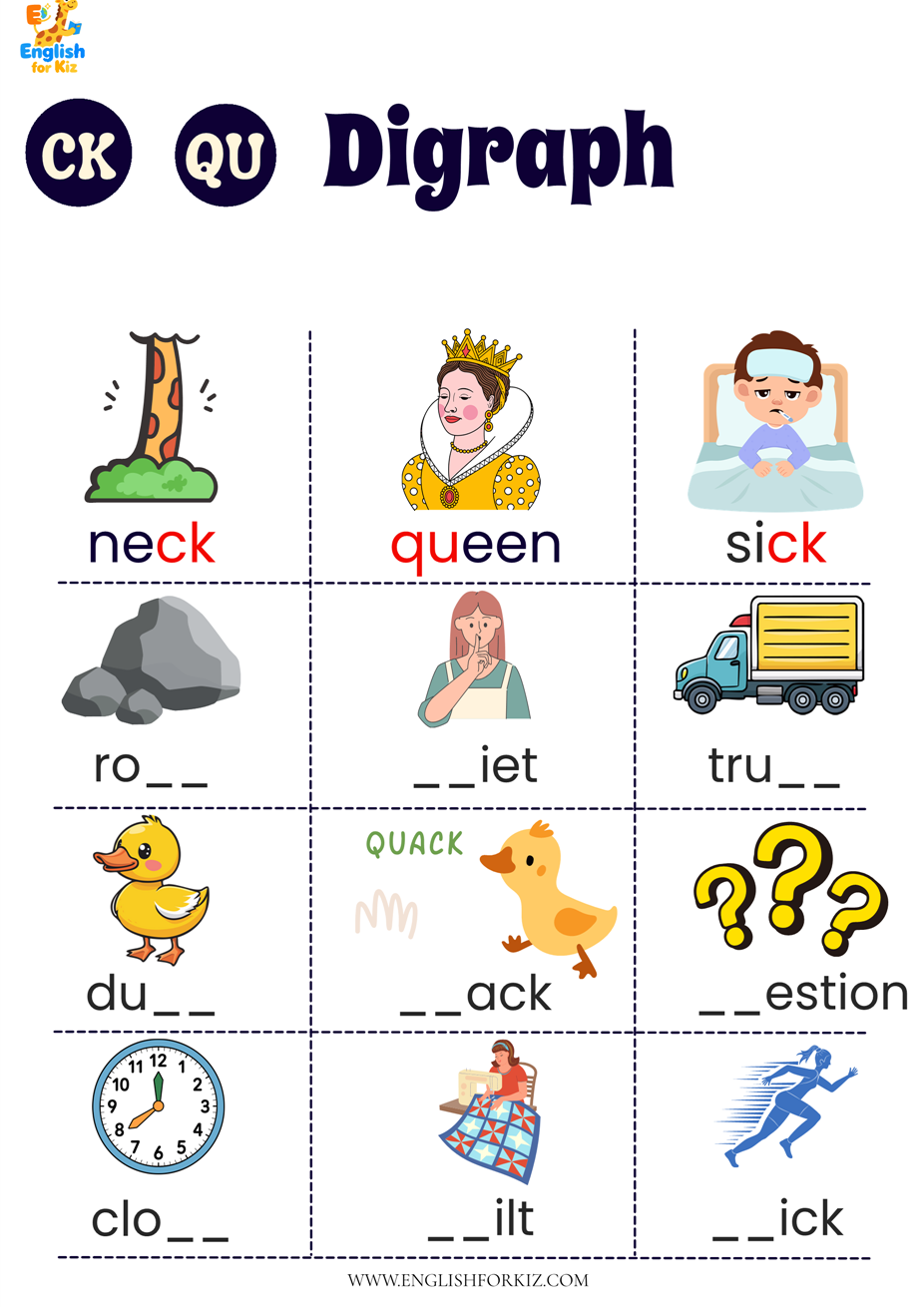
The kindergarten worksheet collection includes a CK/QU activity with words such as neck, sick, and duck. It can reinforce recognition of CK, while the six-word activity in this article is better suited to choosing between CK and K.
Listed as VIP Exclusive. Check current access and download conditions on the collection page.
FAQ
Is CK normally used after a consonant?
No. CK usually follows a short vowel directly in common one-syllable examples. After another consonant, K is common, as in milk and desk.
Can a /k/ word end with a spelling other than CK or K?
Yes. The final /k/ sound in music is spelled with C. In bike, K represents /k/, and the silent E works with I to show the long vowel. These patterns fall outside the CK-versus-K comparison taught here.
Should a child choose by the last sound alone?
No. Hearing /k/ identifies the final sound, but not its spelling. Listen to the sound before /k/, then check whether the word follows the familiar pattern or needs to be learned separately.
When a child mixes up the endings, return to the spoken words before looking at the letters. Hearing the vowel in duck and the /l/ in milk helps turn a guess into a spelling decision. The six-word check above shows whether that difference is becoming familiar.
For paper-based review, explore the current kindergarten collection and choose a page that matches the child’s known sounds and spelling patterns.
Explore Kindergarten Phonics Worksheets →