
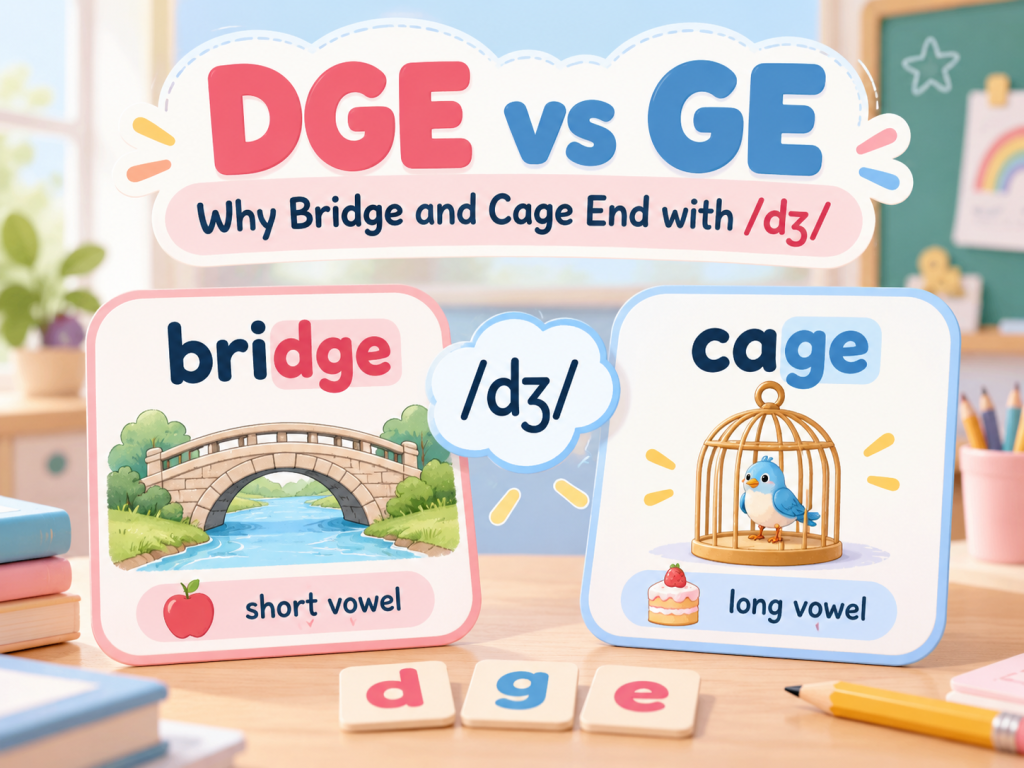
A child may hear the final sound in bridge and cage correctly, yet still write the wrong ending. Both words finish with /dʒ/, the sound at the beginning of jump. So why does bridge need -dge while cage uses -ge?
The clue is what comes immediately before /dʒ/. In one-syllable words, -dge typically follows a short vowel directly, while -ge often follows a long vowel or another consonant. That distinction helps children decide whether to spell the final /dʒ/ sound with -dge or -ge.
Why do bridge and cage end with the same sound?
Say the words aloud. The letters dge in bridge represent one consonant sound, /dʒ/, as does ge in cage.
Neither word has an extra final syllable, and the d in bridge isn’t pronounced as a separate /d/ sound.
Check the sound before the ending
The choice between -dge and -ge depends on the vowel and any consonant immediately before /dʒ/. A short vowel alone is not the whole clue: bridge and hinge both have a short i sound, but only bridge ends in -dge.
If a child still struggles to hear the difference between short and long vowels, practise those sounds first. The spelling choice becomes easier once the vowel sounds are clear.
Compare words ending in -dge and -ge
Short vowel directly before /dʒ/: DGE
In badge, edge and fudge, the short vowel leads straight into /dʒ/, with no consonant sound in between. Dodge follows the same spelling pattern, even though its vowel may sound different across accents.
A long vowel or another consonant: GE
Cage and page have a long a sound, while huge has a long u sound. Hinge and bulge are different: /n/ or /l/ comes immediately before /dʒ/, so the short-vowel clue for -dge does not apply. Large has an r-influenced vowel; the r is pronounced in some accents but not others.
bridge: /ɪ/ → /dʒ/ → -dge
hinge: /ɪ/ → /n/ → /dʒ/ → -ge
The vowel is short in both. The difference is whether a consonant intervenes before the final sound.
What about exceptions and added endings?
The short-vowel clue is most useful for one-syllable words. Village and cottage have two syllables, so they are better learned as separate word patterns. Change and range show why the letters before -ge matter: their a sound is long even though n comes after it.
Adding an ending can also change how a word looks. Bridge becomes bridges and cage becomes cages, with the e kept in both. Before -ing, that e drops: bridging and caging. The /dʒ/ sound stays the same.
Choose, explain and check the ending
Use each clue to work out the word, then say it aloud. Choose dge or ge and listen for the sound just before /dʒ/.
Spelling detective complete
You checked all six spellings.
Try the paper version below and explain why each ending fits.
Prefer writing? Open the six-word spelling check and answer key
Which ending belongs here?
Complete the words using their clues. Answers are hidden below so the child can try independently first.
Reveal the six answers and the reasons
- bridge — dge. Short /ɪ/ goes straight into /dʒ/.
- cage — ge. Long a comes before /dʒ/.
- fudge — dge. Short u comes directly before /dʒ/.
- hinge — ge. The consonant /n/ comes before /dʒ/.
- page — ge. Long a comes before /dʒ/.
- badge — dge. Short a comes directly before /dʒ/.
If a word is tricky, compare it with a similar one: bridge and hinge differ because of /n/, while badge and cage have different vowel sounds.
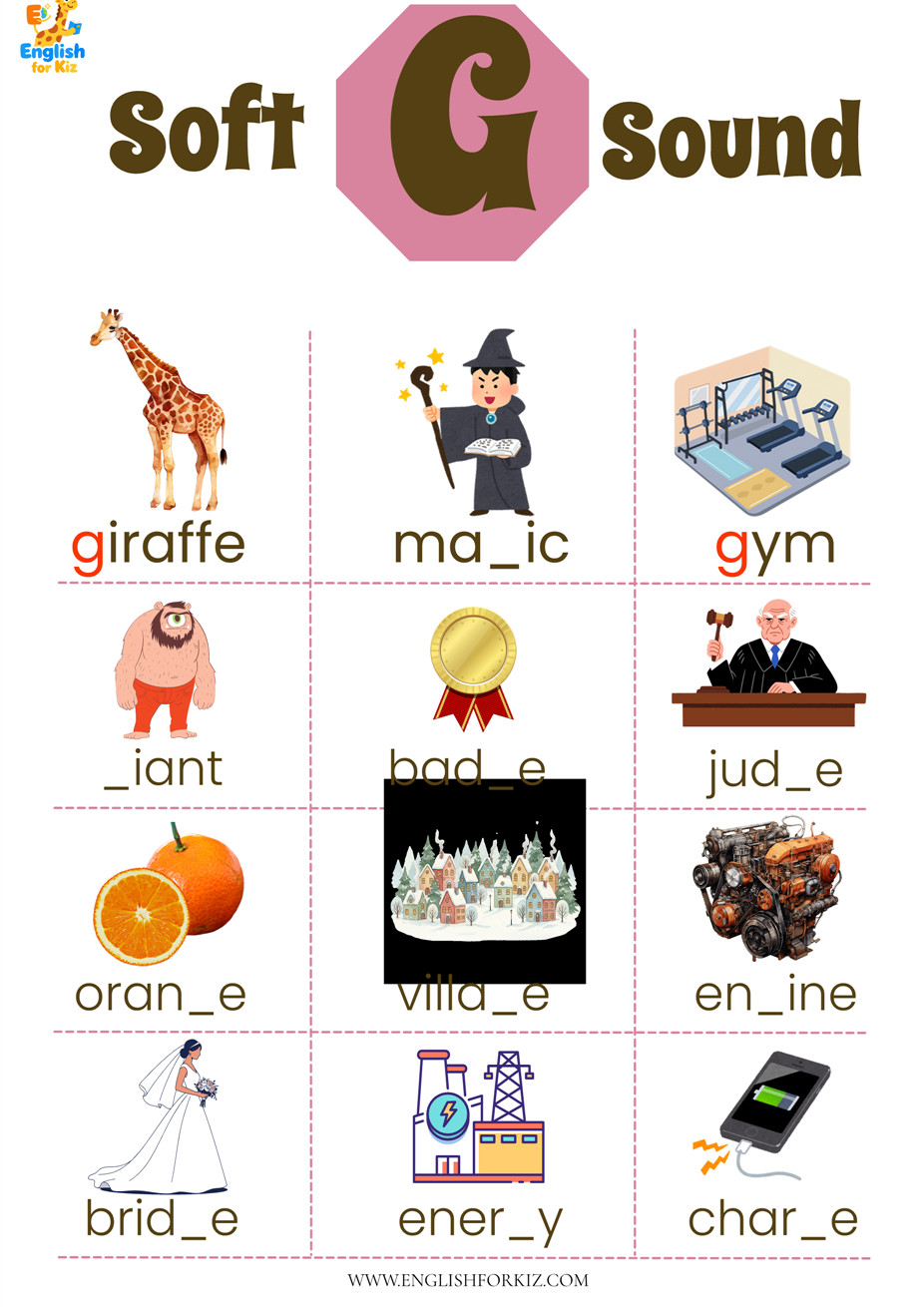
This Soft G worksheet includes badge, judge and bridge. It practices g representing /dʒ/ but is not a dedicated DGE/GE word sort.
If written soft G practice would be helpful, check the activity and its access conditions before choosing it.
Explore worksheet collection →FAQ
Does GE always represent /dʒ/?
No. The letters ge do not always signal the same pronunciation in every position. For instance, get begins with hard /ɡ/. This comparison focuses on familiar words whose final sound is already /dʒ/.
Can J normally be used at the end of these English words?
Not in the usual spellings of words like badge, bridge and cage. English typically uses -dge or -ge for this final /dʒ/ sound in such words, though rare borrowed words may end in j.
Does the spelling stay identical when a suffix is added?
No. Bridge becomes bridges but also bridging; cage becomes cages but also caging. The final e is dropped before -ing in these examples, while /dʒ/ stays.
The six-word check can help show which sound is causing trouble. Confusing bridge and hinge may point to the consonant before /dʒ/; mixing up cage and badge may point to a long-versus-short-vowel difficulty.
For paper-based review, check the first-grade collection for a suitable skill match.
Explore 1st grade phonics worksheets →Review worksheet content and current access requirements on the collection page.