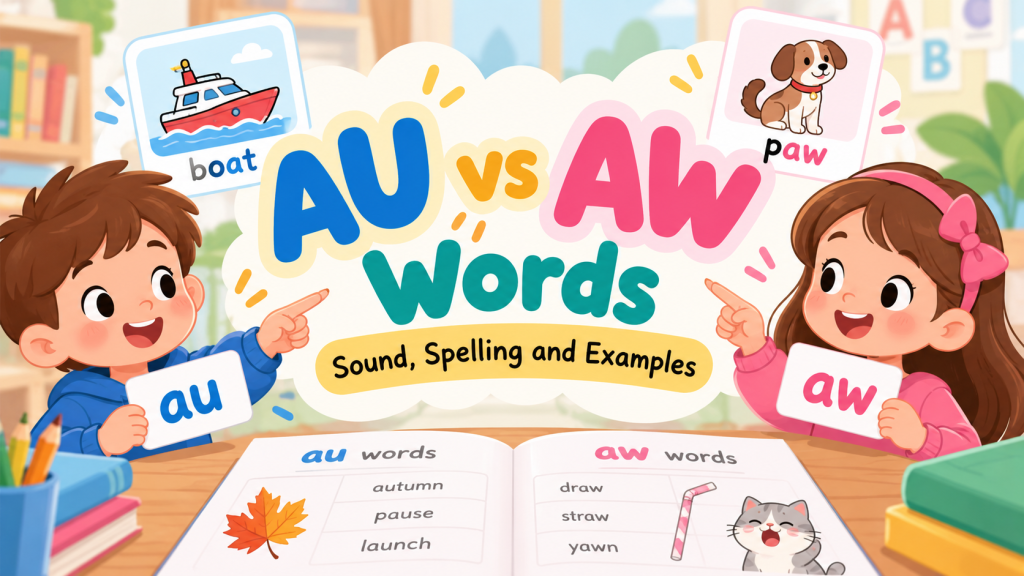
Why does saw use AW while pause uses AU? Both spellings can represent the same vowel sound, so listening alone may not tell a child which letters to write.
The main difference between au vs aw words is often where the spelling appears. AU commonly occurs inside words, as in author and fault. AW frequently appears at the end, as in saw and draw, but it also appears before consonants in words such as lawn.
These patterns give children a useful starting point rather than a rule without exceptions. Pronunciation also varies between English accents, even when the written word stays the same.
What is the difference between AU and AW?
AU and AW are two different vowel spellings that often represent the same sound within an English accent. In British English, words such as pause and saw commonly contain the vowel /ɔː/. In American English, the vowel may sound different depending on the speaker’s region.
Read pause and saw aloud using the pronunciation familiar in class. The vowels may match, although the spellings differ. This is why children cannot reliably choose AU or AW by sound alone.
A more useful question is: Where do the vowel letters appear in the word? Once children notice that pattern, they can compare familiar words rather than guessing which two letters to use.
Compare common AU and AW words
Small word groups make the spelling difference easier to see. Instead of memorizing two long lists, children can compare how similar vowel sounds are written in different positions.
AU words: commonly inside the word
AU appears near the beginning or middle of these words, with consonant letters following it.
Notice that pause and cause share the -ause spelling. Once children recognize this familiar pattern, they have another clue to use when reading or spelling similar words.
Other AU words look different. In author, autumn, and August, AU appears near the beginning, while fault and launch place it further inside the word.
Children who already recognize these patterns can use 2nd grade phonics worksheets for written review. Check the individual activity first, since the collection includes several advanced vowel patterns rather than only AU and AW.
AW words: at the end or before consonants
AW finishes the first four words. In the remaining examples, consonant letters follow AW.
The final-AW words are especially easy to compare visually. Saw, draw, and claw all end with the same two letters, although their beginning sounds differ.
Then look at lawn, dawn, and yawn. Each has AW before N. These examples show why AW should not be taught as an ending-only spelling.
After comparing the word groups, children who are ready for written spelling practice can work with familiar AU and AW examples. EnglishForKiz includes these patterns in its complex-vowels worksheet collection.
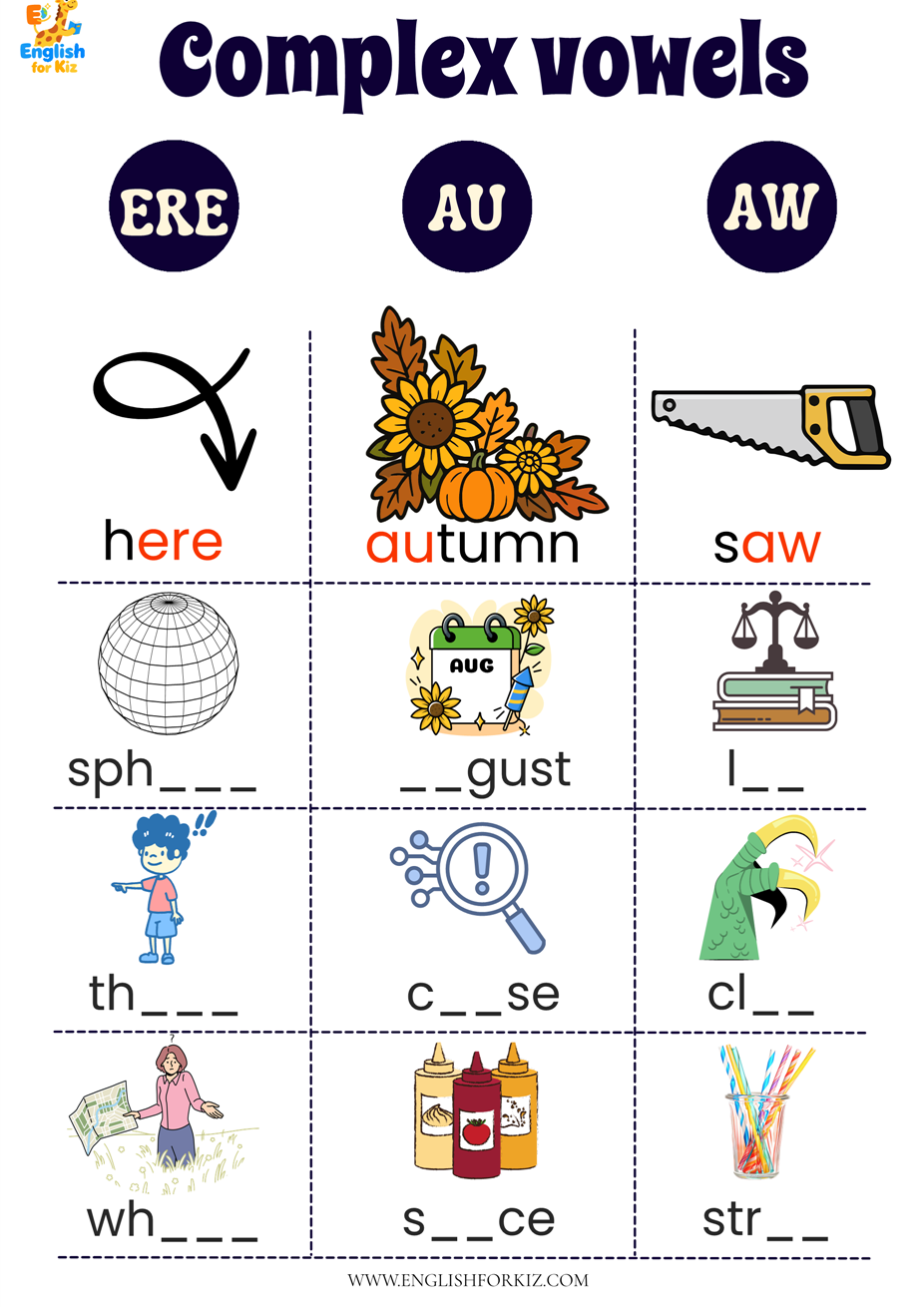
Complex Vowels: ERE, AU & AW
This EnglishForKiz worksheet combines illustrated word examples with missing-letter exercises. Children can revisit AU in words such as autumn and AW in words such as saw while connecting spelling with word meaning.
The worksheet also covers ERE, so it is better suited to children who are ready to review more than the two patterns discussed here.
Listed as VIP Exclusive. Check the current access and download conditions on the resource page.
View Worksheet CollectionUse position as a clue, not a guarantee
When children hear the target vowel sound at the end of a word, AW is a useful first guess. Inside a word, both spellings are possible. That is when comparing a familiar word, such as lawn or fault, becomes more helpful than relying on position alone.
However, lawn, dawn, and hawk show why position cannot decide every spelling. AW also appears before consonants, just as AU does in fault and pause.
Word families offer another clue. Knowing draw helps a child recognize AW in drawing. Knowing pause can also help a child notice the same -ause ending in cause.
Position helps predict; word knowledge confirms. Children can make a spelling choice from a familiar pattern, then check whether it matches the actual word. Neither AU nor AW has a position rule that identifies every spelling correctly.
When an unfamiliar word causes difficulty, comparing it with two or three known examples is often more productive than introducing another long list of exceptions.
Look at the missing letters and read the clue. Choose AU or AW before opening each card to check your answer.
WORD 01 p__se Stop something for a moment.
WORD 02 cr__l Move slowly on hands and knees.
WORD 03 h__nt A ghost might do this to a house.
WORD 04 p__ A cat has one on each foot.
Match the pronunciation model used in class
AU and AW often represent the same vowel within an accent, but that vowel is not pronounced identically by every English speaker. British and American dictionaries may show different phonetic symbols for the same written word.
For example, Cambridge Dictionary gives the British pronunciations /pɔːz/ for pause and /sɔː/ for saw. Its American pronunciations use /ɑː/ in both words, although regional accents can differ.
Some Americans pronounce cot and caught alike; others keep their vowels distinct. The spelling of caught does not change because of that difference.
For phonics activities, follow the pronunciation model children hear during classroom instruction. If a child hears another established pronunciation at home, acknowledge the difference rather than treating the home accent as an error.
A learner’s dictionary with regional audio can help when a word is unfamiliar. Compare examples within one pronunciation model instead of presenting a single IPA transcription as universal.
Practise a focused spelling choice
Once children can recognize a few AU and AW words, a short sentence activity helps reveal whether they remember the spellings without depending entirely on the vowel sound.
Read each sentence, identify the missing word, and choose the vowel spelling.
- I s__ a bird outside.
- The grass grows on the l__n.
- It was not your f__lt.
- Please dr__ a picture.
- Please p__se the video.
- The sun rises at d__n.
Show the answer key
1. saw — AW at the end.
2. lawn — AW before N.
3. fault — AU before L.
4. draw — AW at the end.
5. pause — AU inside the word.
6. dawn — AW before N.
If saw and draw are correct but lawn and dawn are difficult, revisit the AW-before-N group. If pause causes trouble, compare it with cause so the shared spelling becomes easier to notice.
There is no need to add more words immediately. Read the missed examples aloud, write them again, and check the answers before moving to a new activity. For repeated spelling difficulties across different tasks, the EnglishForKiz guide to understanding phonics worksheet errors offers ways to identify what needs a closer look.
FAQ
Can AW appear before a consonant?
Yes. AW appears before consonants in words such as lawn, dawn, yawn, and hawk. Although final AW is common, the spelling is not limited to word endings.
Do AU and AW sound identical in every accent?
No. Both spellings often represent the same vowel within an accent, but vowel quality differs across English varieties. British, American, and regional pronunciations may not match exactly.
How should a child check an unfamiliar AU or AW word?
Start by noticing the spelling position and comparing the word with a familiar example. Then check its conventional spelling in a reliable dictionary or classroom word list. Dictionary audio can also help when pronunciation is uncertain.
Understanding au vs aw words becomes easier when children connect the vowel sound with spelling position and familiar word groups. AU commonly appears inside words, while AW frequently finishes words or appears before certain consonants. Neither clue works for every example.
Use the short exercise to see which group deserves another look. Once the words are familiar, children can practise recognizing the patterns in a new format without changing the spelling conventions they have learned.
Ready to recognise vowel patterns in a game?
After checking the spelling activity, children who can already recognize AU and AW may be ready for interactive word review. The EnglishForKiz second-grade games library includes a VIP complex-vowels activity covering AU, AW, AL, and ALL. Choose it only when those additional patterns are appropriate.
Explore Complex Vowel Games