
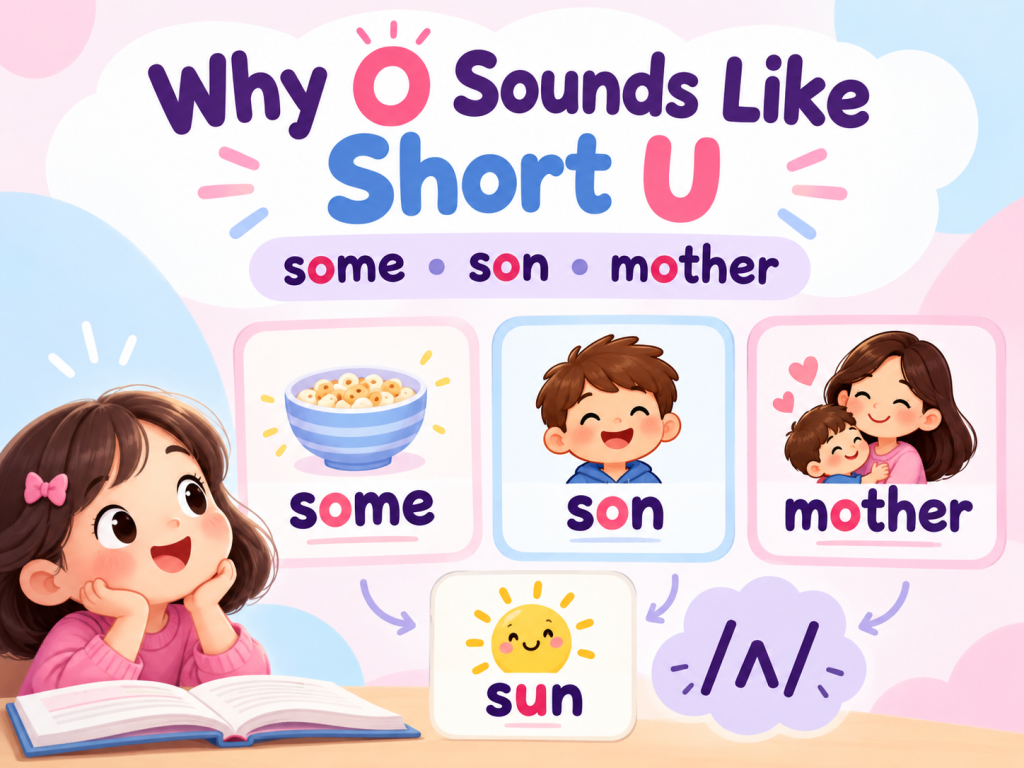
A child who confidently reads hot may stumble over some. The O looks familiar, so they try the short-O sound they already know. But in some, son, and mother, the letter O represents /ʌ/—the vowel usually taught as short U in sun and cup.
When O sounds like short U, the useful lesson is not a new rule for every O word. It is learning that a small group of common words shares a familiar sound despite an unexpected spelling. A few carefully chosen comparisons can make that connection clearer.
Why can O sound like short U?
English vowel letters do not always represent the same sound. O often has the familiar short-O pronunciation in words such as hot and top, but in certain common words it represents /ʌ/. That is the same vowel heard in sun, run, and cup in standard American and British English.
01 · A FAMILIAR WORD some /sʌm/ Tap to see it in a sentence
02 · SAME SOUND, NEW SPELLING son /sʌn/ Tap to reveal the match
03 · A LONGER WORD mother /ʌ/ · first syllable Tap to read an example
The first vowel in mother also has /ʌ/. In American English, the whole word is commonly transcribed /ˈmʌðər/; in British English, /ˈmʌðə/. Hear each word spoken naturally first, then notice its written O.
How the O in Some Differs from the O in Hot
Say hot, top, and pot aloud. These are familiar examples of the conventional short-O spelling. Now say some and son. The vowel has changed even though the written letter is still O.
Son and sun are particularly useful because they sound alike but have different spellings and meanings. Compare them without showing pictures first. Then reveal the letters, say each word, and ask which vowel letter appears in the middle.
For children who still confuse the two familiar vowels before encountering unusual O spellings, the EnglishForKiz guide to teaching short O and short U separately offers a more foundational comparison.
Short-O pronunciation itself varies by accent: hot is often transcribed /hɒt/ in British English and /hɑːt/ in American English. The teaching point is the contrast with /ʌ/, not forcing every child to copy one accent.
When children need to revisit familiar vowel sounds on paper, the EnglishForKiz phonics worksheets collection can be browsed by skill. Choose a suitable activity only after checking which words and spelling patterns it actually covers.
Learn a small group of O-to-/ʌ/ words
These familiar O as short U examples are enough for a first comparison.
Start with short, familiar words
Some and come look similar at the end, and both use /ʌ/. The same vowel appears in son, done, and love, even though the letters around O are different.
“Come and sit with us.”
“My son has done his work.”
“We love this story.”
Notice the sound in longer words
The O also represents /ʌ/ in the first syllable of mother and brother, and in familiar words such as money and month. Say them slowly once, then at a natural speaking pace. The sound stays recognizable even when another syllable or consonant follows it.
Try: “My mother has some money.” Then read: “My brother will come home.” The second sentence introduces an important contrast: come has /ʌ/, but home does not.
If the unfamiliar O is still distracting, it helps to check the vowel children already know. The following genuine EnglishForKiz preview uses the ordinary U spelling in sun, so it works as a sound reference—not as a substitute for practising some and mother.
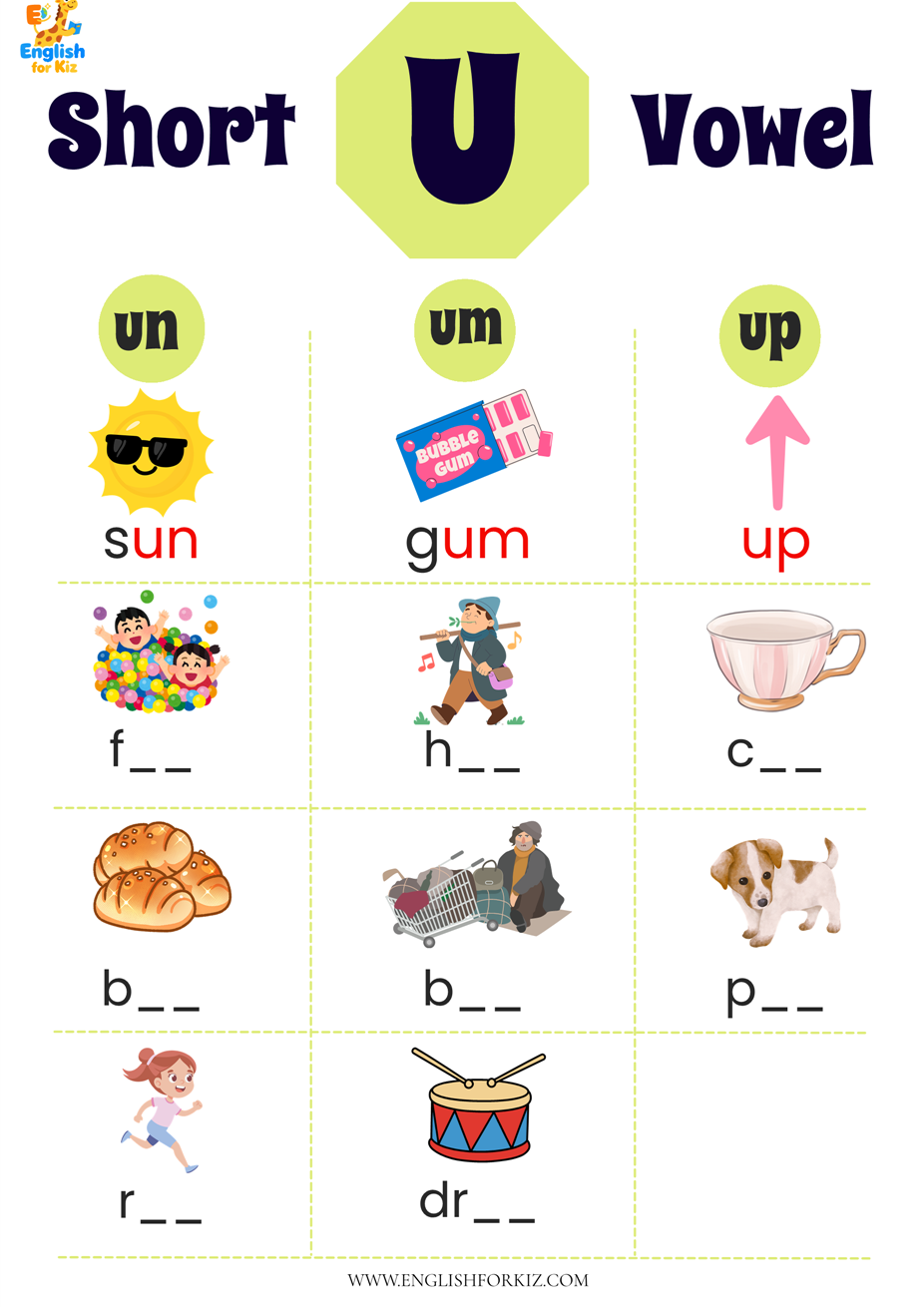
Short U Word Families: -un, -um and -up
This actual EnglishForKiz worksheet preview includes sun, gum, and up. It reinforces the familiar /ʌ/ sound spelled with U, giving children a clear reference before they compare sun with son.
This is Short U word-family practice, not a dedicated worksheet on O-to-/ʌ/ exceptions. The resource is marked VIP Exclusive on the site; review current access requirements before choosing it.
View Short U Worksheets →Do spelling clues predict every example?
No. The letters next to O can offer something to notice, but they do not create a dependable rule for every word. Come and home share the ending -ome, yet their vowels sound different. Son uses /ʌ/, while on does not in standard British or American English.
Read a familiar O-to-/ʌ/ word as a known spelling-and-sound match. For a word the child has not heard before, do not guess that O says /ʌ/ simply because M or N follows it. Model the pronunciation or check a reliable learner’s dictionary.
Say each pair aloud, then choose one word to reveal a short explanation. The spelling alone will not always tell you the answer.
Accent and sentence stress matter too. When some is stressed or read on its own, it is pronounced /sʌm/. When it is an unstressed determiner before a plural or uncountable noun, it commonly takes the weak form /səm/, with schwa /ə/. This is a normal feature of connected speech, not a rule that changes how O is pronounced in other words.
Check the word in a sentence
A sentence gives a child enough meaning to distinguish words such as son and sun, but meaning should confirm the reading—not replace looking closely at the letters. Use the word bank below to complete each sentence. Read the sentences naturally, then say each chosen word on its own to hear its full form. In “some apples,” for example, some commonly takes the weak form /səm/.
Which word belongs in the sentence?
- The is shining in the sky.
- Her is learning to read.
- Please and sit beside me.
- My is making lunch.
- We have apples in the basket.
- I reading stories with my family.
Reveal the answers and check the sounds
- sun — U represents /ʌ/.
- son — O represents /ʌ/.
- come — O represents /ʌ/.
- mother — The first O represents /ʌ/.
- some — O represents /ʌ/ in its strong form /sʌm/. Before a plural noun such as apples, the weak form /səm/ is common.
- love — O represents /ʌ/.
Notice: son and sun have the same spoken form but different spellings and meanings.
If several answers are difficult, return to some, son, and mother and read them in new sentences. If the words are secure, changing the sentence provides a better check than repeatedly reading the same list in the same order. If reading is accurate but spelling remains difficult, see why reading a familiar word and spelling it can require different checks.
FAQ
Are son and sun homophones in every accent?
They are homophones in standard British and American English, both pronounced /sʌn/. Speech differs across dialects, however, so it is better not to make an absolute claim about every accent.
Does every O before M or N say /ʌ/?
No. Some, come, and son contain /ʌ/, but home and on have different vowels. M or N after O is not a reliable pronunciation rule.
Should these words be memorised without looking at their sounds?
No. Help the child connect each spoken sound to its written letters. Short comparisons and sentence reading build awareness of the unusual O spelling without relying only on a word’s visual shape.
The main idea is simple: some, son, and mother contain an O that represents the familiar /ʌ/ vowel. That does not mean every O makes this sound. Hearing a known word, noticing its spelling, and comparing it with sun or cup gives early readers a useful way to understand the difference.
Choose practice that matches the sound
Finish the sentence activity and check the answers first. For paper-based review, explore the available worksheet collection and choose resources by the sound or spelling skill the child currently needs. The collection should not be assumed to include a dedicated activity for every unusual O word.
Explore Printable Phonics Worksheets →If these words still feel unfamiliar, revisit the examples in this article before moving to a new activity.