
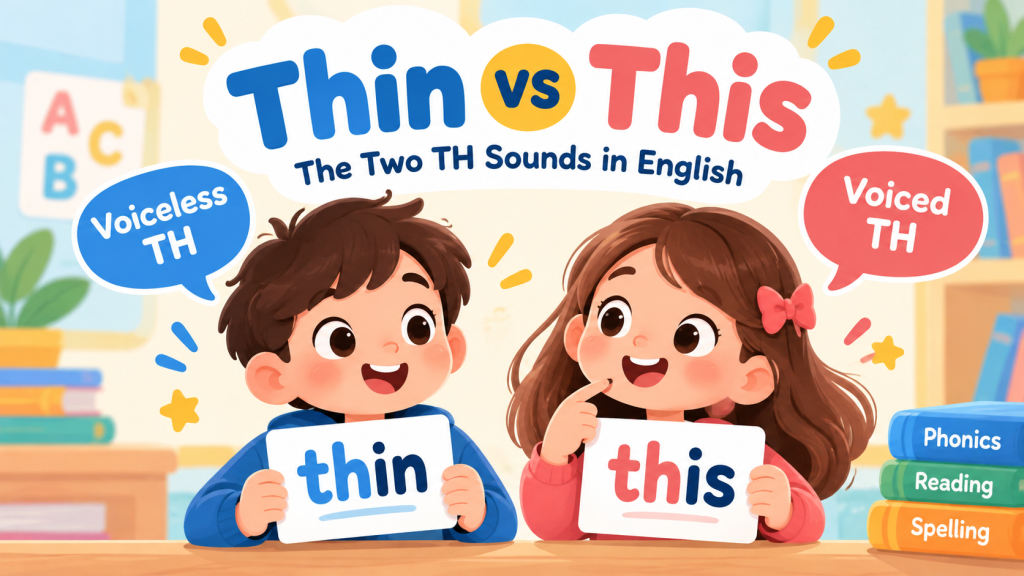
A child reads thin and this as though they begin with the same sound. The letters match, so why does the pronunciation change?
English has two common TH sounds: voiceless /θ/ as in thin and voiced /ð/ as in this. The mouth position is similar, but the vocal folds vibrate for /ð/ and not for /θ/. Hearing that difference is the key to understanding voiced and voiceless th.
What are the two TH sounds?
TH is a consonant digraph: two letters that usually represent one consonant sound. In thin /θɪn/, the first sound is voiceless. In this /ðɪs/, the first sound is voiced. They are useful examples, although they are not a minimal pair because their final sounds differ too.
Voiceless TH/θ/thinA gentle, airy soundTap for a pronunciation tip +
Voiced TH/ð/thisAirflow with a quiet buzzTap for a pronunciation tip +
Recognizing TH in print does not always mean hearing its two pronunciations. After introducing the sounds, EnglishForKiz offers 1st grade phonics worksheets. Choose the activity by skill, not grade alone.
Keep the mouth position similar and change voicing
For both TH sounds, the tongue comes close to the upper front teeth. It may touch them lightly or sit just between the front teeth as air passes through a narrow opening. Linguists call these sounds dental fricatives. Do not push or bite the tongue.
Try saying only the beginning of thin, holding /θ/ for a moment. Then hold the beginning of this, /ð/. Rest two fingers lightly against the throat. The voiced sound may create a small buzz; the voiceless sound should not. Keep the first sound separate from the vowel.
A mirror shows tongue placement, not voicing. Some dialects pronounce TH differently; this comparison follows common standard American and British pronunciations.
Sort familiar TH words by what you hear
Start with familiar words. Sort them by the sound heard in thin or this, then listen for TH within words.
Airy TH /θ/
thin · think · three · thumb · thank · teeth · bath · thick
The TH sound may come at the beginning or end.
Buzzing TH /ð/
this · that · these · those · they · them · mother · father
It also appears inside familiar words.
The position of TH is not a dependable rule: mother has /ð/ in the middle, while nothing has /θ/ there. Compare pronunciations rather than guessing from nearby letters.
For an unfamiliar word, compare reliable dictionary audio with the familiar groups, choosing the accent being taught.
Fix common substitutions without forcing the sound
A child might read tin for thin or dis for this. Another child might use an /f/ or /v/ sound. Some substitutions reflect the language variety heard at home.
For tin versus thin, compare the stopped /t/ with the flowing /θ/. For dis versus this, demonstrate the voiced, flowing /ð/ instead of the brief /d/. If /f/ or /v/ appears, draw attention to the tongue near the teeth rather than the lip against the teeth.
Keep the correction brief and meaningful. Say this book while pointing to a book, or describe three thin sticks while counting. Then return to the sentence. Avoid interrupting every sentence.
Recognizing words and producing speech are different skills. A qualified speech-language professional can assess broader clarity concerns; phonics practice is not a diagnosis.
For a listening check, ask an adult to say each word while the child looks away from the screen. Then choose the TH sound you heard. Practicing alone? Say the word aloud before choosing. You can change your answer.
Read short phrases and check the contrast
Once the child can distinguish the two TH sounds in individual words, move on to the short phrases below. Read each phrase aloud and listen for /θ/, /ð/, or both.
Read each phrase before opening the answer key. An adult can also say it first while the child listens without looking.
- Three thin sticks
- This is their bag
- Those are my teeth
- Thank them for that
Reveal the answers and explanations
1. Three and thin both begin with voiceless /θ/.
2. This and their both begin with voiced /ð/.
3. Those begins with voiced /ð/; teeth ends with voiceless /θ/.
4. Thank begins with voiceless /θ/; them and that begin with voiced /ð/.
If the third or fourth phrase was difficult, reread it slowly and focus on one TH word at a time. Then say the whole phrase naturally. Revisit thin and this before adding more words. Once those sounds are familiar, the guide to using phonics games after direct teaching can help you decide whether playful review is useful.
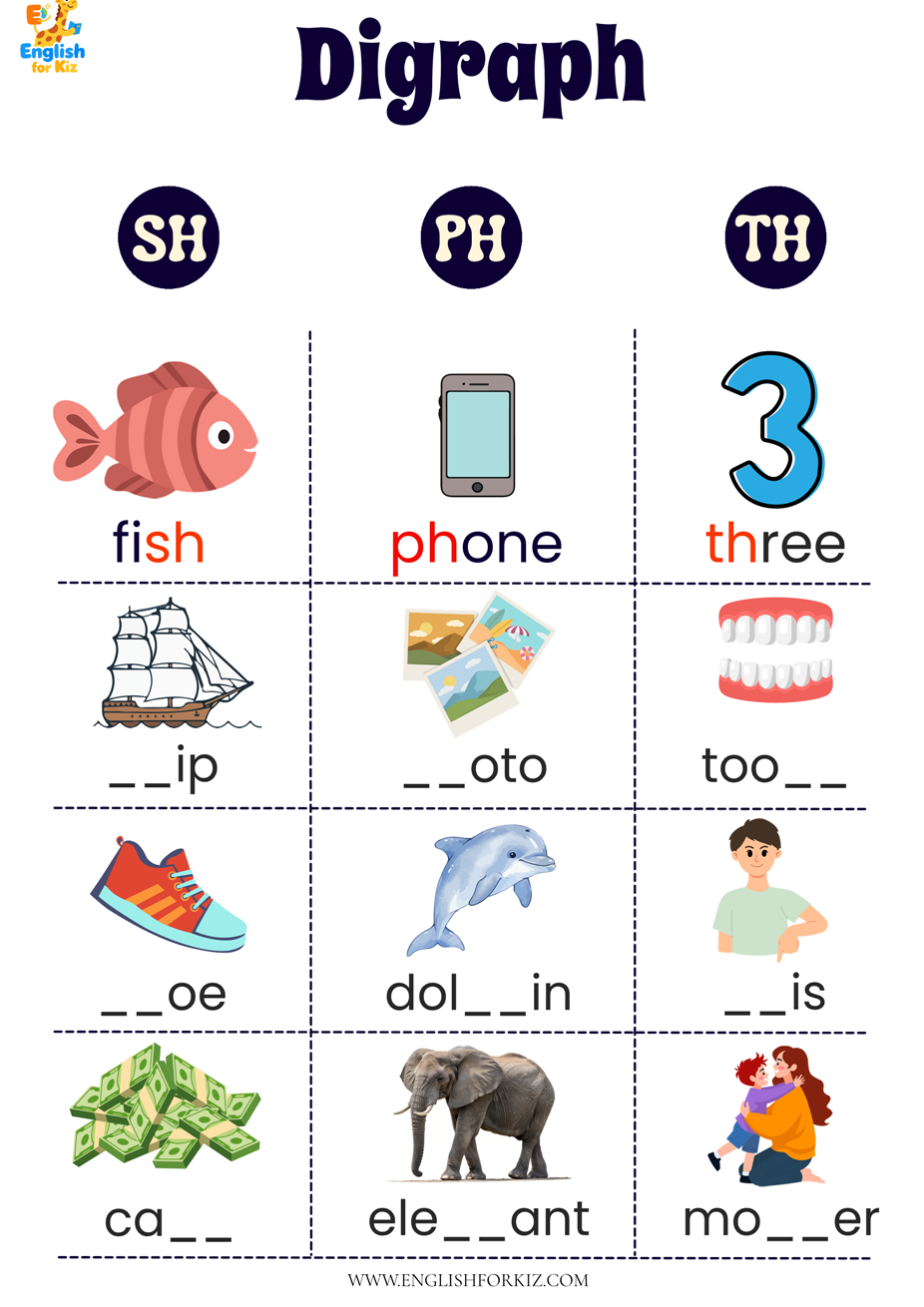
From hearing TH to recognizing its spelling
The EnglishForKiz first-grade collection includes a Consonant Digraphs (sh, ph, th) worksheet. In the TH column, three appears alongside spelling prompts for this and mother—familiar words from this lesson.
The page supports recognizing and completing digraph spellings; it is not a dedicated /θ/–/ð/ pronunciation lesson. Listen to the two TH sounds first, then use the printable for written review.
Explore WorksheetsThe worksheet is marked VIP Exclusive on the collection page. Check current access and download conditions there.
FAQ
Can TH be voiced in the middle of a word?
Yes. TH is voiced /ð/ in mother, father, and brother. But nothing has voiceless /θ/ in the middle, so position alone does not determine the sound.
Does TH spelling alone tell me which sound to use?
No. Both sounds are written TH. Familiar word groups and dictionary audio are more useful than relying only on the spelling.
Should a child stop reading if the TH sound is not yet clear?
Not necessarily. If the word is understood, finish the sentence and revisit the pronunciation afterward. Clear speech production and successful word reading do not always develop at the same pace.
Keep the contrast simple
In thin, TH is airy /θ/. In this, TH is voiced /ð/. Keep the tongue in a similar position, listen for the buzz, and use a few familiar words to check what the child hears.
After the short practice, review any confusing phrases once more. For optional written work, explore the first-grade collection and select a digraph activity only if it matches the skill being learned.