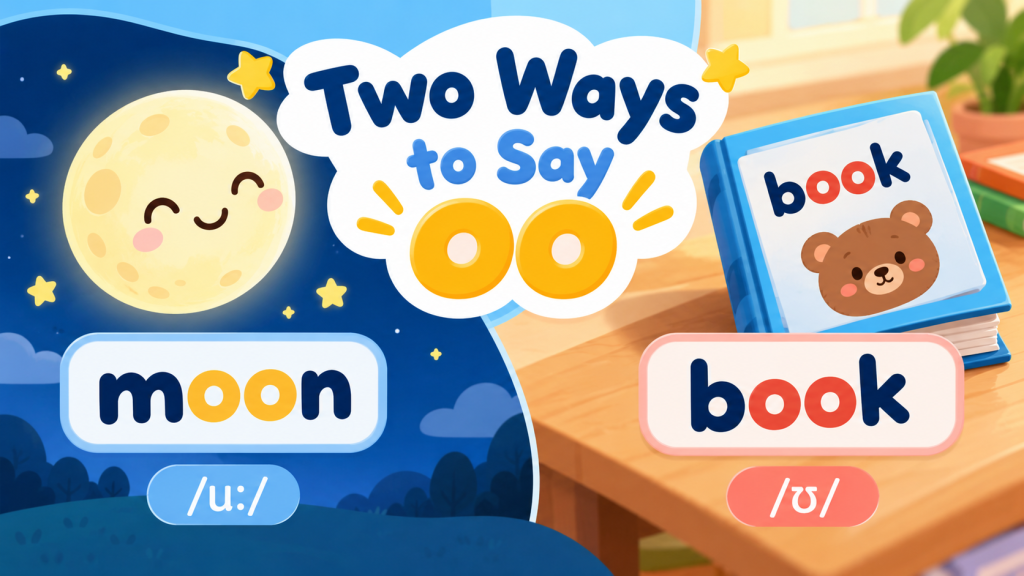
Why do moon and book sound different when both contain OO? In common American and British pronunciations, moon has /uː/, while book has /ʊ/. The spelling looks the same, but the vowel sounds are different.
A child who has learned OO through moon may use that sound for every new OO word. It works for spoon, but not for look or cook. Comparing the two sounds helps children understand why a familiar spelling doesn’t always produce the pronunciation they expect.
The OO words moon and book make a useful starting pair. From there, children can build small sound groups, listen for the difference, and check unfamiliar words without relying on an absolute spelling rule.
Why do moon and book have different OO sounds?
The letters OO can represent more than one vowel. In moon, they represent /uː/, often called the long OO sound in phonics lessons. In book, they represent /ʊ/, commonly called the short OO sound.
Usually held longer
Usually shorter
Say the words aloud. The difference isn’t just how long the vowel lasts. The tongue and lips also change position, producing a different vowel quality. Stretching the vowel in book doesn’t automatically turn it into the sound in moon.
English spelling has developed over time, and the same letters don’t always represent the same pronunciation. There isn’t a dependable rule that lets a beginning reader identify every OO sound from its spelling alone. Familiar spoken words provide a better reference.
Build two small OO word groups
Rather than introducing a long list, start with a few familiar words. Children can hear what the words have in common before studying their written forms.
OO as /uː/ in moon
Begin with moon–spoon, which share both a sound and an ending. Then compare food and pool, whose spellings differ beyond OO.
OO as /ʊ/ in book
The shared ending in book–look–cook is easy to notice. Good and foot belong here because of their vowel sound, not their ending.
A particularly useful comparison is food versus good. Both contain the spelling -ood, but they belong to different sound groups. That makes it clear why children shouldn’t rely on the letters after OO alone.
Once a child can distinguish the groups aloud, written practice can help connect the sounds with their spellings. The EnglishForKiz 2nd grade phonics worksheets collection includes variant-vowel material. Select practice according to the vowel patterns the child already knows, rather than assuming that a grade label guarantees readiness.
Practice the book sound on paper
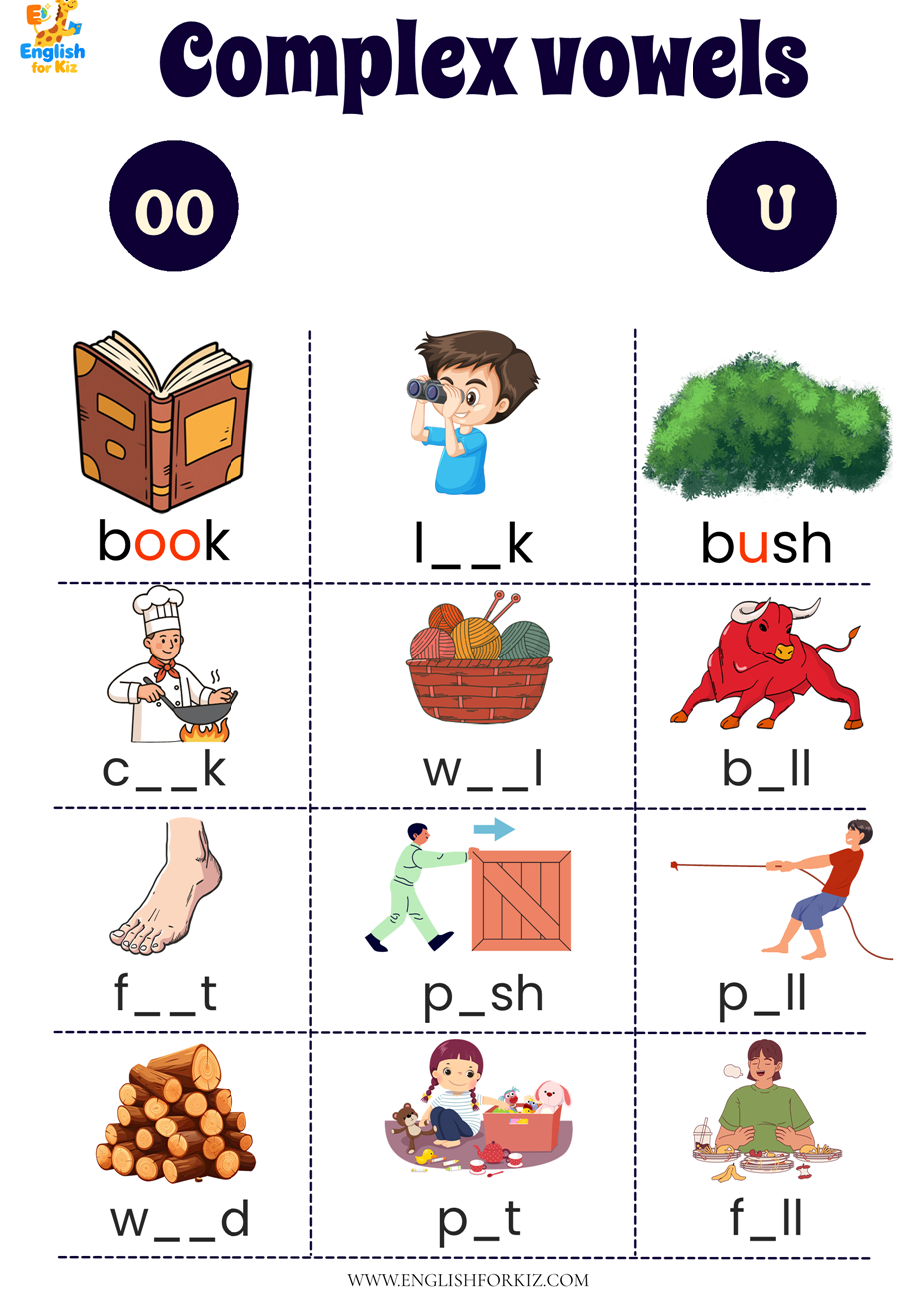
This EnglishForKiz worksheet features words such as book, look, cook, foot, and wood, alongside U-spelling examples including bush and push.
It’s a useful follow-up for children reviewing the /ʊ/ sound. The pictured worksheet doesn’t teach both OO groups as a side-by-side comparison, so keep the moon versus book listening activity in this article for that purpose.
Listed as VIP Exclusive. Check current access and download requirements on the resource page.
View OO and U WorksheetListen to vowel quality as well as length
The easiest way to introduce the contrast is to say the two vowels naturally. In many common English accents, both vowels are made with rounded lips. For /uː/ in moon, the tongue is higher and the vowel is tenser; for /ʊ/ in book, the tongue is slightly lower and the vowel is more relaxed.
Try saying pool–pull. The consonants stay the same while the vowel changes, making the difference easier to hear. You can also compare food–foot to practise the two OO sounds, although their final consonants differ as well. Although pull is spelled with U, it helps isolate the /ʊ/ sound without depending on OO spelling.
Same letters. Which vowel?
Read each word aloud. Decide whether its vowel matches moon or book, then tap the word to reveal the answer.
food
good
pool
foot
This is a read-and-reveal activity, not audio playback. An adult can say the words first if the child is practicing listening rather than decoding.
Listening tip: Say each pair at a normal speaking pace before slowing down. Exaggerating the vowels too much can make them harder to recognize in ordinary speech.
These descriptions are approximate because pronunciation varies across English accents. American and British dictionary pronunciations commonly distinguish /uː/ and /ʊ/, but the precise vowel quality and duration can vary. The goal is to recognize the contrast in the model being used, not to make every child imitate one accent.
What should a child do with an unfamiliar OO word?
Imagine a child reading wood for the first time. They may try the sound from moon, because that is the OO pronunciation they already know. It’s a reasonable first attempt, but in common American and British English, wood contains /ʊ/, like book.
Model the correct word, compare wood–book, and then let the child read it again in the sentence. A learner’s dictionary recording is helpful when neither adult nor child knows the pronunciation.
Sentence context can help confirm meaning, but it cannot reliably determine which vowel an unfamiliar spelling represents. When a child guesses from the surrounding sentence instead of reading the letters, return to the printed word and compare it with the spoken model.
Not every OO word belongs in the two groups shown here. Blood and flood, for example, commonly contain /ʌ/, as in cup. These are useful reminders that two common OO sounds are not the only possible OO pronunciations.
There’s no need to mix every exception into a beginner’s first practice session. Start with the familiar groups, then introduce other pronunciations as children encounter those words in reading.
Try a listening and reading check
A short check can show whether the difficulty is hearing the two vowels or connecting them with written words. For Part 1, have an adult read the words aloud while the child listens without looking at the printed list. Cover the list or use a separate copy so the child cannot rely on the spelling.
Part 1: Listen and choose
Which words have the vowel in moon, and which sound like book?
cook · foot · food
Part 2: Read and sort
Now show the child these written words. Ask them to read each one aloud and say which group it belongs to, or write it under the matching heading on a separate sheet.
moon · food · good
For a final comparison, ask why food and good belong in different groups despite their similar spelling.
Show the listening and reading answers
Part 1 — Moon /uː/: spoon, pool, food.
Part 1 — Book /ʊ/: good, cook, foot.
Part 2 — Moon /uː/: school, moon, food.
Part 2 — Book /ʊ/: look, book, good.
Food and good share -ood, but the vowel sounds are different.
If listening is accurate but reading is uncertain, revisit the written examples. If the child struggles with both, return to just moon and book before trying the full set again. The next activity should follow the skill that needs review.
FAQ
Are /uː/ and /ʊ/ different only in length?
No. They also differ in vowel quality. The /uː/ in moon generally has a higher, tenser tongue position, while /ʊ/ in book is more relaxed. Length alone doesn’t reliably distinguish them.
Can OO have another pronunciation beyond these two?
Yes. Blood and flood commonly have /ʌ/, as in cup. The two groups in this article cover common pronunciations, not every possible OO word.
Why do some OO words sound different across accents?
Accents differ in vowel quality, duration, and sometimes individual word pronunciations. Some regional northern English speakers, for instance, pronounce book with /uː/. A dictionary recording with a specified accent provides a consistent reference for practice.
The important lesson from comparing the OO words moon and book is that matching letters don’t always mean matching sounds. Children can use familiar words as pronunciation guides, listen for the vowel, and check unfamiliar words when their first attempt doesn’t fit.
Before moving on, repeat the short listening and reading check. Reviewing the group that still causes confusion is more useful than adding another long word list.
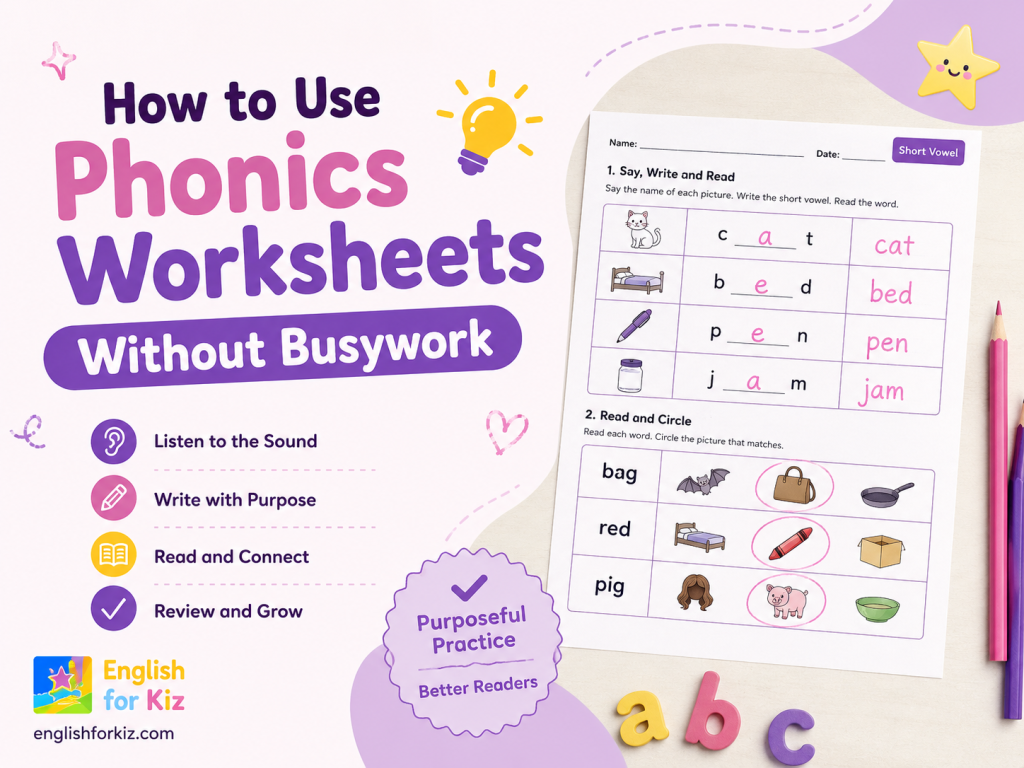 Written PracticeHow to Use Phonics Worksheets Without BusyworkMake the next page purposeful: connect the sound a child hears with what they read and write.Read the guide
 Choosing PracticePhonics Games vs Worksheets: Which Should Come First?Decide when another spoken sound check makes more sense than written spelling practice.Read the guide
Choose practice for the sound that needs review
After the listening and reading check, choose the next activity according to the child’s current skill. The EnglishForKiz second-grade collection includes variant-vowel worksheets and other spelling-pattern practice.
Review each worksheet’s target sounds and access requirements before choosing it. If the two OO groups are still unfamiliar, return to the word examples above before adding more written work.