
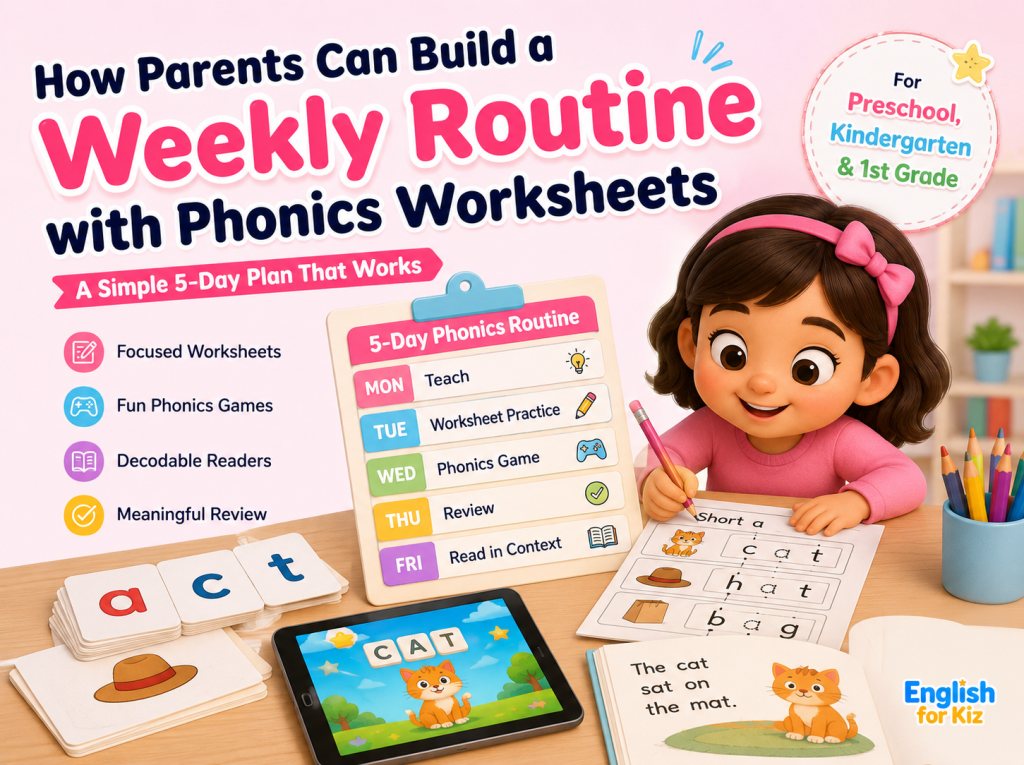
A weekly routine works best when phonics worksheets support one clearly taught skill instead of becoming a stack of unrelated printables. Five short sessions can move a child from hearing a pattern to practicing it, recalling it through play, and reading it in connected text.
This guide is for parents, teachers, and homeschool families working with preschool, kindergarten, and first-grade learners. It provides a Monday-to-Friday sequence, stage-specific examples, practical stopping points, and a clear way to choose between printables, games, readers, and a connected membership path.
Start by Identifying One Weekly Phonics Goal
A strong week begins with a target that can be named in one sentence. “Practice reading” is too broad because it does not show which sound, spelling pattern, or reading behavior needs attention. A goal such as “hear words beginning with /m/” or “blend short a CVC words” leads to better material choices.
The target should come from recent reading behavior. A child may know many letter names but hesitate over their sounds. Another may say /m/ /a/ /p/ correctly yet struggle to blend the sounds into map. Those children need different routines, even when they are close in age.
Preschool goals usually center on listening, letter recognition, and beginning sounds. Kindergarten goals often involve short vowels, CVC blending, word families, and simple spelling. First-grade goals may include consonant blends, digraphs, long vowels, or applying a familiar pattern in sentences.
Use a three-question check before choosing the skill
Begin by asking what the child can already do without help. Next, identify where the reading process breaks down. Finally, choose the smallest teachable step that would make the next reading task easier.
- If sounds are confused, begin with listening and letter-sound matching.
- If sounds are accurate but remain separate, choose oral and printed blending.
- If words can be read but not spelled, add letter building and short dictation.
- If word lists feel easy, move the same pattern into phrases or a suitable reader.
Once the goal is clear, gather only the materials needed for that pattern. One short teaching prompt, one focused page, one game, one review activity, and one reading selection create enough variety for a full week. Collecting more resources rarely improves a plan that lacks a precise target.
By Friday, the child will blend unfamiliar short a words and recognize the same vowel pattern in a short passage.
A Five-Day Routine
The most useful weekly sequence gives each day a separate purpose. Monday introduces the skill. Tuesday turns it into guided print practice. Wednesday strengthens recall through play, Thursday checks whether the learning remained, and Friday applies it during reading.
Make one sound or spelling pattern visible through direct modeling.
Use one page that repeats the taught pattern without adding a new rule.
Retrieve the same sounds or words through a focused game.
Mix familiar examples with a few fresh words that follow the pattern.
Find and decode the pattern inside connected text.
Monday makes the pattern visible
Monday should be brief and direct. Say the target sound, show the letter or spelling pattern, and model two or three examples. For short a, letter cards can form map, mat, and man while one letter changes at a time.
A digraph needs a different explanation. In ship, the letters s and h work together, so both letters can be underlined as one sound unit. The lesson should end after the child successfully tries a small number of examples.
Tuesday gives the worksheet a clear job
The selected page should practice Monday’s target rather than introduce a second lesson. Before independent work begins, complete one item aloud. This quick model separates difficulty with the directions from difficulty with the phonics skill.
When a page contains many items, choose the section that gives enough evidence. Six careful responses can be more useful than twenty rushed answers. Afterward, ask the child to read several completed words so the task returns to spoken language.
Wednesday changes the energy, not the goal
Midweek review can use cards, letter tiles, a word hunt, or one of the EnglishForKiz phonics games. The game should require the target sound or word to be heard, identified, blended, or read. A child who can win through picture guessing is not practicing the intended decoding behavior.
For a no-prep option, place eight word cards face down. Each card is kept after a correct blend. Younger learners can use picture cards and name the beginning sound before placing the card under a matching letter.
Thursday checks what remained
Start with two examples seen earlier in the week. Then add two new words that follow the same pattern. New examples reveal whether the child understands the sound-spelling relationship or simply remembers a previous list.
Letter tiles work well when handwriting slows the session. Say a word, stretch the sounds, and ask the child to build it before writing it once. For sentence practice, one controlled line such as “The fish is in the dish” is enough to connect a digraph with meaning.
Friday brings the skill into reading
Choose one of the EnglishForKiz decodable readers that includes patterns the child has already learned. Preview only genuinely untaught words or unfamiliar names. Rehearsing every target word beforehand can turn reading into memory rather than decoding.
After the passage, use one small response. The child might find three target words, reread a favorite line, draw one event, or write a short caption. Friday is not a formal test; it shows whether the week’s practice transfers into connected text.
Build This Week’s Practice Path
Each resource below has a different job. The page supports careful written practice, the game refreshes recall, and the reader shows whether the pattern can be used in real reading.
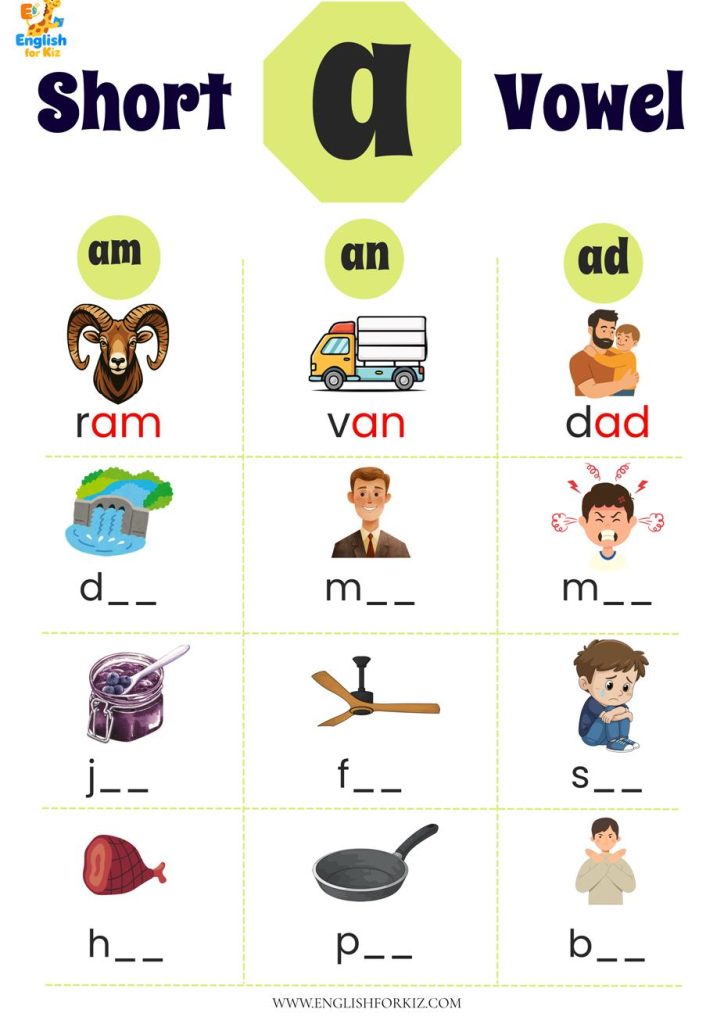
Practice the Weekly Pattern
Best when one sound, vowel, word family, or spelling pattern needs focused paper-based practice.
Browse Worksheets
Review It Through Play
Best after direct teaching when the same skill needs another round of active, focused retrieval.
Explore Phonics Games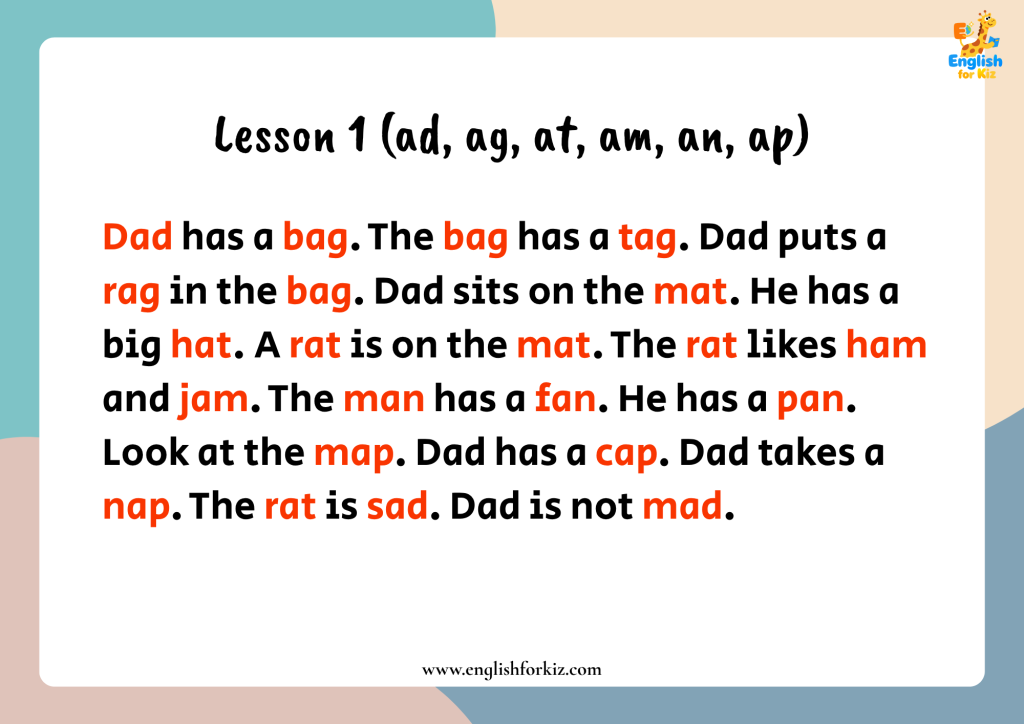
Apply It in a Reader
Best when the child can blend target words and is ready to meet them inside sentences and connected text.
Find a Decodable ReaderSample Routines for Preschool, Kindergarten and 1st Grade
Grade labels offer a starting point, but the child’s current reading behavior should make the final decision. A preschool learner who already blends simple words may need kindergarten-level practice. A first grader who still confuses basic sounds may benefit from a shorter foundational routine.
| Learning stage | Suitable weekly target | Best practice format | Ready to move on when |
|---|---|---|---|
| Preschool | Hear and match one or two beginning sounds | Objects, picture sorts, oral games, light marking | The sound is identified in familiar and new spoken words |
| Kindergarten | Blend one short vowel across several CVC words | Letter tiles, focused pages, word chains, short readers | An unfamiliar word with the same vowel can be blended |
| First grade | Read and compare blends, digraphs, or long-vowel spellings | Pattern sorting, sentence work, dictation, connected text | The pattern transfers into new words and a short passage |
Preschool: Hear /m/ at the beginning
Keep most responses oral. Name each picture or object before asking for the sound, since unfamiliar vocabulary can hide what the child actually knows.
- Monday: Compare moon, mug, map, and sun.
- Tuesday: Sort /m/ and non-/m/ pictures.
- Wednesday: Hunt for /m/ objects nearby.
- Thursday: Review with a mystery bag.
- Friday: Find /m/ words in shared reading.
Kindergarten: Blend short o words
Use words such as hot, log, fox, top, and sock. Keep the vowel stable while the surrounding consonants change.
- Monday: Build log, dog, and dot.
- Tuesday: Complete a short-vowel page.
- Wednesday: Play a change-one-letter game.
- Thursday: Spell four words and one sentence.
- Friday: Read a short o passage.
First grade: Compare long a spellings
Use a_e, ai, and ay in words such as game, rain, and play. The aim is to notice where each spelling appears.
- Monday: Sort example words by spelling.
- Tuesday: Choose patterns in written practice.
- Wednesday: Run a three-column card sort.
- Thursday: Read and mark one sentence.
- Friday: Find each pattern in a passage.
Homeschool families can spread the routine across four days by combining direct teaching with a small printable task. Shared-care households can use a simple handoff note listing the weekly goal, five example words, and the next activity. Consistent language matters more than identical teaching spaces.
Choose one page for the skill that needs attention now
The main worksheet library is the best starting point when the current need is specific: one letter sound, one short vowel, one word family, one blend, or one spelling pattern.
Explore Phonics WorksheetsHow to Keep Sessions Short and Focused
A short session needs a predictable shape. Begin with a quick review, spend most of the time on one activity, and finish with a successful reading or reflection step. This structure prevents a ten-minute plan from expanding into several unrelated tasks.
Preparation protects attention. Keep letter cards, pencils, counters, and the selected page in one small basket. When the activity starts immediately, more of the child’s energy remains available for listening and reading.
Limited choices can support cooperation. A child may choose between pencil and marker, cards and letter tiles, or table and floor. The weekly goal remains fixed, so choice changes the format without replacing the learning purpose.
Repeatedly leaving the task, answering from pictures without looking at print, or arguing over familiar items often signals that the useful learning window has closed.
Feedback should direct attention to one useful place. “Check the middle sound” or “Look at both letters” gives the child an action. Correcting every feature of a word, handwriting sample, and sentence at once makes the original skill difficult to see.
Finishing a page should not be the automatic goal. Stop after enough accurate practice, especially when the child has just corrected a difficult blend or read a sentence independently. A calm ending makes the next session easier to begin.
Track Progress Without Turning Home Practice into a Test
Home progress notes should answer one planning question: what is the next helpful step? Scores and long daily records are not necessary. A few words about independence, error patterns, and transfer provide more useful information.
Mark the highest stage observed by Friday. Reading and spelling may sit at different points. A child might read short a words correctly but omit the vowel during spelling, so the following week can add word building without returning to the beginning.
Use five small items instead of a formal quiz
A calm Friday check can include three practiced words, two unfamiliar words following the same pattern, and one short sentence. The unfamiliar examples matter because they show whether the child can apply the pattern beyond a memorized list.
One error should not change the whole plan. Look for a repeated behavior across several words. Frequent cap-for-cat substitutions may point to weak attention at the end of words, while declining accuracy near the end of a session may simply mean the routine is too long.
Keep occasional samples rather than every completed page. A dated worksheet, a short word list, or a brief reading record every few weeks can show progress. Notes such as “blends after one prompt” or “guesses when tired” lead directly to better decisions.
Adjust the Routine When a Child Struggles or Moves Faster
A routine should remain familiar while its difficulty changes. When a child struggles, reduce the learning load before adding more minutes. When the work becomes easy, deepen the same skill before jumping to an unrelated pattern.
When practice feels too hard
Check the prerequisite first. A child cannot blend a word reliably when one or more letter sounds remain uncertain.
- Return briefly to oral sound matching.
- Reduce the word set to three or four examples.
- Use letter tiles before handwriting.
- Mark digraphs or sound positions visually.
- Change the format while keeping the target.
When practice becomes easy
Use fresh examples to check transfer. Then add a deeper response instead of assigning a longer version of the same easy page.
- Introduce less familiar words with the pattern.
- Add a short phrase or sentence.
- Use two or three words for dictation.
- Compare the pattern with a known alternative.
- Reread a passage with smoother phrasing.
Repeat a weekly goal when new examples still require heavy prompting. However, change the words, game, or reader rather than repeating the exact sequence. Fresh materials preserve interest while giving the underlying pattern more time.
Move forward when the child can handle a new example and use the skill during reading. Perfect speed is not required. The more important sign is that the child looks through the word, uses the taught pattern, and repairs an error with less support.
Use EnglishForKiz Membership for One Connected Resource Path
Different resource types solve different problems. A printable page is suitable when one specific skill needs focused practice. A game helps when the same skill needs active review, while a reader checks whether it transfers into meaningful text.
When membership is the more practical next step
EnglishForKiz membership is most relevant when weekly planning regularly requires several connected formats rather than one isolated printable. It brings grade-level worksheets, games, video lessons, flashcards, songs, and readers into one resource path from Preschool through 2nd Grade.
That broader path does not mean using everything in one session. The weekly goal should still control the choice. A family may use one lesson, one page, one game, and one reader while leaving the remaining materials for later skills.
For a single practice need, begin with the focused resource page. For an ongoing home, classroom, or homeschool sequence, membership offers the clearer place to continue.
Related Reading
FAQ
How many days a week should children use phonics worksheets?
Two focused printable sessions are often enough within a five-day routine. The other days can use direct teaching, oral blending, games, word building, and connected reading. More pages are only helpful when they remain short and continue serving the same weekly target.
How long should a home phonics session last?
Preschool practice often fits within five to ten minutes. Kindergarten sessions commonly last ten to fifteen minutes, while many first-grade learners can manage fifteen to twenty minutes. Attention and emotional readiness matter more than reaching a fixed time.
Should games come before or after worksheets?
A two-minute game can come first when a learner needs an inviting warm-up. It can come afterward when the goal is to retrieve a pattern that has just been practiced on paper. In a weekly routine, a separate midweek game works well because the child has already received direct teaching.
How can the same routine work for different reading levels?
Keep the weekly sound or spelling theme, then change the response. One child may sort pictures, another may blend words, and a more advanced reader may spell or read sentences. The shared theme simplifies planning without forcing every learner to complete the same task.
What should happen when the Friday reader is too difficult?
Select a shorter text with more familiar sound-spelling patterns. If nearly every line needs adult help, return to word-level blending and choose another reader. Friday should stretch the skill slightly while still allowing the child to decode enough text to understand what is happening.
Three actions for the coming week
- Choose one narrow sound, blending, or spelling goal and list five example words.
- Prepare one printable task, one active review, and one suitable reading application.
- Record one Friday observation, then change only the part of the routine that needs adjustment.
A useful weekly routine does not depend on completing the most material. It depends on repeating one well-chosen skill across teaching, paper practice, play, review, and reading until that skill begins to work in unfamiliar words.