
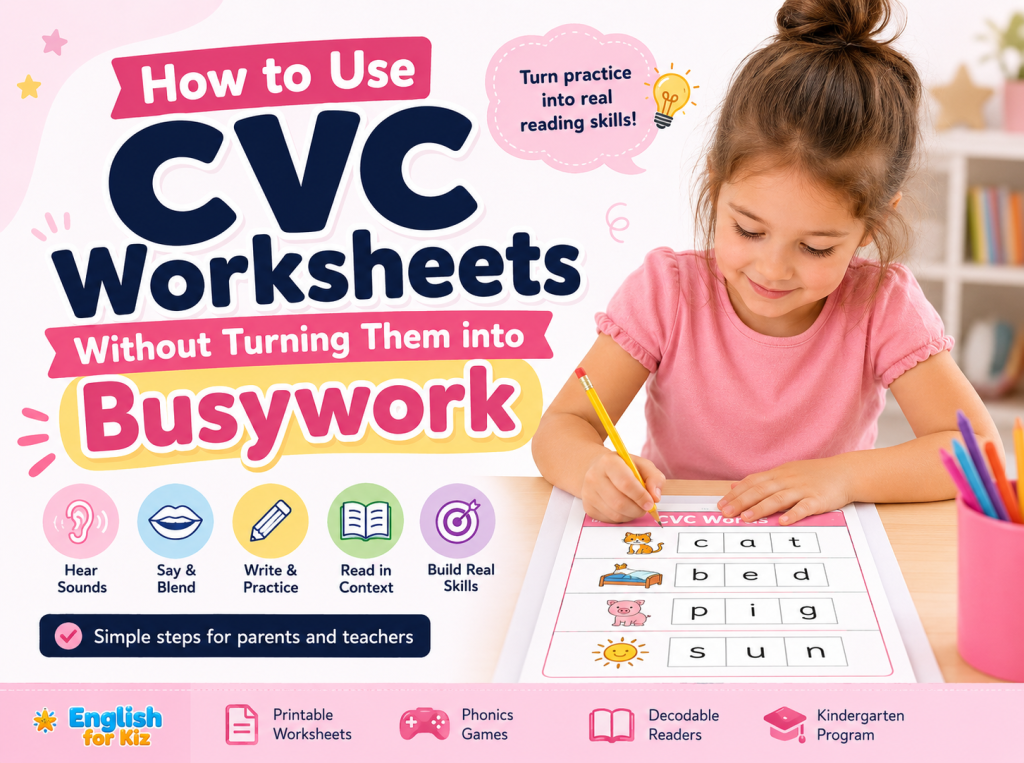
A child can finish several CVC worksheets and still depend on pictures, first-letter guesses, or adult help. This guide shows parents, teachers, and homeschool families how to turn each printable page into a short lesson that builds real blending, spelling, error correction, and sentence reading.
The method is designed for children who know many letter sounds but are still learning to combine three phonemes into words such as cat, bed, pig, hop, and sun. It also explains which resource should come next when a child needs more paper practice, active review, connected reading, or a complete teaching sequence.
What Makes a CVC Worksheet Purposeful
Busywork asks for completion without revealing how the child reached an answer. A page may contain tracing, coloring, circling, or picture matching, yet the child may never blend a printed word from left to right.
Purposeful practice makes the reading process visible. The child hears the target word, notices its beginning, middle, and ending sounds, connects those sounds with letters, blends the word, and checks its meaning. The pencil task records this process rather than replacing it.
A Page Is Becoming Busywork When
- The picture gives away most answers.
- The child copies without reading aloud.
- Several untaught patterns appear together.
- Adults provide answers to keep the page moving.
- The lesson ends when every blank is filled.
A Page Is Supporting Reading When
- One short vowel or blending behavior is targeted.
- The child says sounds before choosing an answer.
- Every word uses patterns already introduced.
- Errors lead to a specific correction routine.
- Practiced words appear in a phrase or sentence.
For example, tracing map may support handwriting, but it does not prove that the word was decoded. After tracing, the child should point under m, a, and p, say each sound, and blend the complete word.
The page should also match the child’s current phonics knowledge. A short-a lesson should not suddenly include silent-e words, vowel teams, or unfamiliar consonant blends. Unexpected spellings make it difficult to tell whether the child is struggling with the target vowel or with a pattern that has not been taught.
A useful page therefore works like a checkpoint. It shows whether the child can hear the vowel, track all three letters, blend without adding extra sounds, and correct an inaccurate attempt. Those behaviors provide better evidence than a neat stack of completed paper.
Choose One Clear Skill Goal Before Printing
“Practice CVC words” is too broad for a focused session. A clearer goal names one observable behavior, such as blending six short-o words, distinguishing short e from short i, or spelling three short-a words from dictation.
This decision matters because decoding and spelling require different thinking. Decoding moves from print to speech, while spelling moves from speech to print. Both can appear on one page, but one should remain the main goal.
Choose Sound Awareness
This is the right starting point when the child cannot hear the middle vowel or separate a spoken word into three sounds.
Choose Blending
This fits children who know individual sounds but pause so long that the sounds never combine into a recognizable word.
Choose Spelling
This supports children who can read a word but leave out, replace, or rearrange letters when writing it.
Before selecting a page, complete one planning sentence: “After this activity, the child should be able to…” The ending should describe something visible, such as “blend five short-u words without using the pictures.”
Next, inspect every word. A focused short-u page may include sun, cup, bug, and mud. A word containing an untaught digraph or an unusual pronunciation should be saved for another lesson.
What to Look for in a Printable Page
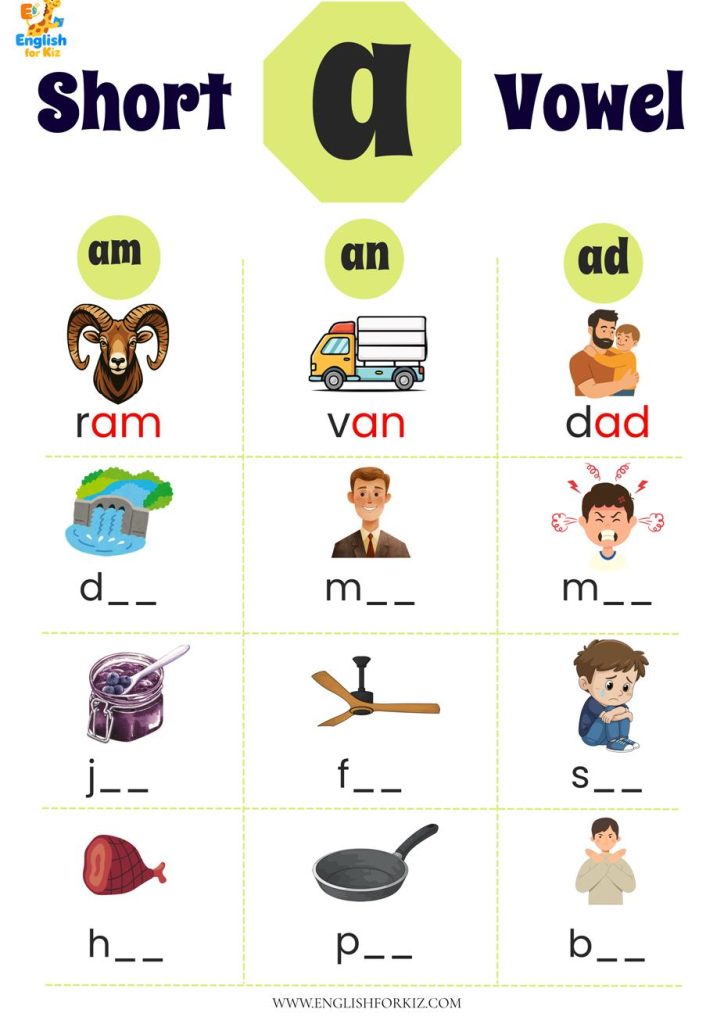
This short-a page keeps the target vowel visible and organizes words by familiar endings. It combines examples such as ram, van, and dad with partially completed words that require the missing sounds to be checked.
A resource like this is most useful after short a has been introduced orally. It suits children who need sound mapping, handwriting, and word-family review on paper.
Explore Printable WorksheetsThe number of items should also match attention and stamina. Six carefully completed words often provide more useful information than twenty rushed responses. A long page can be folded, covered, or divided across two short sessions.
When random downloads make the sequence difficult to manage, the Kindergarten phonics program provides a clearer route from short vowels and CVC blending toward phrases, sentences, and beginner reading.
Before the Worksheet: Hear, Say, and Blend the Target Words
Oral preparation creates a sound pattern before print and handwriting compete for attention. Without this preparation, a child may rely on the picture, the first consonant, or a memorized word-family ending.
A useful warm-up lasts about three to five minutes. It should use the same short vowel and several of the same words that appear on the printable activity.
Hear the Vowel
Say three or four words without showing the spellings. Ask the child to identify the shared middle sound or notice which word sounds different.
Segment the Word
Use three counters or sound boxes. The child moves one counter for the beginning, middle, and ending phoneme.
Build With Letters
Replace the counters with letter cards. The child hears a word, selects three letters, and checks their order from left to right.
Blend Smoothly
Slide a finger under the letters while keeping the sounds close together. Avoid adding extra vowel sounds such as “muh-a-puh” for map.
Example: A Short-A Lesson Flow
- Say the five words and listen for short a.
- Segment map with three counters.
- Build mat with letter cards.
- Blend sat with a continuous finger sweep.
- Complete one row of the selected printable page.
- Read one short phrase using a practiced word.
This warm-up also checks whether the page is at the right level. If the child cannot hear the target vowel in spoken words, more written practice will not solve the underlying listening problem. Continue with oral comparison before returning to print.
Word families can help after the three sounds remain clear. Words such as map, tap, cap, and lap show a predictable ending. Mixed examples such as map, mat, man, and mad should also appear so the final consonant cannot be guessed.
During the Worksheet: Prompt Thinking Instead of Giving Answers
Good prompting points attention toward the part of the word that needs checking. Giving the answer may complete the item quickly, but it does not show whether the child can use the skill independently.
Begin with the smallest amount of support. Increase help only when the child cannot continue after a reasonable pause.
- Wait several seconds before speaking.
- Ask for the first sound.
- Ask the child to point to the vowel.
- Ask for the ending sound.
- Slide a finger beneath all three letters.
- Model the separate sounds without blending them.
- Model the full blend, then request an independent reread.
When a picture causes guessing, cover it for the first reading attempt. The child reads the letters, then uncovers the image to confirm meaning. The picture remains useful, but it no longer replaces decoding.
Suppose pen is read as pin. Rather than giving the correct word, compare the two middle sounds. The child points to e, blends /p/ /e/ /n/, and reads the word again.
Prompts That Support Decoding
- “Point to the vowel.”
- “Check the last sound.”
- “Keep the sounds close together.”
- “Read the complete word again.”
- “Does that word match the picture?”
Responses That Hide Difficulty
- Saying the first sound before the child looks
- Mouthing or pointing toward the answer
- Repeating “try again” without a useful clue
- Using the picture as the main reading strategy
- Completing every difficult item together
Prompts should fade as the activity continues. If every item still needs a complete model, the page is not functioning as independent practice. Return to fewer words, easier contrasts, or stronger oral preparation.
A simple notation system can make the completed page more informative. Mark I for independent, P for prompted, and M for modeled. Eight correct answers may appear successful, but six modeled responses show that the skill still needs direct instruction.
When paper practice begins to feel repetitive, brief phonics games can review the same sound or blending pattern in a more active format. The game should repeat the current lesson target rather than introduce unrelated difficulty.
After the Worksheet: Correct Errors and Read the Words in Context
The page should not disappear into a folder as soon as the final blank is filled. Correct responses need quick rereading, while errors should lead to a precise teaching step. A check mark or cross alone does not change the reading behavior.
Begin by identifying the type of error. Guessing from a picture requires a different response from short-vowel confusion, missing final sounds, reversed letter order, or difficulty combining separate phonemes.
Common CVC Reading Errors
- Reading from the picture or first letter
- Confusing short e and short i
- Omitting the final consonant
- Reading letters in the wrong order
- Saying three sounds without blending
- Reading correctly but spelling inaccurately
A Four-Step Correction
- Name the problem calmly.
- Return to the confusing sound or letter.
- Rebuild or reblend the word.
- Read it in a phrase or sentence.
For example, if rug is read as rag, explain that the middle sound changed. Compare short u with short a, point to the printed vowel, and blend rug again. Then read a controlled phrase such as “the red rug.”
The phrase or sentence step is essential because isolated word reading does not always transfer into connected text. A child may decode map on a list but guess when the same word appears inside a sentence.
Move From Word Practice to Real Reading
This short-a reading lesson repeats patterns such as -ad, -ag, -at, -am, -an, and -ap. It allows a child to meet familiar words such as bag, mat, map, and cap inside connected sentences.
This resource is the right next step when individual words can be blended with reasonable accuracy. It should not replace direct correction when short vowels or letter tracking remain unstable.
Continue With Decodable Readers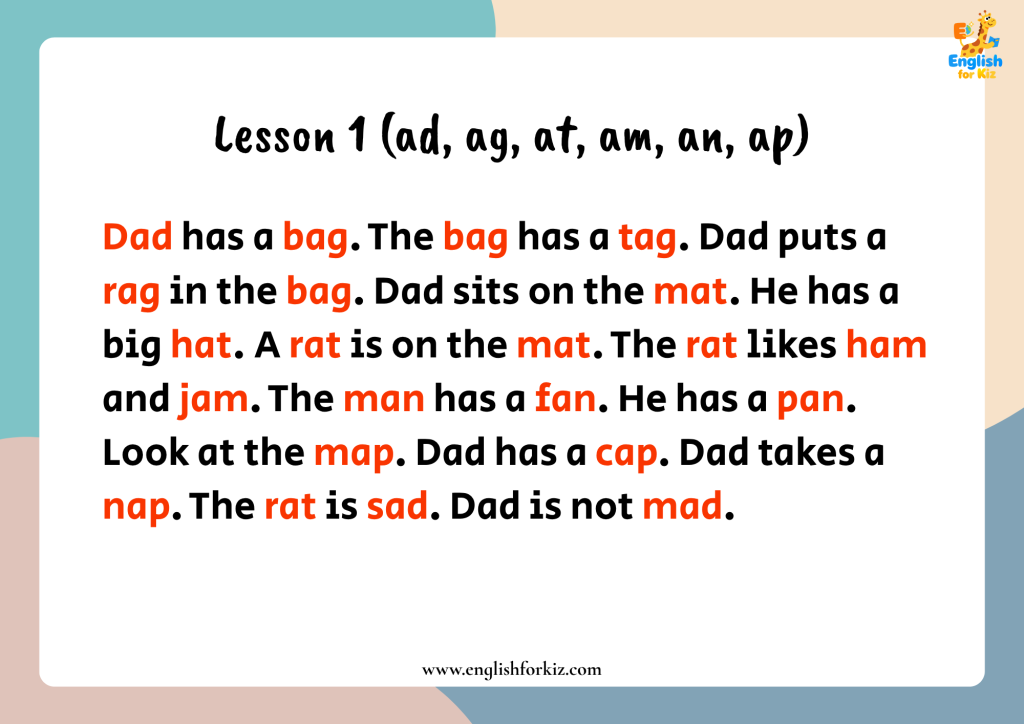
Before reading a short passage, preview only a few target words. During reading, pause at an error and return to the letters. After correction, reread the whole sentence so meaning and phrasing are restored.
A short dictation sentence can check spelling transfer. For example, say “Sam sat.” The child repeats the sentence, counts the words, and maps the sounds in each decodable word to letters.
Home, Small-Group, and Classroom Adaptations
The same printable page can support different settings when the routine changes around it. At home, brevity and calm repetition matter most. In a small group or classroom, every child also needs an opportunity to read aloud and receive targeted feedback.
At Home
Use a ten- to fifteen-minute routine: oral warm-up, one short section, one corrected error, and one sentence. Divide a page across two days when attention begins to drop.
In a Small Group
Begin with choral blending, then listen to each child individually. Independent work should use a familiar task format so new directions do not distract from decoding.
In a Classroom
Keep one shared vowel target while changing the response method. Some children can circle, others can spell, and a supported group can use sound boxes or letter tiles.
Differentiation should usually change support, quantity, or response format before changing the core skill. A child with fine-motor difficulty may point, select letters, or answer orally before writing one word. The reading goal remains intact without turning the lesson into handwriting endurance.
For multilingual learners, name each picture before the task begins. Unfamiliar vocabulary should not determine whether the child appears to understand the phonics pattern. The first reading attempt should still come from letters rather than the picture.
Partner work can help when roles remain clear. One child points and blends, while the other checks all three letters and uses a prompt such as “Check the vowel.” Partners should not provide complete answers.
A Quality Checklist for Choosing the Next Worksheet
The next resource should respond to evidence from the current session. A neatly completed page does not automatically mean that harder material is appropriate. Accuracy, independence, and transfer provide better guidance.
- One short vowel, contrast, or word family is clearly targeted.
- Every spelling pattern has already been introduced.
- The directions can be explained in one short sentence.
- The task requires sound work rather than picture guessing.
- The writing demand matches the reading goal.
- The page can be shortened without losing its purpose.
- The layout is calm and easy to track from left to right.
- Errors can be corrected through a clear routine.
- The words can move into phrases or sentences afterward.
- The difficulty creates effort without constant modeling.
How to Judge the Difficulty
A page is too easy when the child answers immediately without checking all the letters. Easy words can still support brief fluency practice, but the next task should add mixed endings, short phrases, or sentence reading.
A page is too difficult when most words require complete modeling or produce repeated random guesses. Return to fewer examples, stronger oral comparison, or an easier vowel pattern before introducing another printable activity.
The right level creates productive effort. The child pauses, uses known sounds, responds to a light prompt, and becomes more independent as the session continues.
Which Resource Should Come Next?
Choose Printable Practice
Select a focused short-vowel or word-family page when the child needs to connect spoken phonemes with printed letters and written spellings.
Browse the worksheet library →Choose Active Review
Use a short game after direct teaching when attention is fading but the same sound or blending pattern still needs practice.
Explore phonics games →Choose Connected Reading
Move into a matched reader when individual words are accurate and the next goal is tracking, meaning, and sentence-level fluency.
Browse decodable readers →Choose the Kindergarten Program
Use the full level when several skills need to work together and isolated pages no longer provide a clear lesson sequence.
View the Kindergarten program →Start With the Skill That Needs Practice Now
The clearest next step is to identify one short vowel or blending behavior and select a printable page that matches it. Use the page between oral sound work and sentence reading, then choose the next resource according to the child’s errors and level of independence.
Need More Than an Individual Worksheet?
The Kindergarten program is the stronger next step when short vowels, blending, spelling, games, and early reading need to follow one connected learning path.
Frequently Asked Questions
How many CVC worksheets should a child do in one session?
One focused page, or part of one page, is usually enough. A balanced session may include several minutes of oral blending, one short written section, one carefully corrected error, and one phrase or sentence.
Stop when guessing increases, attention drops, or every item requires a complete model. The quality of decoding matters more than the number of finished pages.
How can I tell whether a worksheet is too easy or too difficult?
An activity is too easy when the child answers without checking every letter. It is too difficult when most words require full modeling or lead to repeated random guesses.
A well-matched task creates manageable effort. The child uses known sounds, responds to light prompts, and becomes more independent across the page.
What should I do when a child guesses instead of blending?
Cover the picture and ask the child to point to the beginning, middle, and ending letters. Blend the printed word before uncovering the image and checking its meaning.
If guessing continues, note which clue replaces reading. Some children rely on the first consonant, while others rely on the picture or a familiar ending.
Can CVC worksheets be used without a full phonics lesson?
They can support review when the target vowel and letter sounds are already familiar. A new pattern still needs oral introduction, modeling, guided blending, and correction.
When time is limited, use a compact routine: hear the vowel, model one word, guide two words, complete one small section, and read one sentence.
When should a child move from worksheets to decodable readers?
Begin short connected reading when most target words can be blended accurately with only light prompting. The reader should use the same short vowel or word families that have already been practiced.
Keep word-level support available. When a word is missed, return to its letters, correct the blend, and reread the complete sentence.
Three Actions for the Next Session
- Name one measurable skill, such as blending five short-o words without picture guessing.
- Use a brief hear, say, and blend routine before the written activity begins.
- Correct one error carefully, then read the word inside a controlled phrase or sentence.