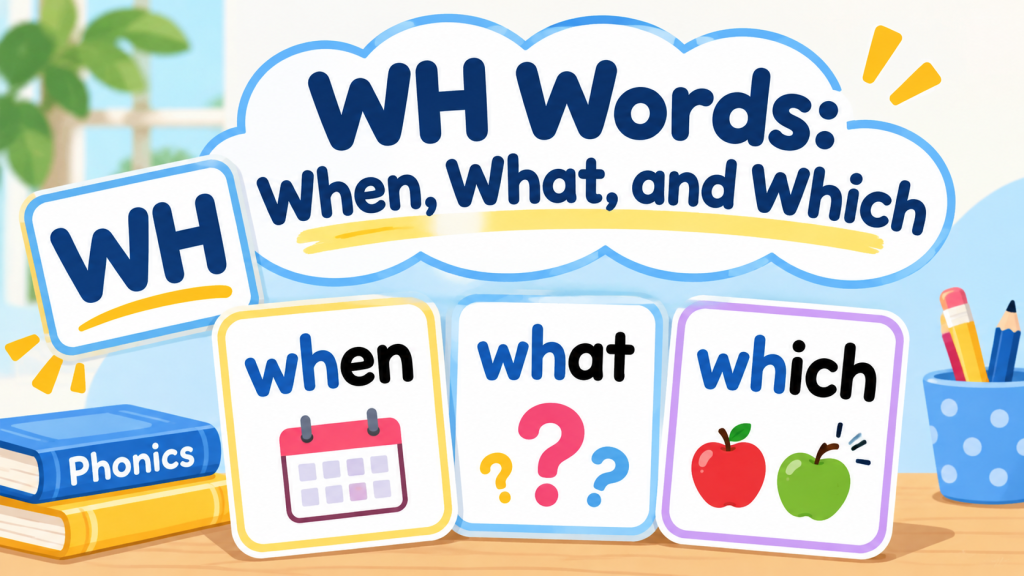
A child may already know how to say when, what, and which but hesitate when those words appear on a page. The difficulty is often recognizing that W and H work together to represent one opening sound, rather than reading each letter separately.
In most English accents, WH in words such as when, what, and which represents the /w/ sound, as in wet and win. Some speakers use a breathier /ʍ/ sound instead. Both pronunciations are established features of English accents.
Starting with familiar words and then reading them in short sentences helps children connect the WH spelling with the sound they use and recognize the pattern in other words.
Read when, what and which aloud first
Say the words when, what, and which naturally. In accents that use /w/ for WH, the lips round slightly before moving into the following vowel. There is no need to pronounce an extra H sound after the W.
Look at the beginning of each word:
Although the words have different vowels and endings, they share the same initial spelling pattern. In phonics, WH is commonly taught as a consonant digraph, meaning two letters that work together to represent a sound.
There is one extra point to notice in what: its vowel is different from the short A in cat. The exact vowel varies by accent. If a child reads WH correctly but says the vowel as in cat, model the whole word and draw attention to the vowel sound rather than correcting the beginning again.
A child may hear /w/ from one speaker and the breathier /ʍ/ from another. The aim is not to change the child’s accent, but to connect the printed WH with the pronunciation used in their own speech.
Find WH at the start of familiar words
When introducing words beginning with WH, move beyond the three familiar question words. Everyday vocabulary helps children notice that WH is a spelling pattern, not simply a signal that a question is coming.
Read each word aloud and notice the shared WH spelling before the vowel.
Choose examples according to the spelling patterns the child already knows. For instance, whip may be more accessible to a child familiar with short vowels than wheel, which also contains the vowel team EE. Whale and white require knowledge of silent-E patterns.
For children who need more written practice recognizing WH, the EnglishForKiz 1st grade phonics worksheets collection includes a WH and TCH activity. It is listed as a VIP-exclusive resource and is best suited to children who have already been introduced to both spelling patterns.
Can children hear the difference between W and WH?
Compare wet with when, or win with which. For speakers who use /w/ in both spellings, the initial sounds are the same. Listening alone cannot tell a child whether a particular word begins with W or WH.
This is where looking carefully at the printed word matters. Encourage children to notice both beginning letters rather than guessing the spelling from the first sound alone.
Why who is different
After practicing when, what, and which, introduce who as a useful contrast. Although it begins with the same two letters, who normally starts with /h/, not /w/ or /ʍ/.
Who is a useful exception to learn alongside the more common WH pattern. There is no need to introduce a long list of exceptions here; this familiar word is enough to show that the same spelling does not always represent the same sound.
If a child reads who with /w/, it is an understandable attempt to apply the pattern. Model the /h/ beginning, then let the child try the whole word again.
Practice reading WH words independently
Word cards make it easy to see whether a child is recognizing the spelling or relying on a memorized list. Try five cards with when, what, which, whip, and wet.
Listen first, then read independently
Start by saying one word aloud while the cards are in front of the child. Let them find the matching word and point out its first two letters. Then shuffle the cards and ask them to read each one without hearing it first. The first round connects speech with print; the second shows whether they can recognize the pattern on the page.
For a stronger check, add an unfamiliar but decodable word such as whim, if the child already knows the short I sound and the final M. This checks whether they can use the pattern on a word they have not already memorized.
If a child says the W and H sounds separately, point to the letters together and model the opening sound as one unit. Then blend it with the rest of the word. This keeps the focus on reading the whole word rather than naming the letters one by one.
A quick WH phonics practice check
Read each question aloud. Let the child find the answer before opening the card to check it.
QUESTION 01 wet · when · whip Which two words begin with WH?
QUESTION 02 who · what Which word begins with the /h/ sound?
QUESTION 03 The wheel can spin. Find and read the WH word.
QUESTION 04 Which hat fits? Which word begins with WH?
A child may recognize WH correctly and still find the rest of a word difficult. If they hesitate over the vowel in what or the other spelling patterns in which and wheel, the difficulty may lie elsewhere in the word rather than with WH itself.
Read WH words in short sentences
Once a child can recognize several WH words on their own, try reading them in short sentences. The extra context gives children a reason to read each word accurately and understand what the sentence means.
Read each sentence at a comfortable pace. If the child hesitates, return briefly to the target word, then read the full sentence again. At this stage, keep the focus on recognizing the spelling in context; question formation can be explored separately.
Consonant Digraph Sentences
WH · CH · TCH · GH
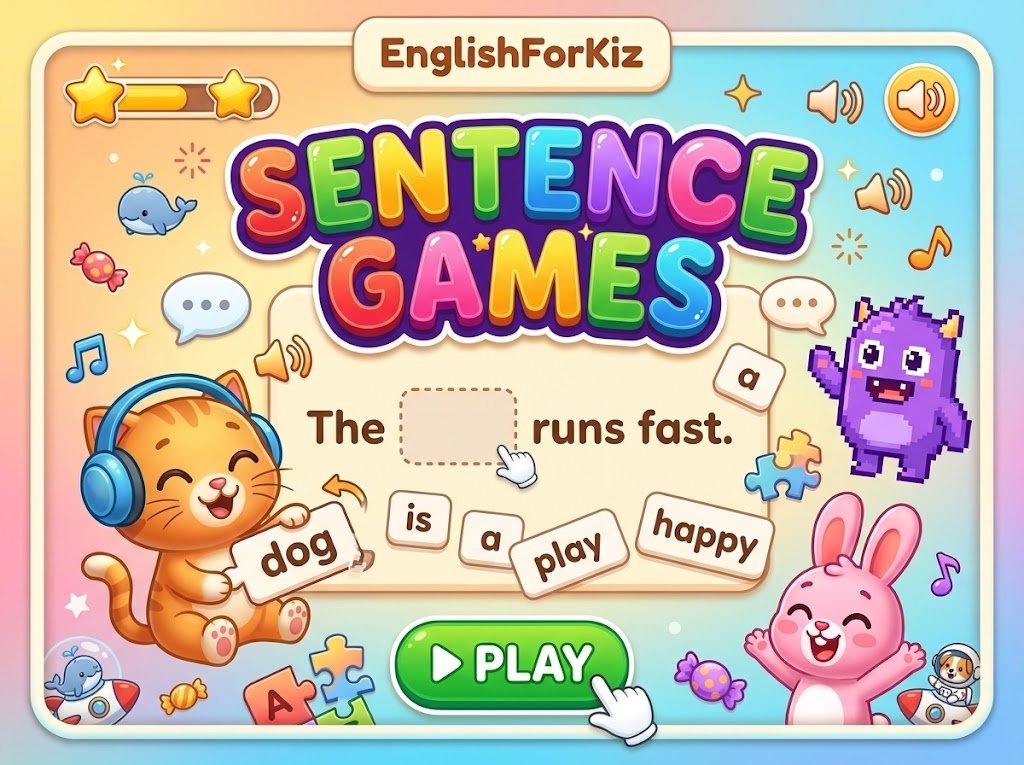
Look for the activity titled Consonant Digraph Sentences (wh, ch, tch, gh) in the first-grade sentence game library.
The activity combines several spelling patterns, so choose it when the child is familiar with the patterns included. It is listed as a VIP-exclusive activity.
The illustration represents the sentence games library, not an individual WH game.
If a child is still separating W and H, a few more minutes with individual words may be more useful than moving straight into mixed-pattern sentences.
Related Reading
Frequently Asked Questions
Are all WH words question words?
No. Words such as whale, wheel, white, and whisk also begin with WH. The spelling pattern does not determine a word’s grammatical function.
Should WH sound like /w/ or /ʍ/?
Both are valid pronunciations in words such as when and which, depending on the speaker’s accent. Children do not need to imitate a different accent to read these words correctly.
Why can my child read when but struggle with what?
A child may recognize WH correctly but still be unsure about the vowel in what. Model the word naturally and help the child notice its vowel sound. Difficulty with one part of a word does not necessarily mean the WH spelling pattern has been misunderstood.
A useful sign of progress is not how many WH words a child can remember, but whether they can recognize the pattern in a new word and read it without separating W and H.
Once that skill becomes familiar, introduce short sentences containing spelling patterns the child already knows. If a new word causes difficulty, focus on the part that needs attention rather than starting the whole lesson again.
From WH words to sentence reading
When your child is ready to read familiar digraphs in context, explore the EnglishForKiz first-grade sentence games for short sentence-reading practice.
Explore Sentence Games