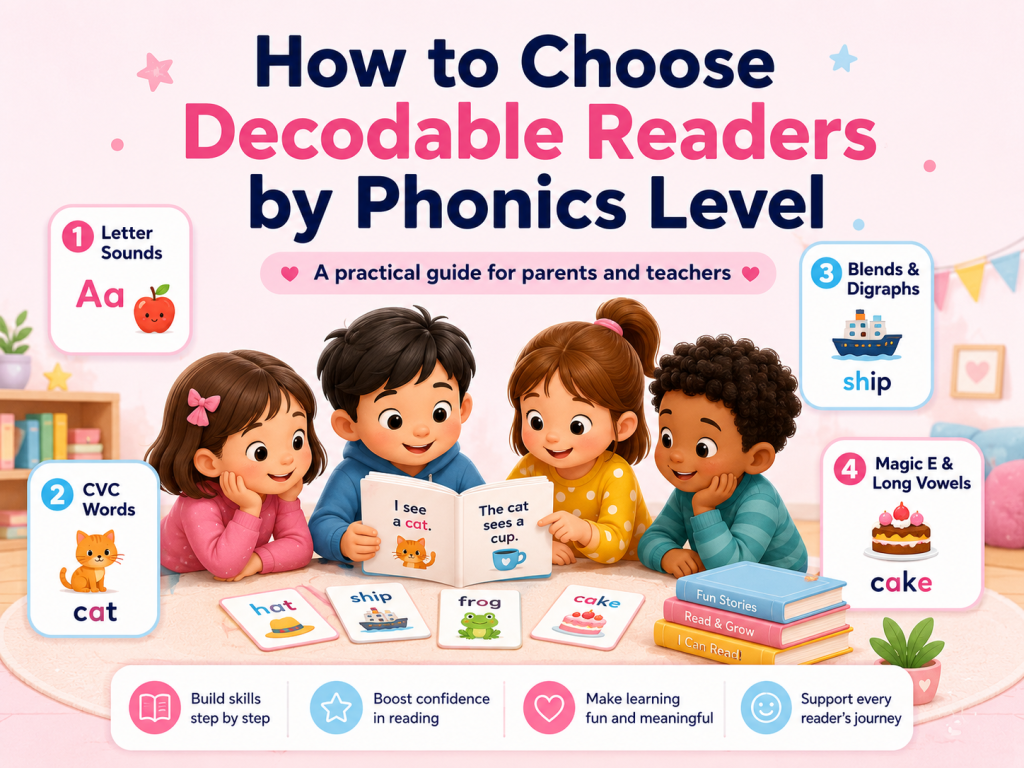
Learning how to choose decodable readers means looking past age labels, page count, large print, and attractive illustrations to inspect the spelling patterns a learner is actually expected to read.
A short book can still be too difficult when several important sound-spelling patterns have not yet been taught. The most useful decodable readers give children enough familiar code to read independently while adding one manageable area of practice.
This guide shows parents, teachers, and homeschool families what to inspect inside a reader before reading begins. Instead of treating phonics levels as broad grade bands, it focuses on the actual decoding load: target patterns, unfamiliar vowels, consonant structures, irregular words, word length, sentence load, and the amount of correction a learner is likely to need.
Level 1: What to Inspect in Letter-Sound Readers
At the earliest stage, the important question is not whether a book looks simple. Check whether the printed page asks the learner to do something that has actually been taught. A learner may know the alphabet song, recognize several letters, or hear the first sound in a spoken word without yet being ready to blend a complete CVC word.
A useful Level 1 reader therefore needs a very small decoding job. It may reinforce one or two known letters, repeat a beginning sound, support left-to-right print tracking, or include a few carefully selected words that an adult can prepare before reading.
What should appear inside the book
- Target letters that have already been introduced.
- Beginning sounds the learner can hear in spoken words.
- Brief, uncluttered lines of print.
- A small and predictable number of supported words.
What signals too much decoding load
- Several unfamiliar letters appear on every page.
- The print depends on advanced vowel patterns.
- The learner can repeat the sentence but is not tracking the words.
- The book expects blending before letter-sound recall is secure.
Before choosing the book, show the target letter in uppercase and lowercase and ask for its sound. Compare two or three spoken words. If letter-sound recall still requires heavy prompting, focused oral and print practice is likely to be more productive than repeatedly guessing through a story.
The Preschool phonics program provides the closest supporting route when letter recognition, beginning sounds, and early phonemic awareness still need direct practice.
Level 2: What to Inspect in CVC and Short-Vowel Readers
A Level 2 reader should allow a learner to use familiar consonants and short vowels in words such as map, bed, sit, hot, and sun. The key selection question is whether the book keeps that decoding demand stable enough for the learner to attend to every sound.
Do not rely only on a “CVC” or “beginner” label. Scan several inside pages. A book may contain short sentences while still introducing vowel teams, Magic E, difficult high-frequency words, consonant clusters, or longer words that make the actual reading load much higher.
Check the vowel demand before the page count
Short vowels often reveal the true difficulty. A learner may read short a confidently but still confuse short e and short i. In that case, a focused short-a story is a better instructional match than a mixed-vowel reader, even if both books have the same number of pages.
Sample content words across the book. Words such as cat, map, ran, jam, and cap keep the short-a code relatively stable. A page containing play, boat, see, come, and have is asking for several additional patterns and is no longer functioning as a simple CVC text.
Use final consonants to check whether the whole word is being read
Final sounds reveal whether attention is staying on the complete printed word. Saying cat for cap, or pin for pig, suggests that the learner left the word too early. A useful reader gives repeated CVC practice without immediately adding dense clusters or several new endings.
Meaning should still be available after decoding. After a sentence such as “The cat sat in the bag,” ask where the cat sat. This checks comprehension after the learner has read the words instead of encouraging a guess from the picture.
The Kindergarten phonics program is the closest supporting route for short vowels, CVC blending, simple spelling, and early connected reading. A more complex reader becomes appropriate when unfamiliar CVC words can be decoded accurately and help is no longer required on most lines.
Level 3: What to Inspect in Blend and Digraph Readers
At this stage, inspect exactly which consonant structures appear and how many are introduced at once. A learner who can handle initial s-blends may not yet be ready for final blends, several digraphs, suffixes, and new vowel patterns in the same story.
The words inside the book should show a clear target. If a reader is intended to practice blends, most supporting vowel patterns and high-frequency words should remain familiar enough that the blend is the main stretch.
Initial blends
Words such as stop, flag, crab, and plan require the learner to preserve each consonant sound before reaching the vowel.
Final blends
Words such as hand, lamp, nest, and milk place the additional sound load after the vowel and can expose dropped endings.
Common digraphs
Patterns such as sh, ch, th, and wh should already function as recognizable sound units before they dominate a story.
Keep the non-target patterns familiar
A blend reader can become unexpectedly difficult when the vowels change at the same time. Words such as flag and stop may be appropriate after short-vowel instruction. Words such as float and steam add vowel teams and create a second major decoding problem.
A practical selection rule is one main stretch with many stable supports. The target blend or digraph should appear often enough to provide useful practice while the majority of vowels, sentence structures, and prepared high-frequency words remain manageable.
Also scan for endings such as -s, -ed, and -ing. A story advertised for blends may hide substantial additional decoding work in inflected words. If those endings have not been taught, choose a simpler title or preview the base word and ending before reading.
The 1st Grade phonics program supports blends, digraphs, long-vowel spellings, and increasingly sustained sentence reading.
Level 4: What to Inspect in Magic E and Long-Vowel Readers
A learner may understand the Magic E rule on a worksheet but still hesitate when vowel-consonant-e words appear in connected text. Before selecting a reader, inspect whether the book focuses on one taught representation or mixes several long-vowel spellings at once.
Words such as cake, bike, home, and cube use a familiar vowel-consonant-e pattern. A book becomes substantially more demanding when that pattern is mixed immediately with spellings such as rain, play, boat, seed, and irregular alternatives.
Look for one clear spelling target in the first long-vowel reader
Long a can appear in cake, rain, day, and eight, but those words do not represent the same decoding problem. A learner who has been taught a_e may still need separate instruction before reading passages filled with ai, ay, and less common spellings.
Start with a book that allows one representation to repeat. Broader comparison becomes more useful after each pattern has received direct instruction. This makes reading errors easier to interpret because fewer unfamiliar variables are competing at the same time.
Inspect word length and sentence load as well as the vowel
Familiar long-vowel spellings may appear inside longer words such as sunshine, inside, or mistake. These words can still be readable, but the learner may need to identify familiar chunks. For example, sunshine can be separated into sun and shine.
Dialogue, punctuation, sentence length, and paragraph density also affect reading effort. A learner may understand Magic E but still benefit from shorter lines while fluency is developing. This is why checking actual inside pages is more reliable than relying on an age band or cover design.
Compare the code inside the story
These two inside pages show why the same “beginner reader” label can hide very different decoding demands. One concentrates on short-a CVC patterns, while the other expects recognition of several Magic E forms.
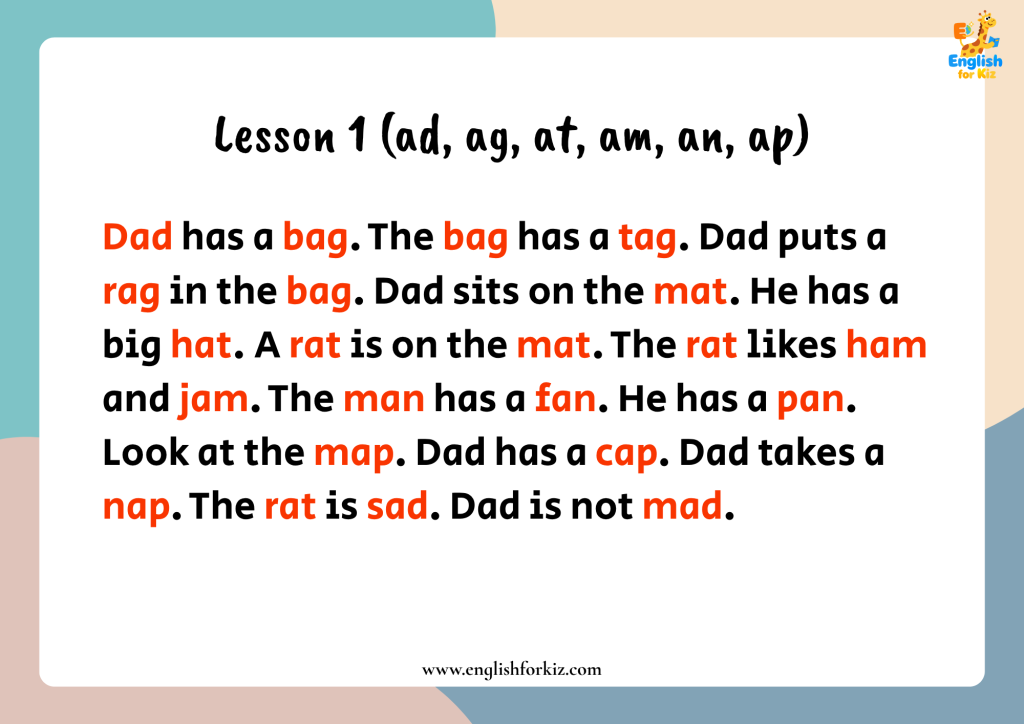
A closer match after short-a word families and complete three-sound blending have been taught.
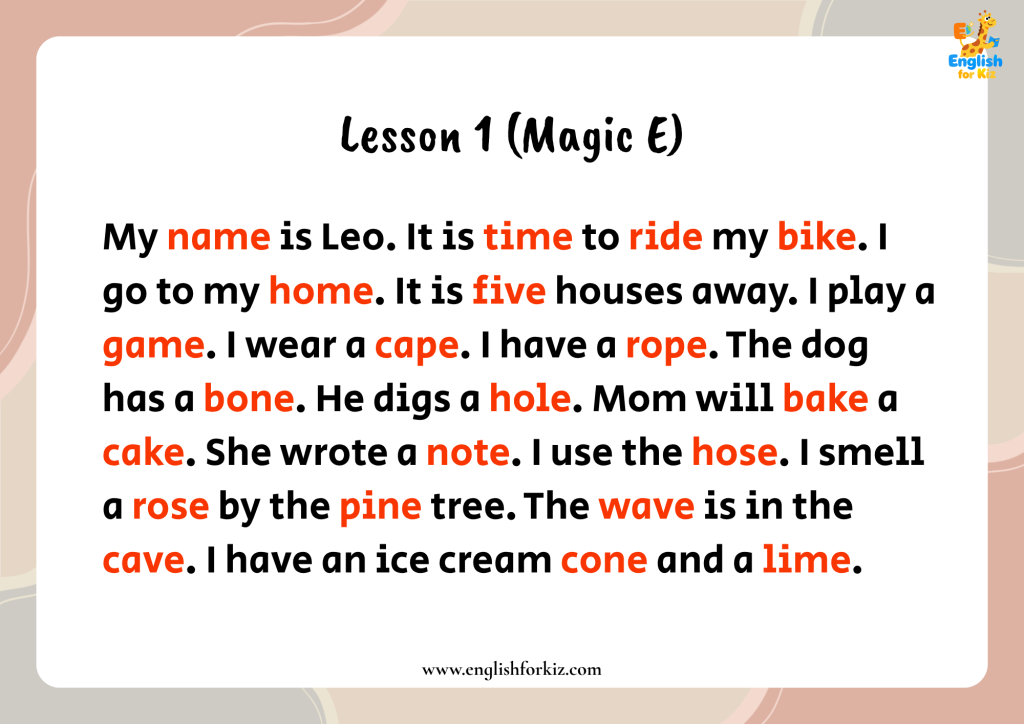
A later choice for learners who can change the vowel sound when a final e appears.
Match the Reader to the Phonics Scope and Sequence
A publisher’s level label is useful only when it broadly matches the phonics sequence the learner is actually following. Two books marked “Level 2” can introduce spelling patterns in a different order, so the number on the cover should never overrule what appears on the page.
Before choosing a reader, compare its main spelling target with what has already been taught. If the learner has worked on short a and short i but has not yet studied vowel teams, a book that repeatedly uses ai, ee, or oa is not a close match simply because the publisher calls it beginner level.
This is especially useful when moving between different book series. Instead of trying to convert one publisher’s level number into another, compare the actual sound-spelling patterns, word structures, and sentence load.
How to Choose Decodable Readers: A Five-Minute Book Audit
A grade label can provide a starting point, but the words inside the book should make the final decision. Two titles marked “beginner” may contain very different vowel patterns, consonant structures, irregular words, word lengths, and sentence demands.
The following audit turns reader selection into a practical check rather than a guess based on packaging.
Choose the story now
- Most content words use taught patterns.
- The target appears often enough to provide meaningful practice.
- Only a few words require preparation.
- A sample sentence can be decoded and understood.
Save the story for later
- Several untaught vowel patterns appear repeatedly.
- The stated target appears only once or twice.
- Pictures are needed to supply many of the words.
- A simpler text can train the same target more directly.
Run one final quality check after the decoding check
A technically decodable book is not automatically the best reader. Once the code is a good match, read a page for meaning. The sentences should sound reasonably natural, the target pattern should repeat without making the text feel forced, and the learner should be able to explain what happened after reading.
Useful signs
- The story or information can be understood without guessing from the picture.
- The target spelling pattern appears often enough to provide practice.
- Repeated words still fit a meaningful sentence or story.
- Illustrations support comprehension without supplying every difficult word.
Reasons to compare another title
- The wording becomes unnatural simply to repeat target words.
- The target appears rarely even though the cover highlights it.
- The learner can decode the words but cannot explain the page.
- Pictures make it easy to recite or guess words without checking the print.
After You Choose the Reader, Keep the First Reading Simple
The first reading can confirm whether the book was well matched. Briefly review the target pattern and any essential irregular word, then let the learner do the decoding. Avoid rehearsing every sentence in advance because that makes it harder to judge whether the print is genuinely manageable.
Before
Name the target pattern and blend three to five representative words. Prepare only the irregular words that are necessary for the story.
During
Give quiet processing time. If help is needed, point to the exact sound-spelling feature instead of asking for a picture guess.
After
Ask for a brief retell and note any repeated decoding error. If help was needed on most lines, the reader was probably not the closest match.
Signs a Decodable Reader Is Too Easy or Too Difficult
A slow reading is not automatically a poor match. A learner who pauses, applies a taught pattern, corrects an error, and understands the sentence may be working at a useful level. In contrast, quick recitation from memory provides little evidence that the learner is decoding unfamiliar print.
The story may be too easy when
- Nearly every word is recognized instantly.
- The target pattern no longer requires attention.
- Phrasing and comprehension remain strong.
- A fresh passage using the same pattern is equally easy.
An easy story can still support expression or independent rereading. The next instructional text should add one manageable challenge rather than several new patterns at once.
The story may be too difficult when
- Picture guessing replaces careful word reading.
- Help is needed on most lines.
- Several untaught patterns appear repeatedly.
- Corrections do not transfer to the next similar word.
- The learner cannot explain the main event after a page.
Return briefly to the missing pattern and select a closer story. The harder title can remain available as a later progress check.
Let repeated errors guide the next lesson
Saying top for stop suggests a missing blend sound. Saying cap for cape points to a Magic E problem. Confusing ship and chip may show that two digraphs need direct contrast practice.
A brief record can include the printed word, the spoken response, and the likely skill need. That small record gives the next story, word list, or worksheet a specific purpose instead of simply moving to the next book in a numbered series.
Match Follow-Up Practice to the Same Phonics Pattern
A worksheet or short word activity is useful when it prepares or repairs the same code used in the selected story. A farm worksheet and a farm story are not automatically a strong match; the important connection is the sound-spelling pattern, not the shared picture theme.
The EnglishForKiz phonics worksheets library organizes practice around letter sounds, CVC words, short vowels, blends, digraphs, Magic E, and fluency. Use the section that answers an observed reading need rather than completing unrelated pages in sequence.
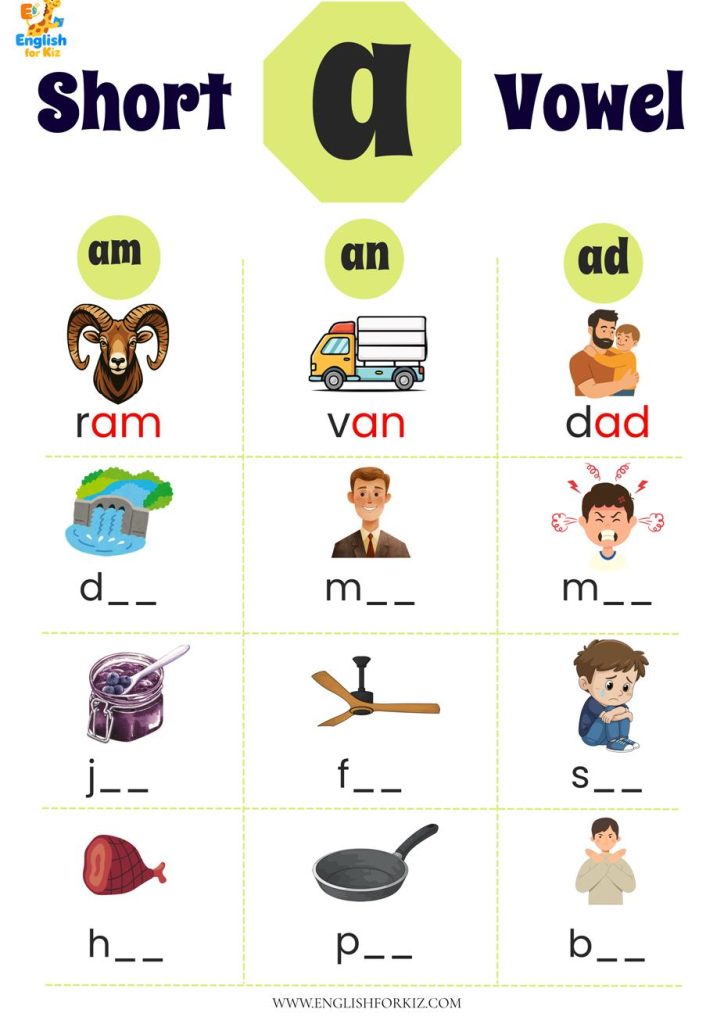
When this worksheet is a useful next step
A focused short-a page fits when consonant sounds are familiar but the middle vowel is still lost in words such as ram, van, and dad. It can prepare the pattern before a short-a story or repair a repeated error afterward.
The whole page does not need to be completed in one sitting. One row of word reading, one short spelling task, and a matching story can be more useful than a long packet because the practice stays connected to the exact reading need.
Find a Matching Phonics WorksheetThis keeps the article’s selection logic intact: the learner’s actual reading behavior determines the next resource. If letter sounds still need direct instruction, use the Preschool phonics program; for CVC blending and short vowels, use the Kindergarten phonics program; for blends, digraphs, and long-vowel patterns, use the 1st Grade phonics program.
Choose the Next Reader from the Skill, Not the Cover
Once the target pattern, phonics sequence, ten-word sample, unfamiliar code, sentence load, and likely correction load have been checked, choose the closest story level. If two readers look similar, open both and compare the inside pages before deciding. Keep the harder title for a later progress check instead of forcing it into the current lesson.
Browse Decodable Readers by LevelFAQ
How do I know a decodable reader matches a child’s phonics level?
Name the main spelling pattern and sample about ten meaningful words from several pages. Most words should use patterns that have already been taught or reviewed. Then listen to one short phrase and check whether decoding remains manageable enough for the learner to understand what was read.
Does every word in a decodable reader need to follow a taught phonics pattern?
Not necessarily. A small number of prepared irregular or high-frequency words can support natural sentences. The problem begins when too many important words depend on untaught spelling patterns or memorization. The learner should still be able to decode most meaningful content words using known code.
Should children read decodable books they have not practiced in worksheets?
A worksheet is not required before every story. The important point is that the target sound-spelling pattern has received direct teaching and some word-level practice first. Letter tiles, a whiteboard, flashcards, oral blending, or a short spelling task can provide that preparation.
Should the same decodable story be read more than once?
Repeated reading can help when each attempt has a clear purpose. The first reading can focus on accurate decoding and meaning. A later reading can develop phrasing and expression. Progress should also be checked with a fresh passage using the same phonics pattern so that improvement is not based only on memorizing one story.
Three practical next steps
- Name one exact phonics pattern that needs story-level practice.
- Open two or three candidate readers and sample ten meaningful words from inside pages.
- Choose the book with the closest taught code, then use one short same-pattern activity only if the first reading reveals a specific gap.