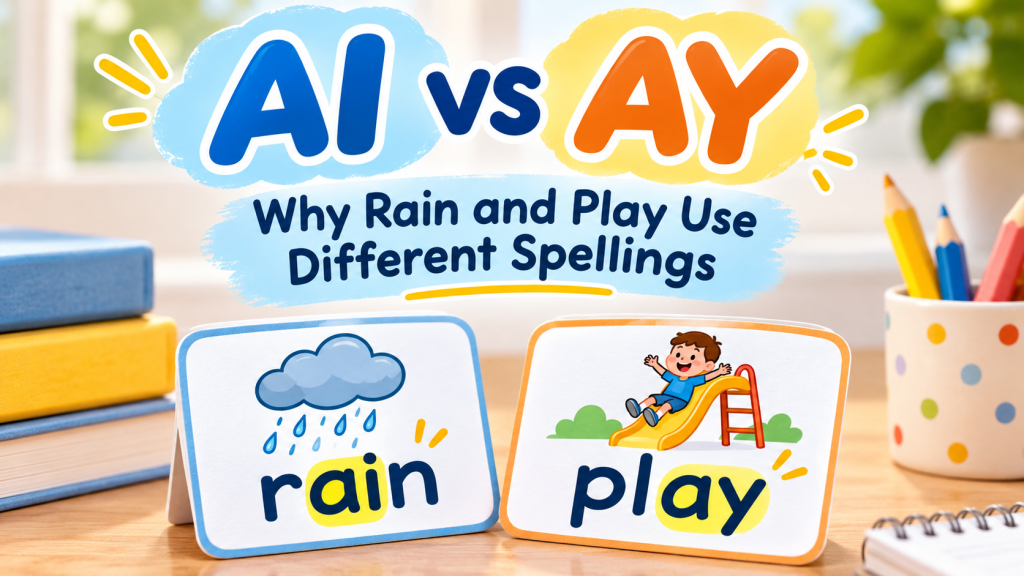
A child who can read rain and play may still hesitate when asked to write them. Both words contain the long A sound, so why does one use AI while the other uses AY?
The position of the long A sound offers a useful clue. When choosing between AI and AY, AI is usually found before a consonant within a syllable, while AY is usually found at the end of a syllable, as in play.
For a child who can already hear long A, this difference makes spelling less of a guessing game.
AI or AY: what is the usual choice?
AI and AY are vowel teams: two letters working together to represent a vowel sound. In these examples, both spell the long A sound (/eɪ/), the vowel sound we hear in the name of the letter A.
Notice that AI does not have to come in the middle of a word. In aim, it comes first, but the /m/ sound still follows long A in the same syllable.
A helpful question for children is: “Do you hear another sound after long A, or does the syllable end there?”
Compare rain and play, sound by sound
When a child writes “rayn” instead of rain, the spelling gives us a clue: the child may already have heard all three sounds but chosen the wrong vowel team. Saying rain and play slowly makes the difference easier to hear.
In rain (/reɪn/), we hear /r/, /eɪ/, and /n/. That final /n/ gives us a reason to try AI. In play (/pleɪ/), we hear /p/, /l/, and /eɪ/. There is no consonant after long A, so AY is the more likely choice between the two.
Both words have four letters but three sounds. The two letters in each vowel team represent one vowel sound, which is why AI or AY belongs in a single sound box.
Now imagine a child writes ran instead of rain. Before correcting the spelling, say both words and see whether the child can hear the difference between short A and long A. If they can hear it but still write ran, they may simply need more practice matching long A to its written spelling. If the sounds are difficult to tell apart, a little listening and oral sound practice is a better starting point.
With “rayn,” the next step is different. Compare rain with play and wait with way to draw attention to what follows long A. A spelling mistake is a useful clue, not a diagnosis on its own; listening to the child’s explanation helps you choose the right kind of practice.
The long A activity in our 1st grade phonics worksheets builds on this listening exercise with written AI and AY practice.
Long A words with AI
Listen to the ends of these words: mail finishes with /l/, wait with /t/, and paint with /n/ followed by /t/. In each case, long A is followed by at least one consonant sound.
Long A words with AY
Long A is the last sound in every word in this group. For a quick listening comparison, say wait and way without showing the spellings. That extra /t/ in wait gives the child a concrete clue for choosing between the two vowel teams.
How AI and AY work in longer words
If AY usually comes at the end of a syllable, why is it in the middle of playful? Longer words become easier to spell when children recognize the smaller words and endings that make them up.
Can AY appear inside a longer word?
In many longer words, AY is still at the end of a syllable or is part of a familiar base word, even though it is no longer at the end of the whole word.
Both playful and playground keep the spelling of play. In railway, the two familiar words offer different clues: AI comes before /l/ in rail, while AY finishes way. Recognizing these smaller parts is often easier than trying to spell the whole word from scratch.
Keep familiar base words together
The same connection helps with AI. A child who knows how to spell rain already has a head start on raining, rainy, and raincoat. Likewise, knowing play helps with played and playing. The familiar base word can be a more useful spelling clue than the position of the vowel team in the whole word.
When the pattern does not settle the spelling
There is more than one way to spell long A. Take cake: the vowel sound is followed by /k/, just as a consonant follows long A in rain. But cake uses the Magic E (silent e) spelling pattern, not AI.
Even the letters AI can represent a different sound. In said, they spell the short E sound, the vowel in bed (written /e/ or /ɛ/ depending on the dictionary).
Sound position helps children choose between AI and AY in many familiar long A words. It does not identify the correct spelling of every word containing /eɪ/.
If a child brings up cake or said, a brief explanation is usually enough. Familiar AI and AY words make a better starting point for practicing this particular spelling choice.
Practice choosing AI or AY
Once children can hear long A and separate the sounds in simple words, they are ready to try the spelling choice for themselves. A parent or teacher can read each sentence aloud, including the missing word, so children hear the vowel sound before choosing its spelling.
Build the missing word
Tap AI or AY to fill each gap. Listen to the word, then try again if the spelling doesn’t fit.
Reveal the answers and check the spelling
- Rain — AI: /n/ follows long A.
- Mail — AI: /l/ follows long A.
- Play — AY: long A comes last.
- Paint — AI: consonant sounds follow long A.
- Day — AY: long A comes last.
- Stay — AY: long A comes last.
The most useful part of checking the answers is hearing the child explain why they chose AI or AY. Two new words, tail and bay, make a good follow-up. Say them without showing the spellings and see whether the child can write each word and explain their choice. That tells you more than a correct answer on a familiar word.
If the new words are still difficult, a little more practice with familiar examples may help. When the child begins to make the distinction independently, short sentence activities are a natural next step.
FAQ
Do AI and AY make the same sound in these examples?
Yes. Both vowel teams represent long A, commonly transcribed as /eɪ/ in British and American English dictionaries. The precise pronunciation may vary between accents, but the spelling distinction remains the same.
Can AY appear before an added ending?
Yes. Common endings such as -ed and -ing can follow AY, as in played and playing. The vowel team remains part of the original base word.
Can children always choose between AI and AY by listening?
Not always. Rain and reign, for instance, sound the same but have different spellings and meanings. Listening provides a starting point, but reading and writing familiar words helps children remember which spelling belongs to each word.
The real sign of progress is not simply spelling rain and play correctly. It is being able to use the same clue with a new word, without needing someone to supply the spelling.
Related Reading
A Long Vowel Word Mapping Routine for First Grade — Connect each sound in a spoken word to its written spelling.
Long Vowel Error Analysis: What a Child’s Misspellings Reveal — Work out what spelling errors suggest and choose a focused follow-up activity.
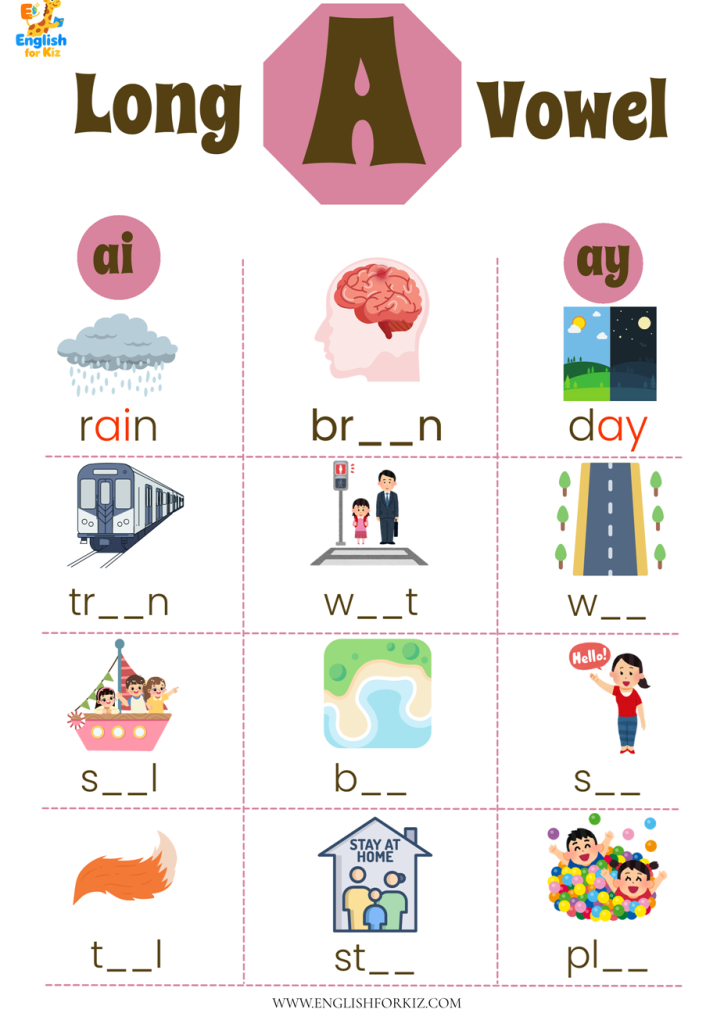
Put the AI and AY spelling pattern into practice
Our first-grade worksheet collection includes the Long ‘a’ Vowel Teams (ai, ay) activity, with picture-based spelling exercises that help children put the pattern into practice.
Explore 1st Grade Phonics Worksheets →