
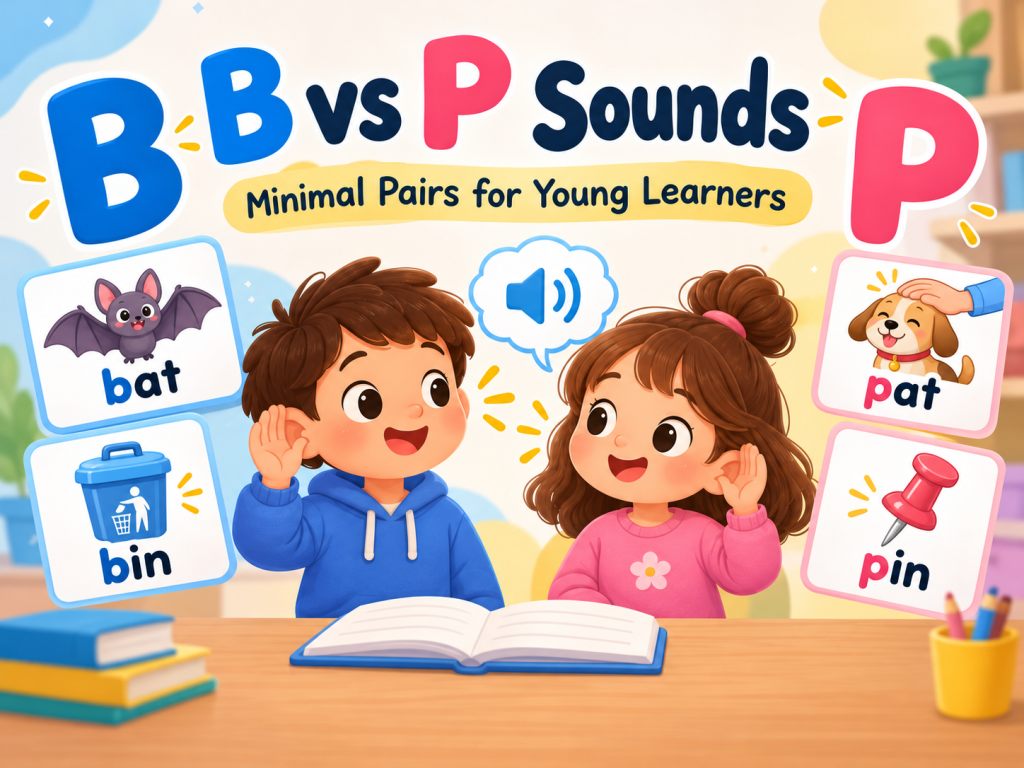
When a child hears bat but says pat, the difference may be difficult to notice at first. Both sounds begin with the lips closing and opening in much the same way. What changes is when the voice begins and, in words like these, how much air is released.
A useful way to introduce B vs P sounds is through familiar minimal pairs such as bat and pat, where changing just one sound changes the meaning. Children can listen to the contrast, explore how each sound feels, and gradually connect what they hear to the letters B and P without needing to memorize technical pronunciation terms.
How are B and P different?
The sounds /b/ and /p/ are both known as bilabial stops. This means that the two lips briefly close to stop the airflow before opening to release it. Although the mouth movements are similar, the sounds differ in voicing and, in certain positions, aspiration.
The voice may begin during the lip closure or around the release of the sound.
batUsually has a noticeable puff of air at the beginning of a stressed syllable.
patThat puff of air is called aspiration. Say bat and pat at a comfortable speaking volume. Notice how pat typically begins with a stronger release of air, even though your lips form both sounds in much the same way.
For young learners, hearing and feeling this contrast is more useful than memorizing the terms voiced and voiceless. The strength of these cues can vary between speakers and accents.
Choose real minimal pairs children understand
A minimal pair consists of two words that differ by only one speech sound. In B and P minimal pairs, replacing /b/ with /p/ changes the word without changing its remaining sounds.
These four pairs provide a small, familiar starting point for listening practice.
Use words the child already understands. For example, a picture of a pig and a gesture showing something big may be easier to work with than buy and pie if the meaning of buy is unfamiliar.
When children are beginning to connect spoken sounds with printed letters, EnglishForKiz preschool phonics worksheets offer a separate opportunity to revisit individual letter sounds and beginning-sound vocabulary.
Keep the initial listening activity focused on just two or three pairs. Adding unfamiliar words can make it difficult to tell whether the child is responding to the sound difference or trying to understand the vocabulary.
Listen before asking for a response
A child may recognize the difference between /b/ and /p/ even when producing the sounds is still difficult. Begin with listening rather than asking the child to repeat every word.
Place two pictures, safe objects, or illustrated examples in front of the child. Say both words naturally to establish their meanings. For actions such as pat, demonstrate the movement beforehand or use a picture. For pin, use a picture rather than a sharp object.
Once the child understands both choices, say one word naturally without pointing to or looking at the correct picture. If you want to focus on listening alone, position yourself so the child can hear you clearly without seeing your mouth. Invite the child to point to the matching picture or demonstrate the action.
Keep printed letters out of sight during this activity. The goal is to notice the sound difference rather than recognize the appearance of B or P.
Can You Hear the Difference Between B and P?
Use pictures or gestures to establish the choices below. An adult reads one word per round from the hidden reading script. Keep the written words and answers out of the child’s view.
Reveal the Reading Script and Answers
Read the following words one at a time, using a natural speaking voice. Allow the child to respond before moving to the next round. The word listed for each round is also its correct answer.
- Say pat.
- Say big.
- Say pin.
- Say bat.
- Say bin.
- Say pig.
When repeating the activity, change the order of the words and occasionally switch the positions of the pictures. This encourages the child to listen rather than remember which picture comes next.
If a child chooses the wrong picture, calmly model both words again and offer another opportunity to listen. Notice whether the difficulty occurs across several familiar pairs or only with a particular word. If the child consistently recognizes the words but finds them difficult to pronounce, gentle sound modeling may be a more useful next step than repeating the same listening activity.
These activities are intended for phonics practice, not for diagnosing hearing or speech difficulties. If concerns persist, discuss them with the child’s teacher or an appropriately qualified professional.
Try gentle voicing and airflow cues
Once the child has heard several examples, physical cues can help make the difference between voiced B and voiceless P easier to explore.
Feel when the voice begins
Invite the child to rest two fingers lightly against the front of their own throat while saying ba and pa at a natural volume, without pressing on the throat.
The voice may begin earlier with /b/, while /p/ typically starts without vocal fold vibration. Both syllables will produce vibration when the vowel begins, so the child is noticing the beginning of each sound rather than whether the whole syllable vibrates.
The difference can be subtle because word-initial /b/ is not always fully voiced throughout the lip closure. If it is difficult to feel, move on to the airflow activity instead.
Notice the puff of air
Hold a small piece of tissue loosely a short distance in front of the mouth and say pie and buy. The tissue will often move more noticeably at the beginning of pie.
This provides a visible example of aspiration without requiring exaggerated pronunciation or forceful blowing.
Use the tissue as an exploration tool, not a pass-or-fail test. The amount of movement depends on speaking style, sound position, and the distance between the tissue and the mouth.
Connect the sound back to B and P letters
When the child is becoming familiar with the spoken contrast, introduce the corresponding printed letters. Show B and P side by side, say a familiar word such as bat or pig, and ask the child to identify its first sound before choosing the matching letter.
For children who are already blending simple words, move on to printed pairs such as bat/pat or bin/pin. Model short, clear consonant sounds without adding an extra “uh” after /b/ or /p/, which can make blending more difficult.
Once a child can hear the difference between bat and pat, a worksheet can help connect those sounds to print. The Letter Bb and Letter Pp examples below focus on each letter separately, using familiar picture words such as bus and panda.
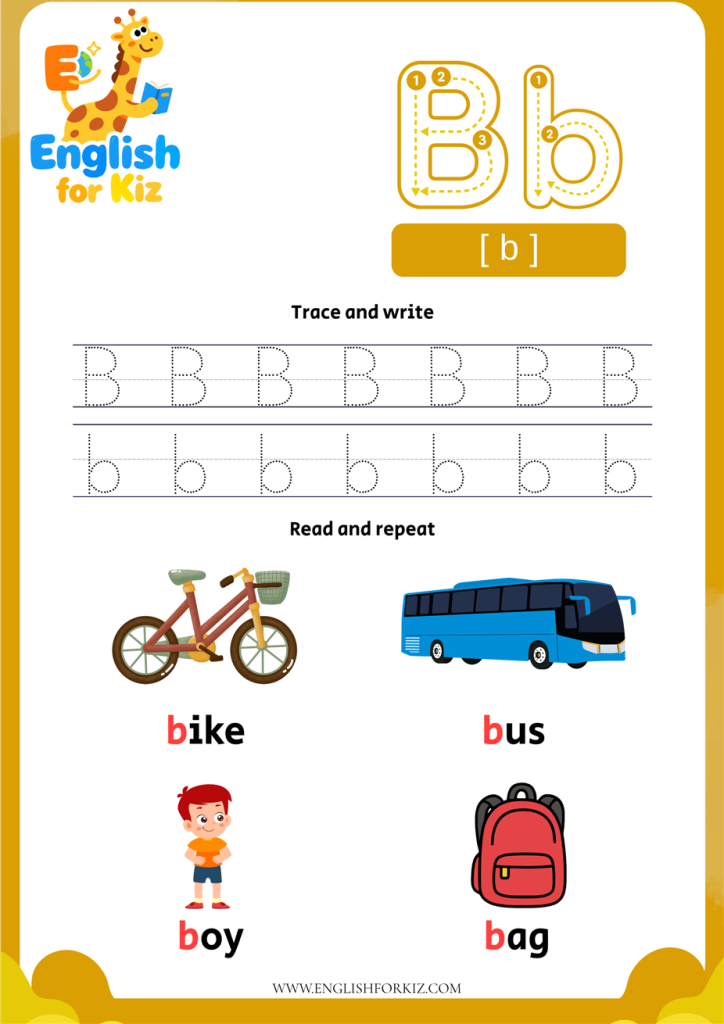 Letter Bb · Beginning Sounds
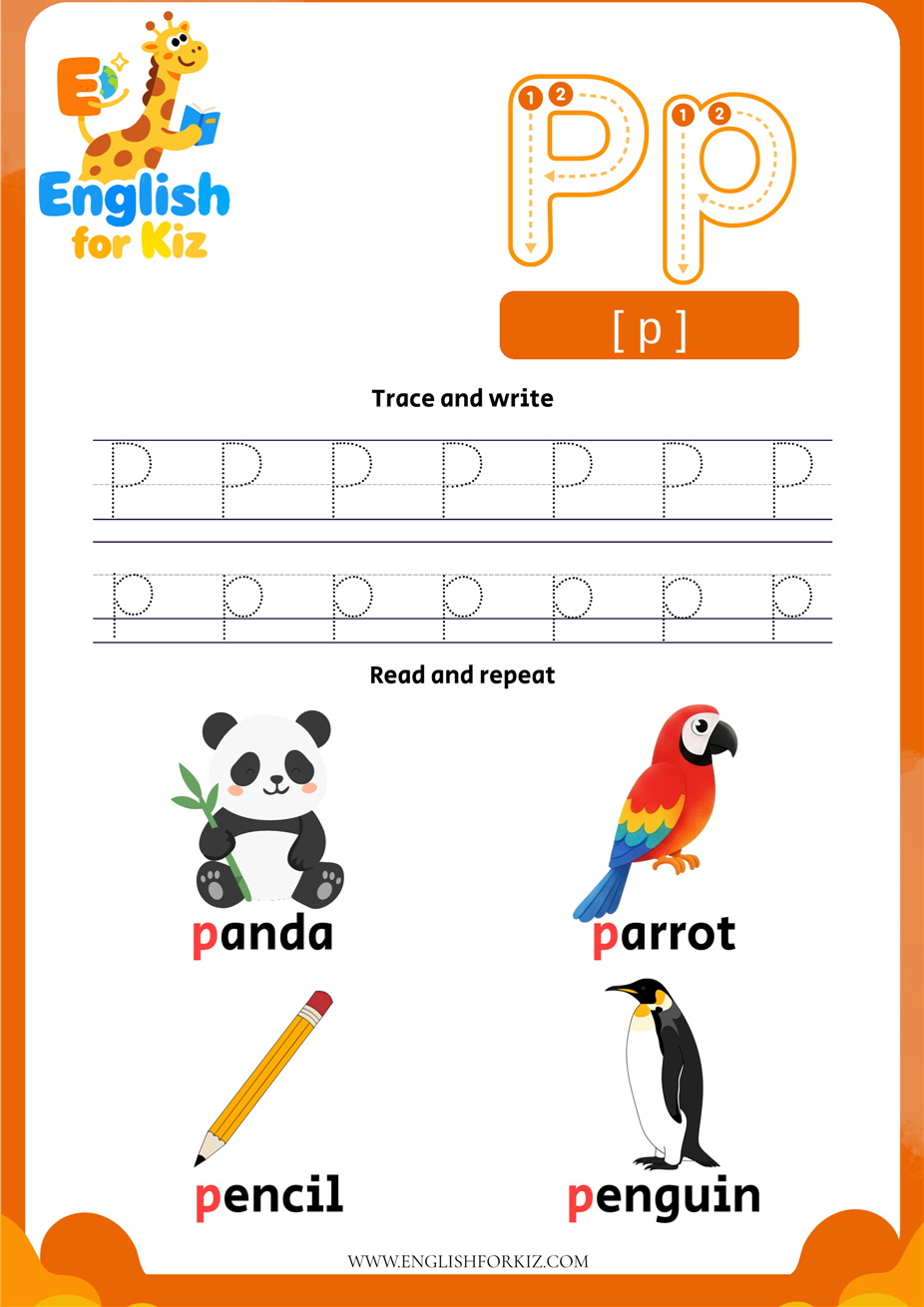 Letter Pp · Beginning Sounds
Choose the next activity according to the child’s current skills rather than their age or grade. A learner who can identify the spoken sounds but struggles with their written forms may need letter-sound practice. A learner who still confuses the spoken words may benefit from revisiting familiar listening pairs.
FAQ
Is P strongly aspirated in every position?
No. English /p/ is usually strongly aspirated at the beginning of a stressed syllable, as in pat. After /s/ within the same syllable, as in spin, it is normally unaspirated. A strong puff of air is a useful cue in certain words, not a universal rule.
Are letter reversals the same as B/P sound confusion?
No. Letter reversals involve the visual orientation or formation of written letters, while B/P sound confusion involves distinguishing or producing spoken sounds. A child may experience one difficulty without experiencing the other.
Do all learners need the same set of minimal pairs?
No. Word familiarity, pronunciation, language background, and current listening skills should guide the selection. Two well-understood pairs may be more useful than a long list containing unfamiliar vocabulary.
Distinguishing B vs P sounds begins with noticing how two similar mouth movements can produce different words. Familiar minimal pairs, relaxed listening practice, and gentle airflow and voicing cues give children several ways to explore that contrast.
Try the short listening exercise again before moving on to written practice. If particular words are still confusing, revisit those pairs rather than introducing a longer list.
Ready to Practice B and P on Paper?
If the child can distinguish familiar B and P words by listening, try a short letter-sound activity on paper. Explore the preschool worksheet collection and choose Letter Bb or Letter Pp practice based on the sound that needs more attention.
Explore Preschool Phonics Worksheets →Check the available activities and current access requirements before downloading.