
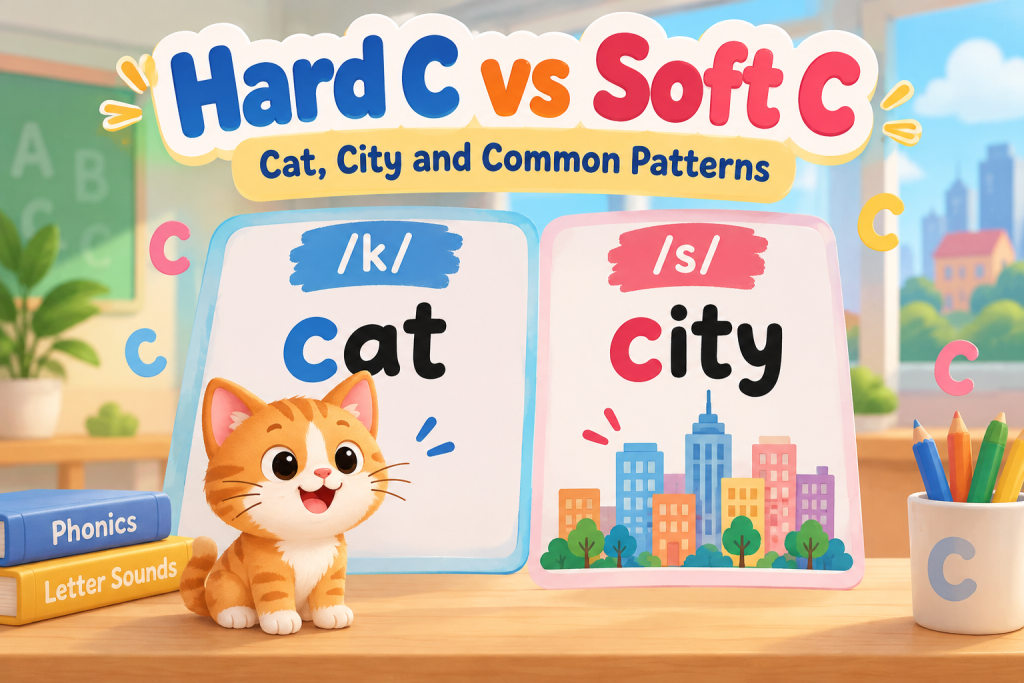
The letter C sounds like /k/ in cat but /s/ in city. The spelling hasn’t changed; the sound has. To begin understanding hard c vs soft c, look at the letter immediately after C. It usually tells readers which sound to try.
A child who reads cat but stops at city needs a clue to choose the sound—not two unrelated words to memorize.
When does C sound like /k/ or /s/?
A hard C makes /k/, the sound at the beginning of cat and cup. A soft C makes /s/, the sound at the beginning of city and cent. “Hard” and “soft” name pronunciations, not volume.
Hard CCat/k/Tap to see the clue +
Soft CCity/s/Tap to see the clue +
Read the pair aloud before pointing out the spelling. Children can hear that /k/ briefly stops and releases the airflow, while /s/ continues with a gentle hissing sound. The useful reading question is simple: Which letter comes next?
Look at the following letter
In many English words, C makes /s/ before E, I, or Y. These are the most helpful soft C clues. Before A, O, or U, it generally makes /k/. The sound /k/ is also common when C appears before another consonant, as in clap and crab, or at the end of music.
The clue also works when C appears near the end of a word. In face, the final E is silent, but it still follows C in the spelling, so C represents /s/. For this pattern, look at the next written letter, not the next spoken sound.
Once the sound contrast is familiar, a short written word sort can help children check whether they can apply the clue to new examples.
Compare a small set of hard and soft C words
Use familiar spoken words to make the pattern visible without a long memorization list.
Hard C /k/
Soft C /s/
There is an interesting twist in cycle: the first C, before Y, says /s/, but the second C, before L, says /k/. Recognizing both sounds shows attention to each C and its next letter.
One word, two C soundsOpen this little letter puzzle to see why cycle is special.cycle +
If cycle is too difficult, stay with cat, cent, and city until the sound choices are familiar.
What should happen when a word breaks the pattern?
The E, I, Y clue is reliable in many words, but it is not a rule without exceptions. The word Celtic is a useful reminder: Cambridge records both /ˈkel.tɪk/ and /ˈsel.tɪk/. Treat it as a word to check in a dictionary rather than a first practice example.
When a pronunciation does not match the expected pattern, say the word naturally or listen to a trusted dictionary recording. Confirm what it means, then record the unexpected word separately. Don’t change the sound simply to make the spelling rule work.
Pictures help with meaning, not with verifying a printed C sound. Let the child look at the letters, try the likely sound, and check the complete spoken word.
Try a C-sound decision check
Look after the highlighted C, choose /k/ or /s/, and read the whole word aloud. Focus on the marked C.
Read the word, look at the highlighted C, and choose /k/ or /s/. Each choice reveals its letter clue.
Look at the highlighted C. What sound would you try?
Sound detective: complete!
Prefer reading on paper? Open the eight-word check
Read each word aloud and decide which sound the highlighted C makes. Then reveal the answer key below.
- 01can/k/ or /s/?
- 02cent/k/ or /s/?
- 03city/k/ or /s/?
- 04cold/k/ or /s/?
- 05cycle/k/ or /s/?
- 06face/k/ or /s/?
- 07music/k/ or /s/?
- 08cup/k/ or /s/?
Reveal the answers and letter clues
- 01 · can — /k/. A follows C.
- 02 · cent — /s/. E follows C.
- 03 · city — /s/. I follows C.
- 04 · cold — /k/. O follows C.
- 05 · cycle — /s/. Y follows the first C.
- 06 · face — /s/. E follows C.
- 07 · music — /k/. C ends the word.
- 08 · cup — /k/. U follows C.
Ask for the reason behind two answers: “I chose /s/ in city because C comes before I” tells you more than a score alone. If that explanation is still difficult, return to the cent–city–cycle group and try again later.
For a child who now recognizes the /s/ sound but needs to see the spelling several times on paper, the matching worksheet collection can provide a next step. The featured Soft Sound ‘C’ page includes familiar words such as ice, face, bicycle, and city; it does not cover every exception.
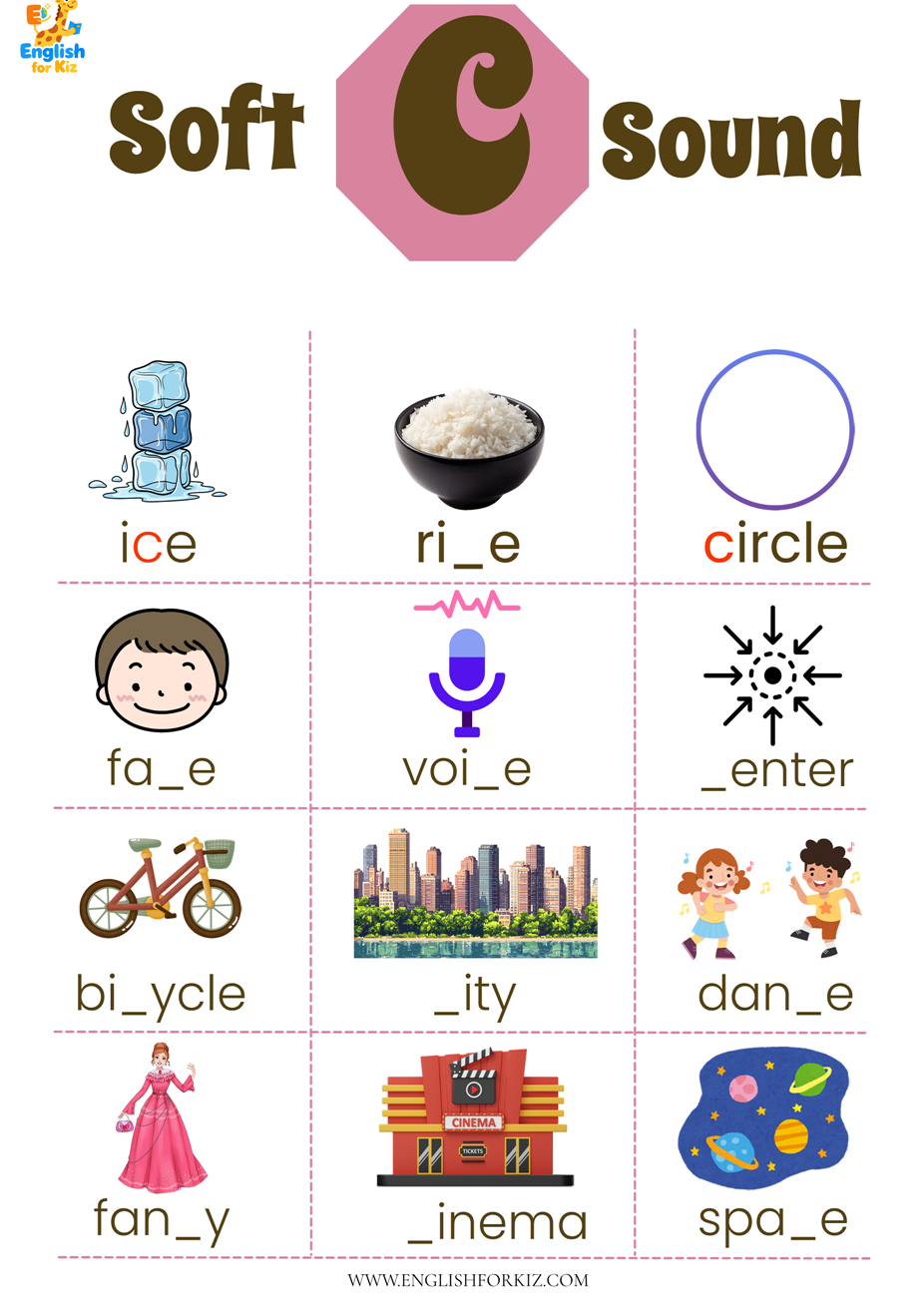
Use this page when the learner is ready to recognize soft C in written words. Check the activity against the pattern practiced above before choosing it.
Explore the Worksheet Collection Listed as VIP Exclusive. Check current access and download conditions on the collection page.FAQ
Can C before E ever keep a hard sound?
Yes. Celtic can begin with /k/, although an /s/ pronunciation is also recorded. It is an exception to the usual C-before-E pattern, so check unfamiliar pronunciations rather than treating the clue as absolute.
Is soft C the same sound as S?
Yes. Soft C in city represents /s/, the same consonant sound heard at the beginning of sun. The spellings are different, but the sound is the same.
Should CH be treated as hard or soft C here?
No. CH is a separate letter combination with its own sound patterns. Keep this comparison focused on a single C choosing between /k/ and /s/.
For hard c vs soft c, the most useful habit is to inspect the following letter, predict a sound, and check it against the word you know. E, I, and Y usually point toward /s/; many other positions point toward /k/. The occasional exception belongs in a separate review, not in the child’s first word sort.
Choose practice for the sound that needs work
Finish the decision check and revisit any missed words aloud. If a modeled explanation would help before more written practice, the 1st Grade Video Lessons include a lesson on Soft C and Soft G. Full video access requires login.
View 1st Grade Video Lessons