

A child reads chair without hesitation, then reaches chorus and tries the same CH sound. Later, chef causes another pause. The letters look identical, but the pronunciation has changed.
The three sounds of CH in English are /tʃ/ as in chair, /k/ as in chorus, and /ʃ/ as in chef. Children who already know the usual CH sound may still struggle with the other two. The most useful starting point is to let them hear the difference before asking them to read unfamiliar words.
What are the three sounds of CH?
CH is a consonant digraph: two letters that work together to represent one consonant sound. In familiar English words, this spelling can represent three different sounds.
01 · MOST COMMON Chair /tʃ/ Like CH in cheese Tap to explore
02 · HARD C SOUND Chorus /k/ Like C in cat Tap to explore
03 · SH SOUND Chef /ʃ/ Like SH in ship Tap to explore
The /tʃ/ pronunciation is the most common. That explains why a child might use it automatically, even in a word like chorus.
Try saying chair and chef aloud without showing the written words. Do they begin with the same sound? Listening first makes the contrast easier to recognize.
Sort familiar CH words by sound
Instead of memorizing a long list of exceptions, children can begin with three small groups of words. Each group gives them a familiar pronunciation to compare with new examples.
The chair group: CH says /tʃ/
This is the usual CH sound, heard at the beginning of chair. The tongue briefly stops the airflow before releasing it into the sound.
Cheese — a food made from milk
Chin — the bottom part of the face
Lunch — a meal eaten around midday
Lunch ends with CH, while the other words begin with it. All four still contain /tʃ/. This shows why letter position alone is not enough to predict pronunciation.
For children who need more written practice with familiar digraphs, EnglishForKiz has a collection of 1st grade phonics worksheets, including CH/GH practice. Check the actual activity before choosing it for a specific sound.
The chorus group: CH says /k/
Now compare chair with chorus. The beginning of chorus sounds like /k/ in cat, not /tʃ/ in chair.
School — a place where children learn
Chemistry — the study of substances and how they change
Character — a person or figure in a story
When a child asks how to pronounce CH in chorus, start by saying the /k/ sound clearly. In American English, its dictionary pronunciation is /ˈkɔːr.əs/.
School is often a helpful example because children already use the word. Once they hear /k/ in school, introduce chorus as another word with the same CH pronunciation.
The chef group: CH says /ʃ/
The CH in chef makes the same consonant sound as SH in ship. It does not begin with the /tʃ/ sound from chair.
Machine — a device that performs a task
Parachute — equipment that slows a fall through the air
Brochure — a small booklet containing information
Compare chef and ship. Their first sounds match, even though the spellings differ. In machine, the same /ʃ/ sound appears in the middle of the word.
This group often becomes more memorable when a word is connected to a familiar situation, such as a chef cooking lunch or a machine working in a kitchen.
What clues help when CH changes sound?
Sometimes a word’s history helps explain its pronunciation.
Several words with CH pronounced /k/, including chorus and character, have Greek roots. Words such as chef and machine entered English through French, which helps explain their /ʃ/ pronunciation.
Word origin can explain a pronunciation, but children cannot reliably identify a word’s history just by looking at its spelling. Neither the position of CH nor the next letter guarantees which sound to use.
When a child meets an unfamiliar CH word, begin by asking whether they have heard it before. If the pronunciation is unknown, model the word or check a reliable learner’s dictionary with audio.
Then compare its CH sound with one of the familiar words: chair, chorus, or chef. This gives the child a clear reference rather than another guess.
Quick listening checkWhich word has the same CH sound as chef: chair, school, or machine?
Read, listen and sort
The following activity helps children distinguish the three CH sounds without relying only on what the words look like.
Sound detective: complete!
You sorted all nine words.
Try two or three words aloud again without looking at the screen.
Prefer an off-screen activity? Open the word sort
Read the words aloud and sort them into the three sound groups.
lunch · chorus · chef
chin · chemistry · parachute
/tʃ/
/k/
/ʃ/
Now read these sentences:
- The chef made lunch.
- The chorus sang at school.
- Put the chair near the machine.
For a listening challenge, cover the written words while an adult says them aloud. Identify the sound before looking at the spelling.
Show the answers and explanations
/tʃ/ — chair group: chair, lunch, chin.
/k/ — chorus group: school, chorus, chemistry.
/ʃ/ — chef group: machine, chef, parachute.
Sentence 1: Chef contains /ʃ/, while lunch contains /tʃ/.
Sentence 2: Both chorus and school contain /k/.
Sentence 3: Chair begins with /tʃ/, but machine contains /ʃ/.
If a child sorts machine into the chair group, compare it aloud with chef. Their CH sounds match even though the letters appear in different positions.
For more practice beyond this quick activity, browse the 1st grade phonics games and choose a game that matches the sound or spelling skill your child has already learned.
Choose practice for the sound your child confuses
Not every child needs equal practice with all three sounds. What matters is the mistake you actually hear.
If chair, chin, and lunch are difficult, continue with /tʃ/ and familiar words before introducing the other pronunciations.
If chorus causes confusion, compare a small group of /tʃ/ words with /k/ words such as school and chorus.
If chef and machine are difficult, practice /ʃ/ and compare it with words beginning with SH.
Once the child can hear the difference, use a resource that matches the skill being practiced. A worksheet may help with recognizing spelling patterns, while a video lesson may be useful when the child needs to hear an example first.
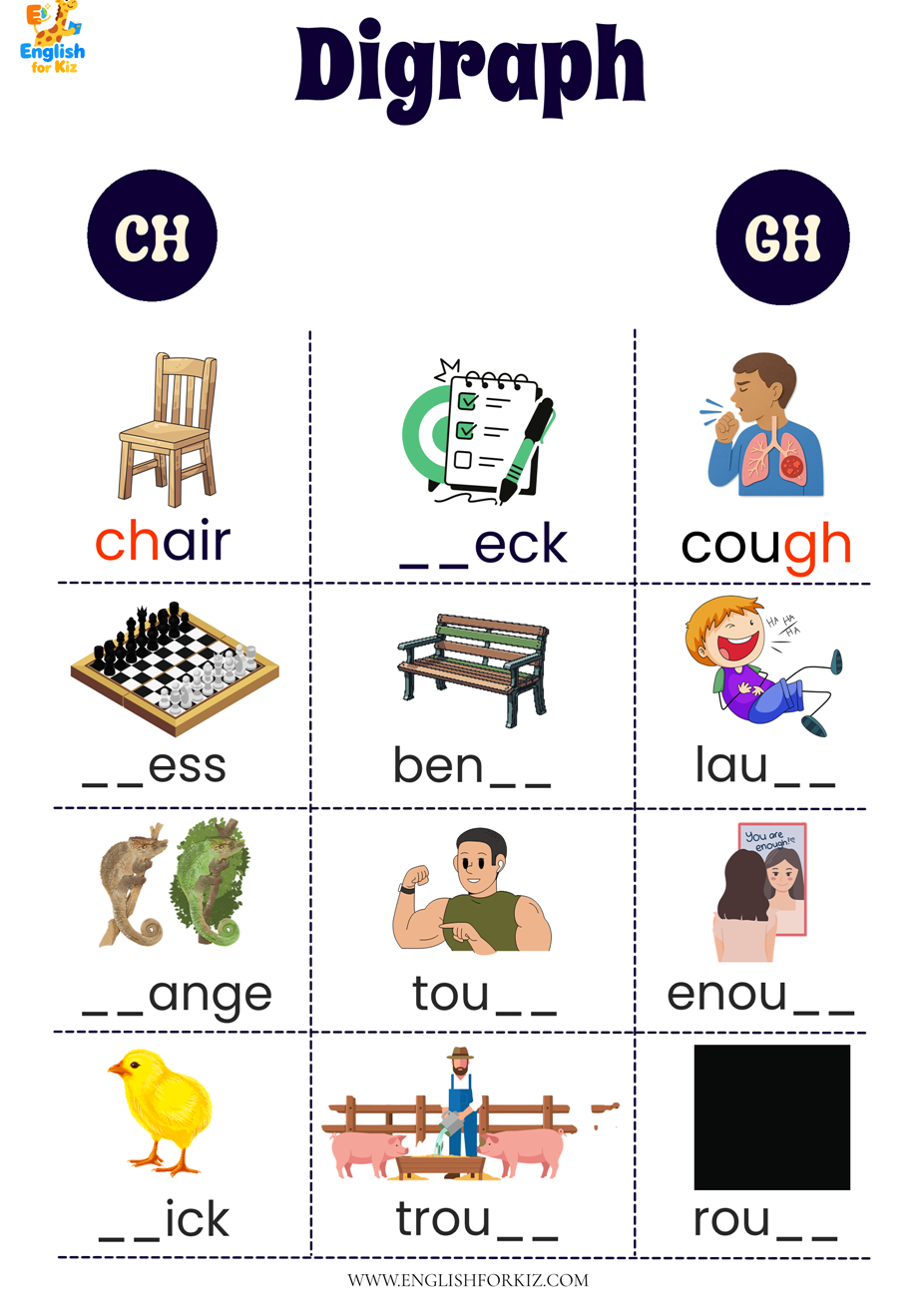
For children who need written practice recognizing familiar digraph spellings, the first-grade worksheet collection includes this CH/GH activity.
It practices CH and GH spelling, not all three CH pronunciations covered in this article.
The first-grade video library includes a Complex Digraphs lesson covering WH, CH, TCH and GH.
Consider it when the child needs modeled pronunciation before written work. It is not presented as a dedicated lesson on all three CH sounds.
Neither resource needs to replace the sorting exercise. If a child still confuses /tʃ/ and /k/, repeat a few spoken examples first. If the sounds are secure but the spelling is difficult, a relevant printable activity may offer a better next step.
FAQ
Does CH always represent one sound?
No. CH can represent /tʃ/ in chair, /k/ in chorus, and /ʃ/ in chef. The two letters work together as a spelling unit, but the pronunciation varies by word.
Can a word’s origin help predict its CH sound?
Sometimes. Greek-derived words often contain CH pronounced /k/, while some words borrowed through French use /ʃ/. These are historical clues rather than guaranteed pronunciation rules.
Should a beginner learn all three CH sounds at once?
Not necessarily. A child still learning the common /tʃ/ sound may benefit from practicing that group first. Introduce /k/ and /ʃ/ when the child is ready to compare pronunciations.
Remember: chair, chorus and chef
The three sounds of CH become easier to distinguish when children have one familiar word for each pronunciation: chair /tʃ/, chorus /k/, and chef /ʃ/.
When another CH word appears, ask the child to listen and compare it with these examples. If the pronunciation is unfamiliar, check it rather than inventing a spelling rule.
Before moving to another activity, return to the sorting exercise. The words a child still confuses provide a useful starting point for the next short practice session.
Choose the next practice step
If the child recognizes the sounds but needs spelling practice, explore the first-grade worksheet collection. If hearing and comparing digraph pronunciations is still difficult, review the first-grade video lessons.
Check the resource contents and access conditions before choosing an activity. The best starting point is the sound or spelling pattern the child is currently learning, not simply the grade label.