

A child writes b correctly during tracing, then turns it around when the page is taken away. Another child can write it neatly but hesitates when asked to find it among other letters. Both look like letter reversals, yet they call for different kinds of support. And an occasional backward letter in preschool, on its own, is not a reason to assume something is wrong.
With letter reversals in preschool, the interesting question is not simply whether a letter is backward, but when it happens. A child may recognize its shape, remember its sound, and still struggle to write it from memory. Looking at those abilities separately makes the next bit of practice more useful—and usually less frustrating.
The difference matters: Finding a letter in print, connecting it to a sound, and writing it without a model are three related skills. A child can be confident with one and still be learning another.
One Backward Letter Does Not Tell the Whole Story
Imagine three children in the same classroom, each producing a backward letter. One does it only occasionally. One confuses the letter when looking at a book. The third knows exactly which letter is which, but turns it around while writing. The visible error is similar; the learning need may not be.
Occasional reversal
The letter comes out backward once and correctly a moment later. If recognition and sound recall are otherwise secure, this may be a passing inconsistency rather than a skill that needs a whole new lesson.
Stable visual confusion
The child hesitates between b and d even when the pencil is put away. That points toward uncertainty about the printed forms, so extra copying alone is unlikely to address the immediate difficulty.
Writing-only reversal
The child finds b and says /b/ without trouble, yet reverses it when writing from memory. Here, it is the formation habit—not necessarily the letter’s identity—that still needs to settle.
Consider the child who quickly spots b, says /b/, and offers bus as an example, but draws the rounded part on the wrong side. Another stack of matching cards misses the problem. A consistent way of starting and forming the letter is more relevant.
The reverse situation is just as telling: a neat copied b, followed by pointing to d in a line of print. What looks like a handwriting issue may actually appear before writing begins. That is why the next activity should depend on what the child can already do.
Where the Confusion Begins: Shape, Sound, or Writing
You do not need a formal test to notice where the difficulty appears. In a relaxed moment, compare what happens when the child sees the letter, hears or recalls its sound, and writes it without looking at an example. Each situation tells a slightly different story.
Among familiar letters, does the child find b without looking for help?
With b in view, can the child recall /b/ or think of a familiar /b/ word?
What changes when the example disappears and the child writes the letter independently?
None of these quick observations is a diagnosis, and one attempt can be misleading. What matters is the pattern across a few ordinary practice moments. A child who knows the sound but struggles with the shape needs something different from a child who knows the shape but cannot write it.
Why Focusing on One Letter Can Help
It is tempting to place b beside d at once, because the contrast seems obvious to an adult. For a child still learning both shapes, though, the comparison can become the hardest part of the task. One familiar letter often makes a better starting point.
What this looks like during a lesson
Suppose b is the troublesome letter. Instead of beginning with a sheet full of bs and ds, the adult brings out one clear example of b. The child notices the tall line and where the rounded part belongs before any comparison begins.
The same starting point and a short, familiar movement cue make the letter easier to reproduce. If the child can copy it but still reverses it when the model disappears, that tells you more than another row of tracing would. The useful practice is a brief return to the model followed by a fresh independent try.
It is worth watching the child rather than counting completed letters. A few attentive attempts can build a steadier habit; a long row may only repeat the same mistake after concentration fades.
For a child who benefits from watching the pencil movement, the EnglishForKiz A–Z handwriting guide shows the stroke order for individual letters. A short demonstration can help make the movement clearer before the child tries it on paper again.
Keeping Letter Sounds Connected to Handwriting
The handwriting problem and the phonics problem are related, but they are not identical. A child might form a tidy b without being sure what sound it represents. In a phonics lesson, that uncertainty matters as much as the direction of the rounded stroke.
Take b. Seeing the printed letter, saying /b/, forming its shape, and hearing that sound again in bus or bag all point back to the same letter. The connection is easier to notice when the example word is already familiar.
For a child who is already confident with /b/, that sound connection may take only a moment. For a child who hesitates, it deserves more attention. The point is not to turn handwriting into a separate phonics lecture, but to let the shape and sound reinforce each other.
There is no need to test vocabulary at the same time. If bag is a word the child knows, it is enough; searching for five more /b/ words only distracts from the letter being learned.
When the difficulty goes beyond one letter
If several letters and sounds still need support, the Preschool Letter-Sound Learning Path connects letter recognition, beginning sounds, printable practice, and review in one preschool sequence.
When the child needs a different practice format
The wider letter tracing and sound worksheets library is useful when the target skill is already clear and a different practice format is needed.
What Tracing Can—and Cannot—Tell You
A perfect tracing page can be reassuring to an adult. But the dotted path makes every directional choice for the child. The revealing moment comes later, when those dots disappear. Writing the same letter independently asks for something that tracing alone does not.
The printed path shows exactly where the line begins and where it goes. The child can concentrate on feeling the movement.
Copying removes the dotted route, but the child can still look back at the finished letter for orientation.
Without an example to follow, the child has to recall both the shape and the way it is formed.
Hearing /b/ or a familiar cue word adds another task: recalling the matching written letter.
If a reversal appears only when the example is hidden, the child has shown exactly where support is still needed. Briefly seeing and copying the letter again can help, followed by another try without the model. Repeating a full tracing page is not the only option.
Can the Child Recognize the Letter Away From the Worksheet?
A handwriting habit can improve before letter recognition catches up. That is why a child who writes b confidently at the table may still hesitate when it appears in a storybook or among other letters. Changing the setting reveals whether the letter has become familiar beyond one worksheet.
Recognition away from the model
Here, b appears among letters with noticeably different shapes. The challenge is simply to recognize it wherever it sits, rather than remember its position on a familiar sheet.
When the child finds b comfortably, d can enter the picture as a comparison—but only after it has had some separate attention of its own. If even the easier mixed group remains uncertain, more writing is unlikely to be the first answer.
A small set of movable letters offers another way to see whether recognition carries over. The Alphabet Tracing Cards include A–Z letter models with stroke-order guidance; one target card and a few familiar comparisons are usually enough for this kind of review.
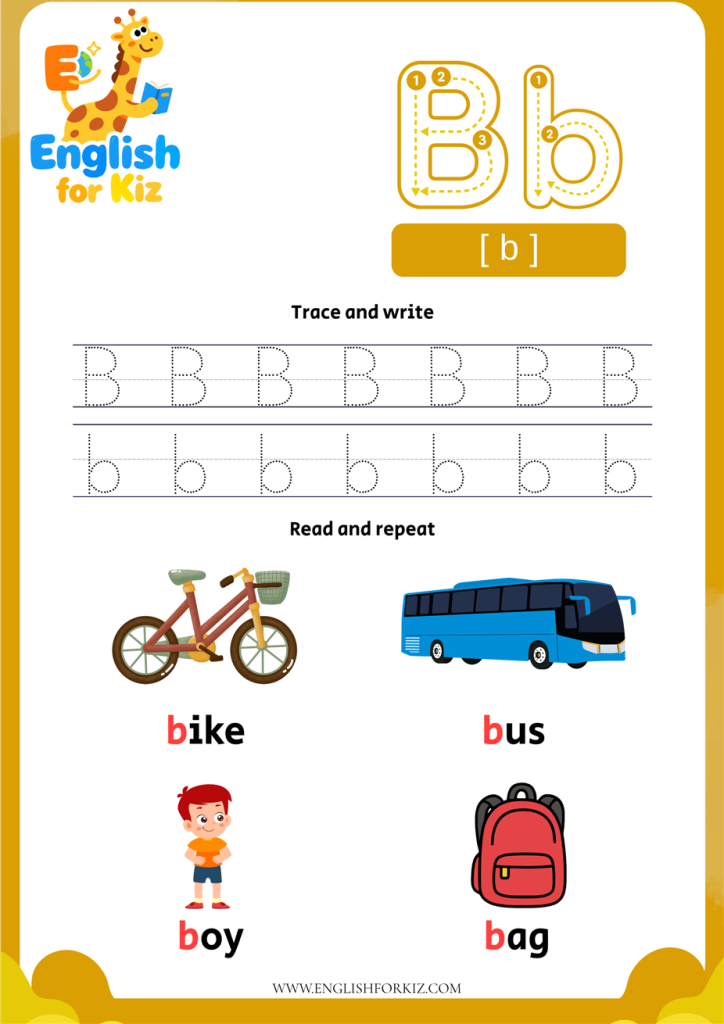
The shape of b comes first
With the letter on its own page, the child can become familiar with its shape, the /b/ sound, and the way it is written.
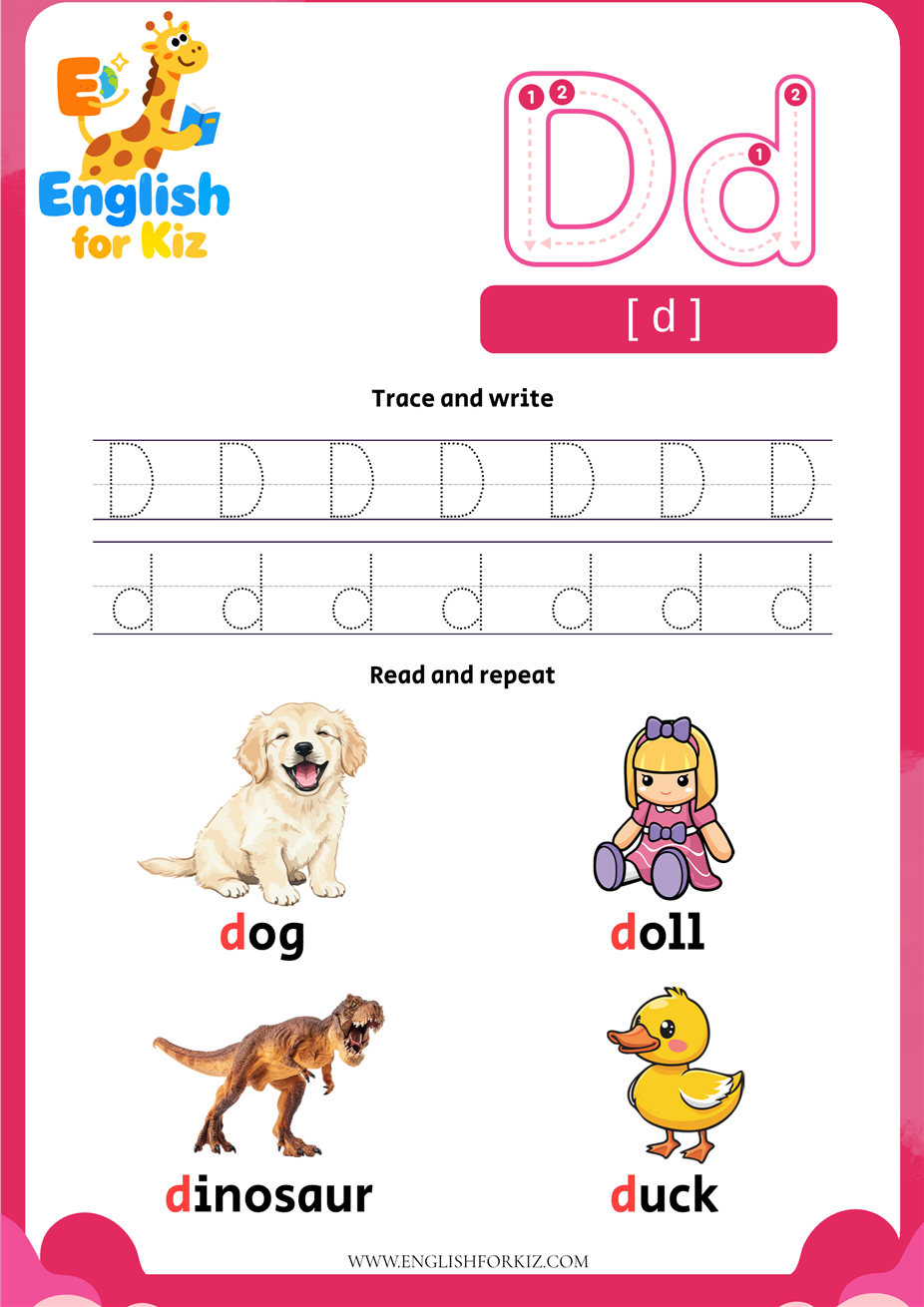
Give d its own identity
The same approach works for d. Once both forms are more familiar separately, a brief comparison becomes much more meaningful.
When More Practice Makes Letter Reversals Harder
When a letter keeps coming out backward, more worksheets can seem like the obvious solution. Yet the amount of practice is often less important than what the child is actually practicing. Three familiar approaches can accidentally make the confusion harder to resolve.
Pages of repetitive copying
A long row of letters soon becomes a race to fill the page. If the child loses track of the starting point, the same reversal may be repeated many times.
A handful of thoughtful attempts, including one without a model, reveals much more about what the child has learned.
Teaching b/d/p/q as one set
To an adult, the four forms make a tidy comparison. To a child who is still learning their directions, they may look like four versions of the same puzzle.
Comparison tends to make more sense after each letter has had a chance to become familiar on its own.
Making every reversal a big event
When every backward letter stops the activity, writing can become a test of avoiding mistakes instead of a chance to learn.
A calm model and a chance to try again usually fit the moment better than turning every slip into a separate lesson.
When Persistent Letter Reversals Need a Closer Look
A single reversed letter is rarely the most useful piece of information. A teacher is better able to help when they know whether the same mix-up happens in reading, sound work, copying, or writing from memory—and whether that pattern is changing over time.
Keep a simple observation record
A simple note can be more useful than saying “b and d are always mixed up.” It might show, for example, that the child recognizes both letters in print but reverses one only when writing independently. These observations help explain the situation; they do not diagnose a learning condition.
b, d, p, q, or another form
recognize, sound, copy, or write
none, verbal cue, or visual model
correct, hesitant, or reversed
independent or needed help
Over a few sessions, the small changes matter: quicker recognition, a more reliable starting point, or fewer reminders before the correct letter appears. Those signs tell a more useful story than whether every letter on one page is perfect.
When to talk with a teacher
Talk with the child’s teacher when reversals remain frequent despite clear and consistent practice, when the child also struggles to identify the letter or recall its sound, when writing difficulties extend beyond one confusable pair, or when frustration is making practice unproductive.
A teacher can compare what happens at home with what happens during classroom reading and writing. If broader concerns remain, a qualified professional can look at the child’s wider reading, language, handwriting, or learning profile.
A backward b by itself is not a diagnosis. The more useful evidence is the complete pattern: what the child recognizes, which sounds are secure, what happens when a model disappears, whether instruction is helping, and whether similar difficulties appear across other literacy tasks.
Choose Practice That Fits the Child’s Difficulty
The aim is not a stack of finished pages. It is the moment when the child sees the letter, knows the sound, and writes it with growing confidence and less help.
Frequently Asked Questions About Preschool Letter Reversals
Are letter reversals normal in preschool?
Letter reversals can appear while young children are still learning letter orientation, directionality, and writing movements. An occasional reversal by itself does not establish a learning disorder. Look at the wider pattern: whether the child recognizes the correct letter, recalls its sound, and can sometimes form it correctly without help.
Why can a child recognize a letter but write it backward?
Recognition and handwriting are different tasks. A child may know which printed form is b but still have an unstable motor pattern when producing it from memory. In that situation, use a consistent start point and stroke sequence, then test the letter after removing the model.
Should b and d be practiced together?
Not necessarily at first. It can be clearer to make one letter reliable, teach the other separately, and then use a brief mixed-recognition check. This reduces the number of orientation decisions the child must manage while each form is still being learned.
Can tracing alone correct reversed letters?
Tracing can help teach a stroke sequence, but it does not show whether the child can retrieve the letter independently. Follow tracing with copying, then hide the model and ask for the letter again.
What should I do when a preschooler keeps reversing b and d?
Check visual recognition, sound recall, and independent formation separately. Choose one of the two letters as the immediate target, use the same formation routine each time, connect it to its sound, and add the other letter to mixed recognition only after both have received separate practice.
When should a parent ask a teacher or specialist for help?
Ask for additional input when reversals remain frequent despite consistent teaching, occur alongside broader letter-sound or handwriting difficulties, affect many tasks rather than one letter pair, or create persistent frustration. A teacher can compare performance across settings, and a qualified professional can assess broader concerns when appropriate.