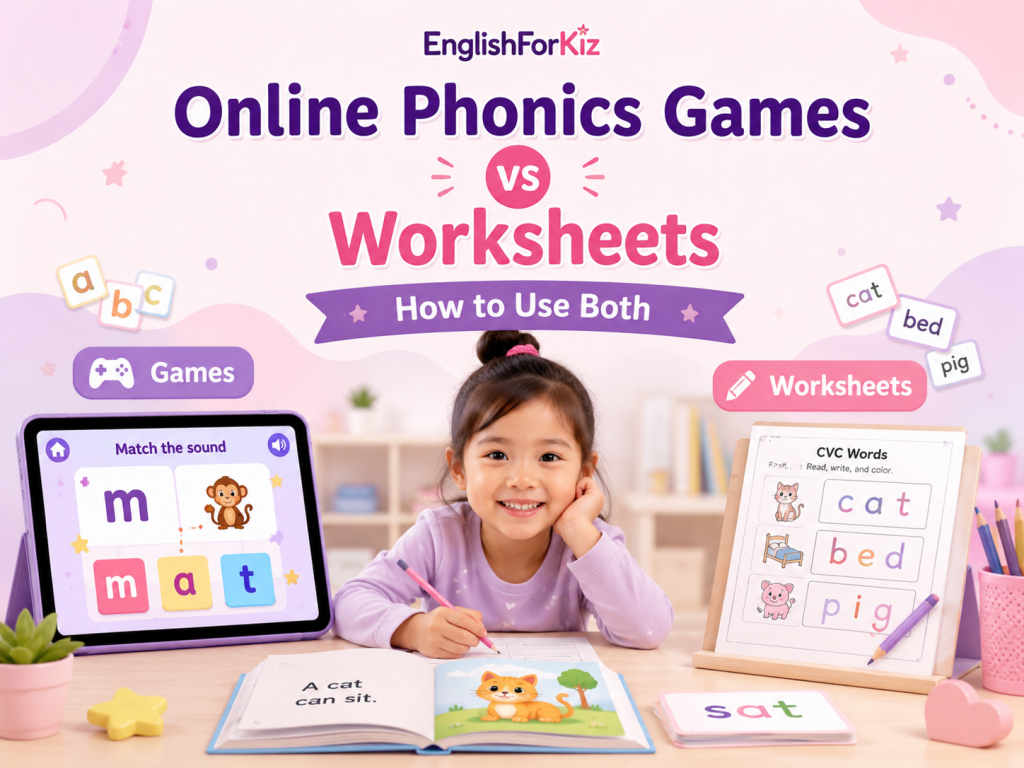
Many parents, teachers, and homeschool families compare online phonics games with printable worksheets because both seem useful, but they do not serve the same purpose. Games can make sound practice active and quick, while worksheets slow learning down for writing, spelling, and review. Therefore, the strongest phonics routine is not games against worksheets. It is games, worksheets, and reading practice working together in a clear order.
For early readers, the learning path should feel simple: hear the sound, recognize the letter, blend the word, write the pattern, and then read it in context. EnglishForKiz supports that path through focused interactive games, printable worksheets, decodable stories, flashcards, video lessons, and membership access. In addition, a structured phonics routine matters because children need repeated practice connecting letters with spoken sounds, a point also explained by Reading Rockets.
Article Navigation
Games vs Worksheets When Games Help When Worksheets Help Resource Path Weekly Plan FAQ
Online Phonics Games vs Worksheets: The Real Difference
First, digital phonics games give children a fast way to respond. A child can hear a sound, choose a picture, match a letter, or blend a word with quick feedback. Because the activity reacts right away, the child can try again without waiting for a page to be checked.
However, worksheets build a slower and more visible kind of practice. A child has to trace, write, circle, spell, or complete a word. As a result, the learning becomes easier to observe. Handwriting, vowel confusion, missing final sounds, and letter reversals can all become clear on paper.
In other words, games are helpful for energy and feedback, while worksheets are helpful for accuracy and retention. Both can support phonics for kids when each resource has a clear role inside the lesson.
When Games Work Best
To begin with, games work best when a child needs repetition without boredom. Letter sounds, beginning sounds, short vowels, CVC blending, digraph review, and vowel team recognition can all fit into a short interactive task. The key is focus. A strong game should practice one skill clearly instead of mixing too many skills at once.
Also, games work well before written practice. For example, a kindergarten learner may first identify the beginning sound in sun, sock, and seal. Then, the child can move into a worksheet that asks for the same sound in printed form. This order keeps the practice connected.
In addition, games help when attention is low. A five-minute activity can warm up the brain before handwriting or reading. For classrooms, this can become a learning station. For home use, it can become a short review before a printable page.
- Preschool: alphabet recognition, letter names, and first sound awareness.
- Kindergarten: beginning sounds, short vowels, and CVC blending.
- 1st Grade: blends, digraphs, magic e, and decoding review.
- 2nd Grade: vowel teams, r-controlled vowels, and longer word patterns.
Gentle Practice Tip
When a child needs more motivation or faster review, start with a short interactive activity. Then, move into printable work so the same skill appears again in writing.
When Worksheets Work Best
Next, worksheets work best when learning needs to become slower, cleaner, and more exact. A child may tap the right answer in a game but still struggle to write the letter. Another child may blend cat aloud but spell it as ct. Therefore, paper practice helps adults see what is secure and what still needs review.
For example, tracing pages support letter formation. CVC pages support short vowel spelling. Word family pages help children notice patterns such as -at, -an, -ig, and -op. Meanwhile, sorting pages help children compare sounds rather than memorize isolated answers.
Furthermore, worksheets give practice a record. A teacher can compare work from Monday and Friday. A homeschool parent can see whether the same sound keeps causing trouble. For this reason, printable practice is useful after short digital review, not only as a separate paper task.
Which EnglishForKiz Resource Should Start First?
A good resource choice depends on the child’s current need. Some learners need attention and sound feedback. Others need writing practice. Some are ready to move from words into short reading. Therefore, the best starting point should match the learning problem, not just the resource format.
For engagement
Phonics Games
Best for learners who need listening practice, sound recognition, confidence, and quick review before written work.
Start with Games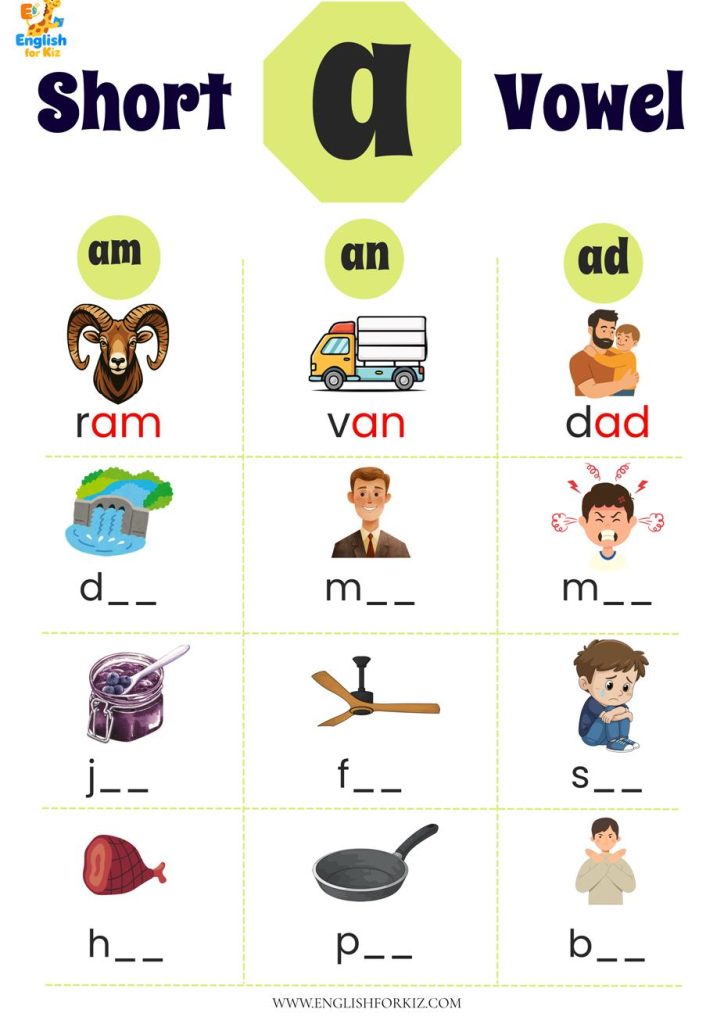
For written accuracy
Printable Worksheets
Best for handwriting, spelling, CVC review, vowel checks, word families, and visible progress tracking.
Use Worksheets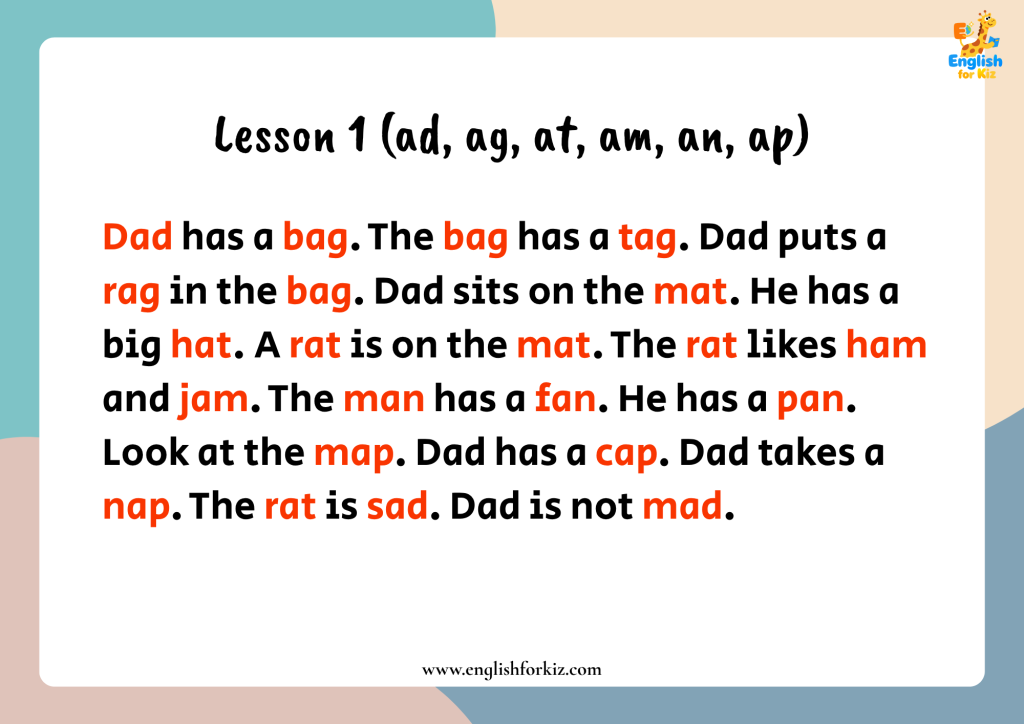
For reading transfer
Decodable Readers
Best for children who can blend words and need to apply phonics patterns inside short reading passages.
Read Stories
For complete access
Full Access
Best for families, teachers, and homeschool routines that need videos, worksheets, games, and readers in one path.
Unlock Full AccessA Simple Weekly Plan Using Both
Now, the routine should follow one skill across several formats. First, introduce the sound or spelling pattern. Then, use a game for quick recognition. After that, use a worksheet for written practice. Finally, use a short decodable text so the child reads the pattern in context.
For preschool, the weekly focus may be one letter sound. For kindergarten, the focus may be short vowels and CVC words. For first grade, the focus can move into blends, digraphs, and magic e. Meanwhile, second grade can add vowel teams, r-controlled vowels, and longer word work.
One Skill, Five Short Steps
- Monday: Introduce the target sound with a short lesson, flashcard, or oral activity.
- Tuesday: Use a focused game for listening, matching, or blending practice.
- Wednesday: Complete a worksheet for tracing, spelling, sorting, or word families.
- Thursday: Read words, phrases, or a short decodable story with the same pattern.
- Friday: Review with one game first, then finish with one short written check.
How Parents Can Use This Routine at Home
At home, short practice usually works better than long lessons. A child may begin with two minutes of sound review, play one focused game, write three to five words, and read one short line. This order keeps the session useful without making it heavy.
Also, the skill should stay consistent. If the target is short a, the game, worksheet, and reading task should all include short a words. This helps the child see the same pattern in different ways instead of jumping between unrelated skills.
How Teachers Can Use Both in Class
In classrooms, games and worksheets can work well as stations. One group can practice with the teacher. Another group can complete a worksheet. Meanwhile, a third group can use a game for review. After a short time, each group can rotate.
This setup gives teachers different kinds of information. The worksheet shows handwriting and spelling. The game shows recognition speed and sound confidence. Teacher time shows blending, correction, and oral reading. Therefore, the class receives a more complete picture of progress.
How Homeschool Families Can Plan Practice
For homeschool learning, flexibility is a major advantage. A child can spend extra time on a tricky vowel or move faster through an easy sound. However, the routine still needs structure. Without a clear path, games can become random and worksheets can feel like busywork.
A simple homeschool plan can use one weekly target. First, teach the sound. Next, play one matching or blending activity. Then, complete a printable page. Finally, read a short decodable passage. This pattern keeps practice calm, clear, and easy to repeat.
What Should Come After Games and Worksheets?
After games and worksheets, children need to apply phonics in reading. This step matters because a child may recognize a sound in a game and write it on paper, yet still pause when the same pattern appears in a sentence. Decodable readers help close that gap.
For example, a child who has practiced short a CVC words can read a short story with words like cat, mat, Sam, and map. Because the text matches the phonics lesson, the child can decode instead of guessing. As a result, reading becomes more connected to the skill just practiced.
Common Mistakes to Avoid
One common mistake is treating games as the whole lesson. Games can improve focus and feedback, but children still need teaching, writing, and reading. Therefore, a game should support instruction rather than replace it.
Another mistake is giving too many worksheets at once. A long stack of pages can make phonics feel tiring. Instead, one focused page after a game often works better. The child gets practice without losing the purpose of the lesson.
Finally, some routines mix unrelated skills. A child might play an alphabet game, complete a long vowel worksheet, and read a digraph story in the same session. That looks busy, but it does not build mastery. A stronger routine keeps one sound or pattern across the whole practice cycle.
Resource Selection Advice
If a child avoids phonics practice, start with a game. If the child can recognize sounds but struggles to spell, add worksheets. If the child can blend words but reads slowly, add decodable stories. If a complete path is easier for daily planning, choose full access.
This sequence keeps every resource useful. It also helps adults avoid random practice. The child moves from interest, to accuracy, to real reading.
FAQ
Are online phonics games better than worksheets?
No. Games and worksheets are better for different jobs. Games support attention, sound recognition, and quick feedback. Worksheets support handwriting, spelling, and slower review. Therefore, both work best when they are connected to the same phonics skill.
Can children learn phonics with games only?
Usually, games alone are not enough. Children also need direct teaching, printed letters, writing practice, and reading practice. In addition, they need time to apply sounds in words, sentences, and short decodable texts.
How should parents combine games and worksheets?
First, choose one skill for the session. Then, use a short game for review or listening practice. After that, complete one worksheet that uses the same sound or word pattern. Finally, read a few matching words or sentences aloud.
Are digital phonics games suitable for kindergarten?
Yes, they can suit kindergarten when the task is focused and short. Beginning sounds, short vowels, and CVC blending are good examples. However, the activity should match the current lesson instead of adding too many new skills.
What should come after games?
After games, children should move into writing and reading. A worksheet can check accuracy. Then, a decodable reader can help the child use the same phonics skill in connected text.
Conclusion: Use Both, but Give Each Resource a Clear Job
In the end, online phonics games work best inside a complete practice path. They make phonics active and encouraging. However, worksheets add written accuracy. Then, decodable readers help children move from isolated words into real reading.
A strong plan does not need to be complicated. It only needs a clear order: play for recognition, write for accuracy, and read for fluency. With that structure, each EnglishForKiz resource has a useful next step.
- Start with games when a child needs interest, listening practice, or fast feedback.
- Add worksheets when the goal is handwriting, spelling, and CVC word accuracy.
- Move into readers when the child is ready to apply phonics patterns in short text.