
Exploring the World of Five-Phoneme Words
When young readers first dive into the world of literacy, they usually start with simple three-letter words like “cat” or “pig.” However, as reading skills advance, children inevitably encounter more complex vocabulary that requires a deeper understanding of sound structures. One of the most significant milestones in reading development is mastering 5 phoneme words, also commonly known as 5 sound words.
Understanding how to navigate these complex sound sequences is crucial for developing strong, independent readers. Let’s break down the mechanics of five-phoneme words, the challenges they present, and the best strategies to teach them effectively.

Understanding the Terminology: Sounds, Meanings, and Beats
Before diving into complex sound structures, it is helpful to clarify some foundational linguistic terms. When evaluating how words are built, educators often refer to the phonemes vs morphemes definition: a phoneme is the smallest unit of sound in speech, whereas a morpheme is the smallest unit of meaning. For example, the word “trusts” has one morpheme for the base word (“trust”) and another for the suffix (“s”), but it contains six distinct phonemes.
Similarly, it is vital to distinguish sounds from word beats. Looking at syllables vs phonemes examples makes this clear. The word “stump” is a single syllable—it represents one unbroken beat of speech. However, it contains five individual phonemes (/s/-/t/-/u/-/m/-/p/).
The Leap to Five Sounds: Why is it Challenging?
Many parents and educators wonder: why is phonemic segmentation difficult for students as words get longer?
The answer lies in working memory. When a child masters four phoneme words (like “slip” /s/-/l/-/i/-/p/), they are already stretching their cognitive load to hold multiple sounds in their mind before blending them together. Moving to a five-sound structure requires holding even more acoustic information simultaneously. Segmenting words with five sounds means a child must recognize, isolate, and sequence every single sound before vocalizing the complete word.
Furthermore, these words often contain complex elements, particularly adjacent consonants. Decoding consonant blends in five sound words—such as the /s/-/p/-/l/ in “split” or the /n/-/d/-/s/ in “ponds”—is notoriously tricky because the consonants naturally want to merge together in our speech.
How to Count Phonemes in Complex Words
Knowing how to count phonemes in complex words is an essential skill for educators. It relies entirely on recognizing the sounds spoken, not the letters written.
To count accurately, you must pay close attention to grapheme-phoneme correspondence patterns. Sometimes, multiple letters (graphemes) represent a single sound (phoneme), such as “sh”, “ch”, or “ck”.
Here is how you would break down the word “crisp”:
- /k/ (c)
- /r/ (r)
- /i/ (i)
- /s/ (s)
- /p/ (p)
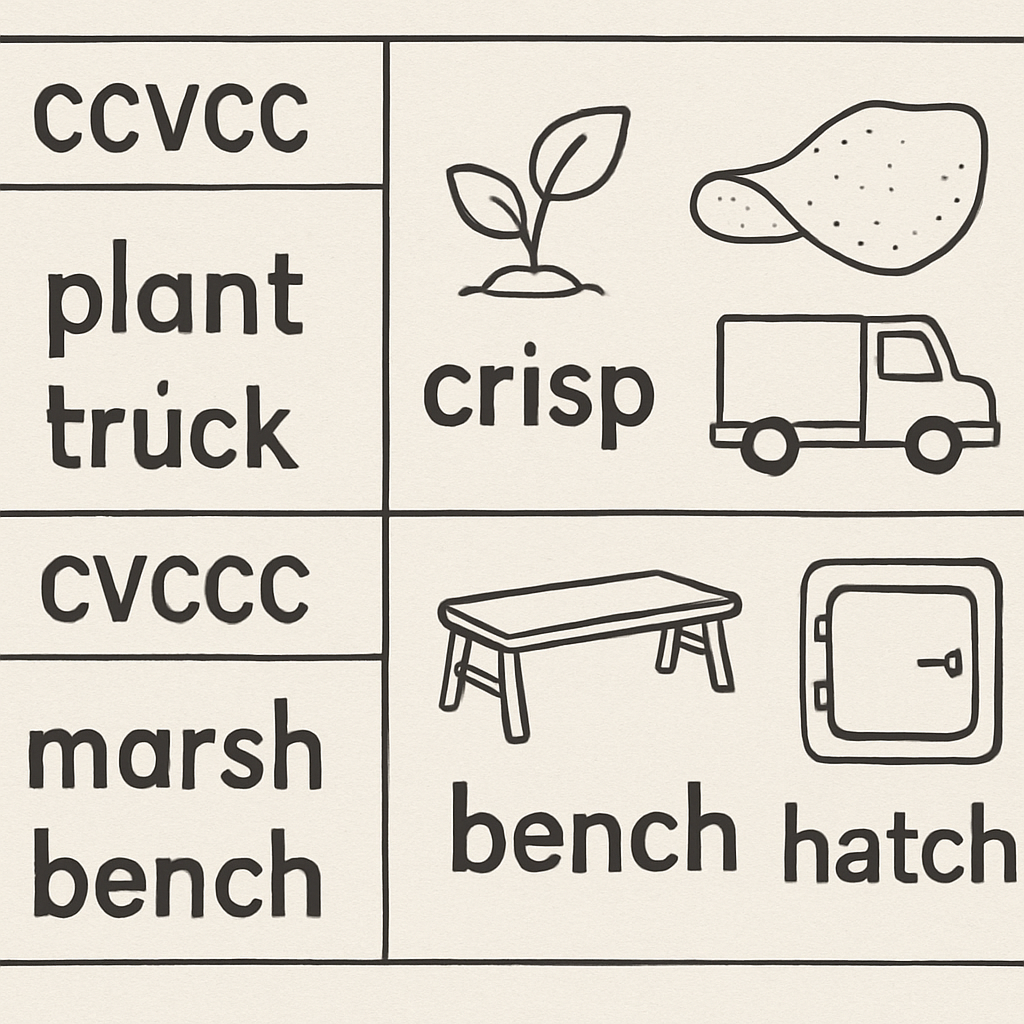
A Quick List of CCVCC and CVCCC Words
Practicing with targeted word lists is one of the most effective ways to build automaticity. By utilizing a list of CCVCC and CVCCC words (where C = Consonant and V = Vowel), you provide students with the exact phonetic patterns they need to master:
CCVCC Words (5 Phonemes):
- Bland: /b/-/l/-/a/-/n/-/d/
- Crust: /k/-/r/-/u/-/s/-/t/
- Plant: /p/-/l/-/a/-/n/-/t/
CVCCC Words (5 Phonemes):
- Facts: /f/-/a/-/k/-/t/-/s/
- Pants: /p/-/a/-/n/-/t/-/s/
- Tempt: /t/-/e/-/m/-/p/-/t/
Effective Teaching Strategies and Interventions
Building a robust foundation begins early. Teaching phonological awareness to kindergarteners through rhyming, syllable clapping, and initial sound isolation sets the stage for more advanced phonics work in first and second grade. When students are ready to tackle five sounds, tactile and visual strategies become incredibly important.
Engaging Multiple Senses
Using multisensory activities for phonemic awareness helps cement these concepts in the brain. Have students physically “tap out” the sounds on their fingers or arms. For a word like “frost,” the student taps a different finger for each of the five sounds: /f/ (thumb), /r/ (index), /o/ (middle), /s/ (ring), /t/ (pinky).
Visual Scaffolding with Boxes
Another highly effective tool is the use of sound boxes. Using Elkonin boxes for advanced blending gives students a visual framework for the invisible sounds they hear. Draw five interconnected boxes on a whiteboard. As the student segments a five-sound word, they push a physical token into a box for each sound.
This visual strategy is incredibly beneficial for eventually mapping sounds to letters in multi-syllable words, as students learn that chunks of sound represent specific letter combinations across longer vocabulary words.
Advanced Decoding and Spelling
Reading and spelling are two sides of the same coin. Once students can hear the five sounds, they need to read them accurately. Effective decoding strategies for five-sound combinations include:
- Continuous Blending: Rather than stopping between sounds (which strains working memory), teach students to hold the sound until they reach the next one (e.g., sssss-mmmm-aaaa-nnnn-tttt).
- Successive Blending: Blend the first two sounds, add the third, add the fourth, and finally the fifth (e.g., /s/ /t/ -> st, /st/ /r/ -> str, /str/ /u/ -> stru, /stru/ /t/ -> strut).
Applying these decoding techniques seamlessly leads to orthographic mapping for spelling mastery. Orthographic mapping is the mental process we use to store words for immediate, effortless retrieval. When a student maps the five distinct sounds in “blend” to their corresponding letters, the word becomes permanently stored in their sight-word memory, allowing for fluent reading and accurate spelling down the road.

Measuring Success
To ensure your instructional methods are working, routine evaluation is necessary. Administering a targeted phonics assessment for reading fluency will quickly highlight whether a student is struggling with the initial blend, the vowel, or the final blend of 5 phoneme words. Assessment data allows you to pivot your instruction, providing targeted intervention exactly where the student needs it most.
Mastering words with five sounds is a significant academic hurdle, but it is also a gateway to reading fluency. By understanding the phonetic makeup of these words, anticipating the cognitive challenges, and utilizing hands-on, multisensory teaching tools, you can help students transition from decoding simple words to reading complex texts with confidence.