Understanding Long and Short Vowel Sounds
English spelling and pronunciation can often feel like a complex puzzle. At the very heart of this puzzle are the building blocks of spoken and written language: vowels. Whether you are a parent helping your child learn to read, an educator refining your literacy curriculum, or a student mastering a new language, understanding long and short vowels is the essential first step toward fluency.
The English alphabet has twenty-six letters, but only five primary vowels: A, E, I, O, and U (with Y occasionally stepping in). Despite this small number, these letters are responsible for producing dozens of distinct sounds. The most critical distinction to master early on is the difference between a long vowel vs short vowel.
In this comprehensive guide, we will break down the mechanics of English vowel sounds. We will explore extensive word lists, uncover the phonetic rules that govern pronunciation, and provide actionable teaching strategies to help readers of all ages master long and short vowel words.
The Foundation: What Are Vowels?
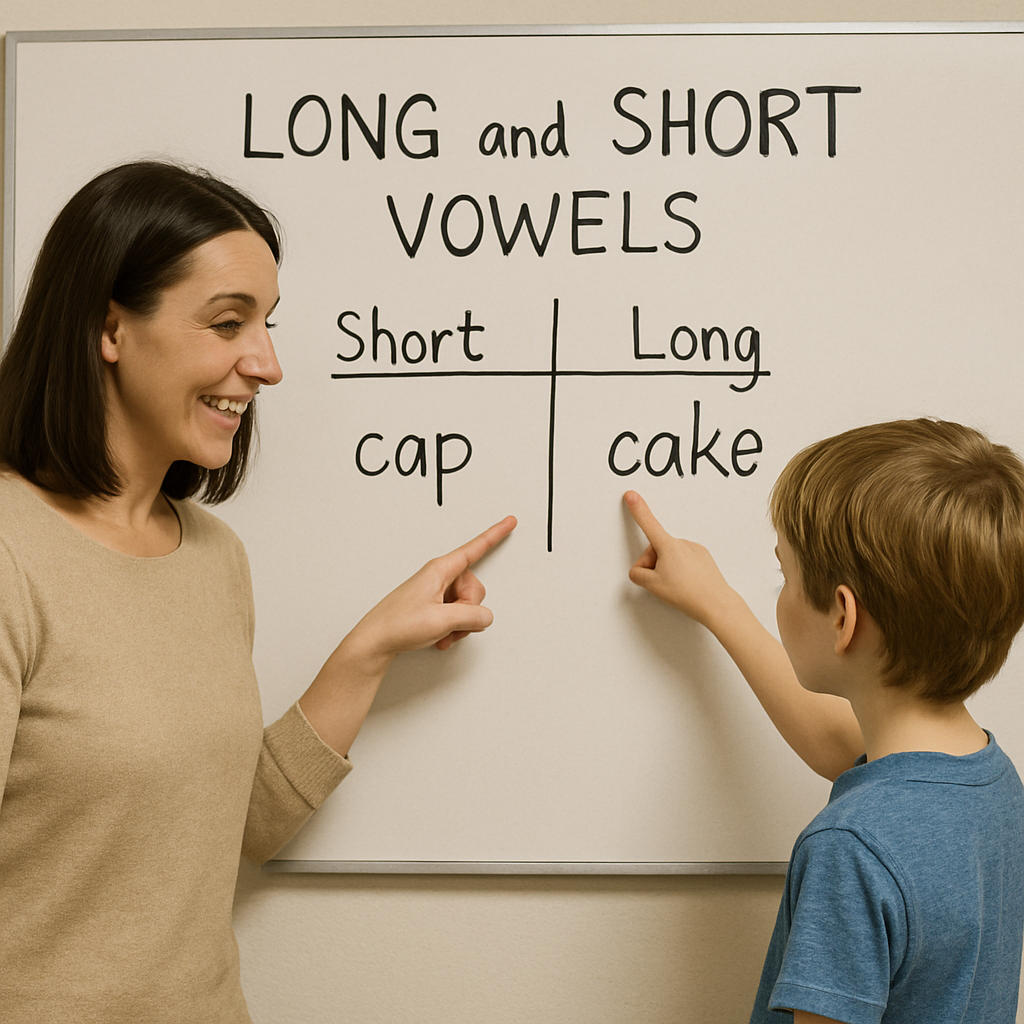
Before diving into the differences between long vowels and short vowels, it helps to understand what a vowel actually is. In linguistics, a vowel is a syllabic speech sound pronounced without any stricture in the vocal tract. Unlike consonants, which are formed by obstructing the airflow with the lips, teeth, or tongue, vowels are shaped by the open mouth.
So, why do some vowels sound different? The answer lies in the historical evolution of the English language—specifically the Great Vowel Shift—and the surrounding consonants that dictate a vowel’s behavior in a syllable. Depending on its position in a word and the letters next to it, a single vowel letter can make multiple sounds.
Differentiating Tense and Lax Vowels
In linguistic terms, the distinction between long vowels and short vowels is often described as differentiating tense and lax vowels.
- Tense Vowels (Long Vowels): These require more muscle tension in the mouth and jaw. The sound is held longer.
- Lax Vowels (Short Vowels): These require less muscle tension. The vocal organs are relatively relaxed, and the sound is clipped and short.
Marking Vowels with Macrons and Breves
When learning how to identify vowel sounds in words, visual cues are incredibly helpful. Dictionaries and phonics programs use specific diacritical marks:
- The Breve ( ˘ ): A curved mark placed over a vowel to indicate a short sound (e.g., ă as in apple).
- The Macron ( ¯ ): A straight line placed over a vowel to indicate a long sound (e.g., ā as in ape).
Marking vowels with macrons and breves is a standard practice in phonics instruction for struggling readers, as it provides an immediate, visual decoding strategy before the student even sounds out the word.
Exploring Short Vowel Sounds
Let’s start with the basics: short vowel sounds. These are typically the first sounds taught to early readers because they are highly consistent. A short vowel sound does not sound like the letter’s name. Instead, it produces a distinct, crisp sound, usually found in the middle of a syllable.
Short Vowels Examples Breakdown
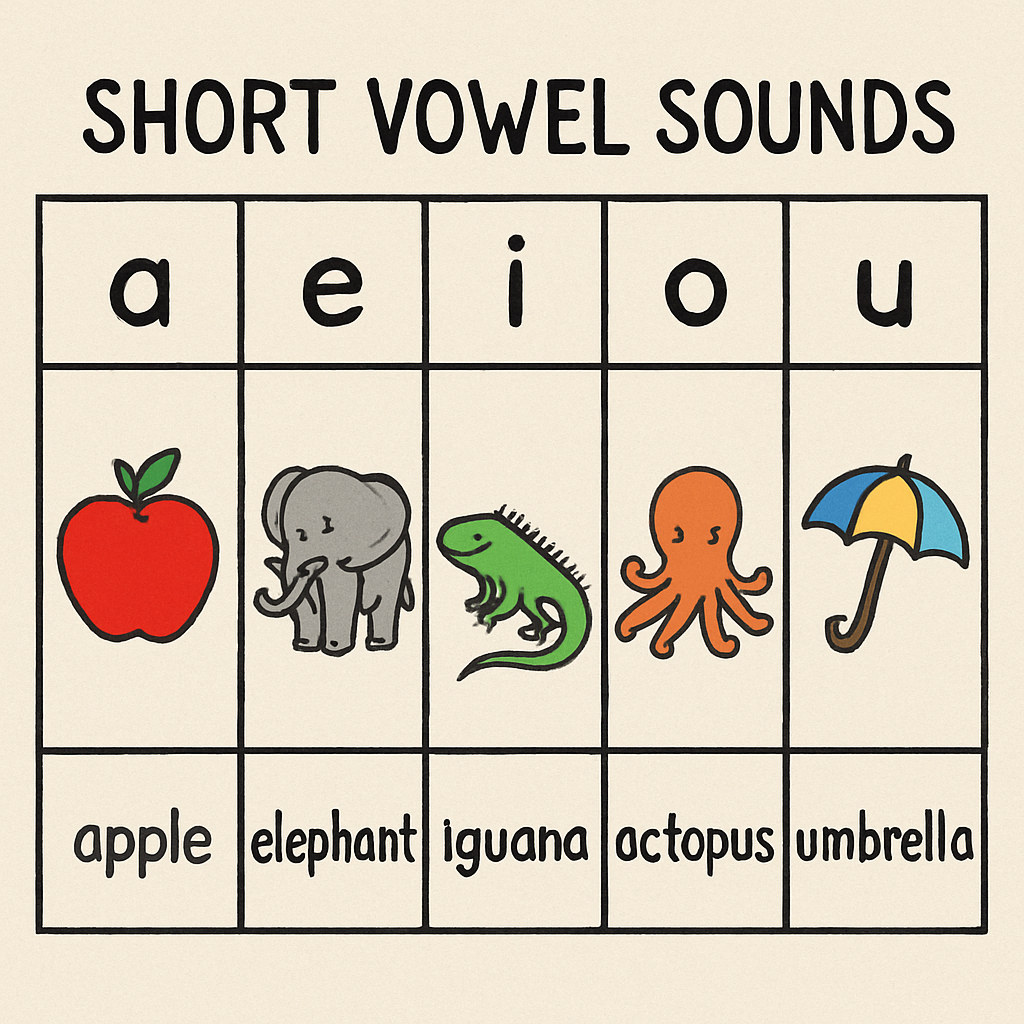
To master reading, one must first master the short sounds. Here is a breakdown of the five primary short vowels examples:
- Short A (ă): This sound is made with the mouth wide open and the tongue resting low. Think of the sound at the beginning of alligator or the middle of cat.
- Short E (ĕ): The mouth is partially open, and the lips are slightly stretched. Think of the sound in egg or bed.
- Short I (ĭ): The teeth are close together, and the lips are relaxed. Think of the sound in igloo or sit.
- Short O (ŏ): The mouth drops open wide into an oval shape. Think of the sound in octopus or log.
- Short U (ŭ): The jaw drops slightly, and the sound comes out neutrally from the throat. Think of the sound in umbrella or cup.
Comprehensive Short Vowel Word List
Building a robust vocabulary requires recognizing patterns. Below is a practical short vowel word list categorized by vowel. These are all short vowel words that follow standard phonetic rules:
- Short A Words: bat, map, sad, flag, hand, track, glass.
- Short E Words: net, red, pen, smell, desk, sled, tent.
- Short I Words: pig, lip, win, fish, brick, spin, milk.
- Short O Words: dog, hop, box, clock, frog, drop, pond.
- Short U Words: sun, bug, tub, jump, drum, plug, hunt.
When teaching early literacy, utilizing a list of CVC and CVCE words is standard practice. CVC stands for Consonant-Vowel-Consonant. Words like cat, dog, and pig are CVC words, and they almost exclusively feature short vowel sounds.
Understanding Long Vowel Sounds
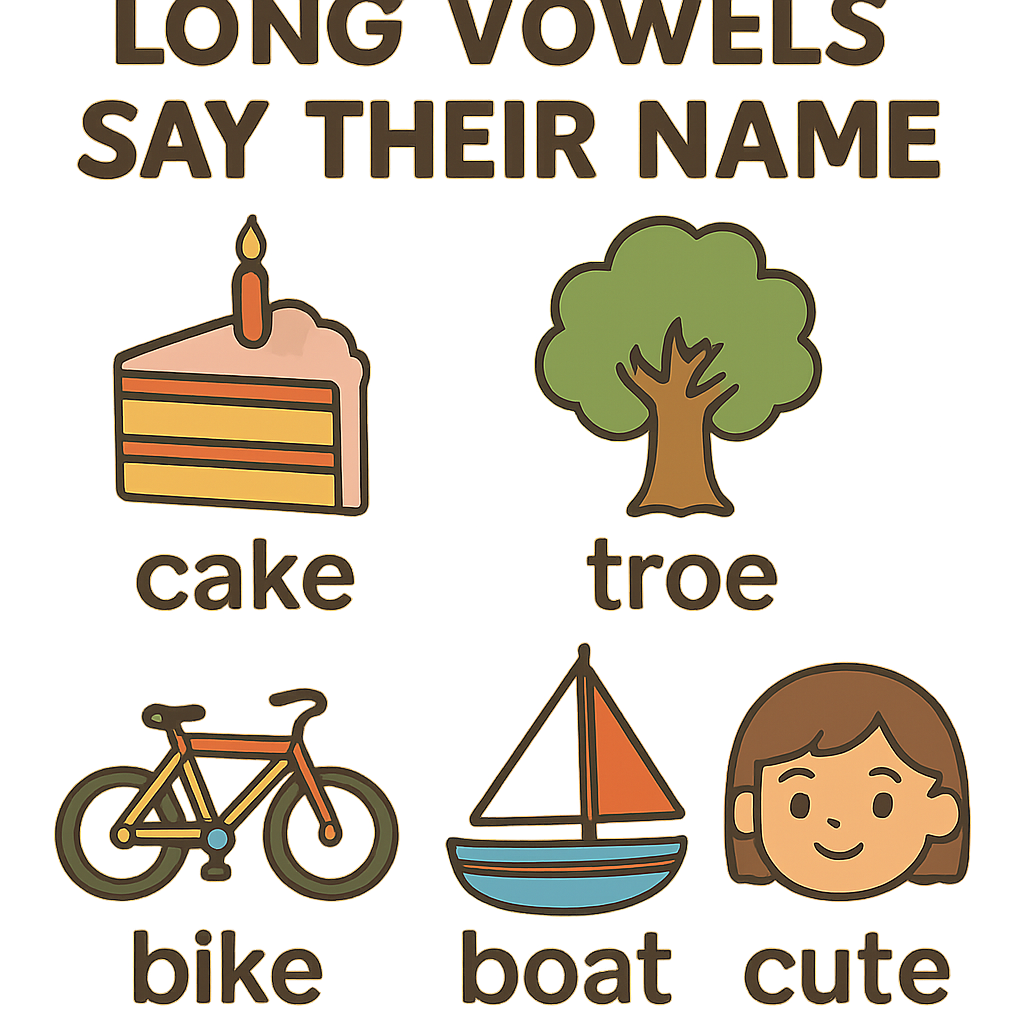
Once a reader has grasped the short sounds, it is time to introduce long vowel sounds. The simplest rule of thumb taught in elementary schools is that a long vowel “says its name.” For instance, the long A sounds exactly like the letter A when you recite the alphabet.
When looking for words that have long vowel sounds, you will notice that they often contain more than one vowel letter. This brings us to the complex spelling patterns of English.
What Does Long A Sound Like?
If you are wondering, “what does long a sound like?”, it is pronounced as /eɪ/. It is a gliding vowel (a diphthong), meaning your mouth slightly changes shape as you produce the sound, moving from an open ‘e’ sound to a closed ‘i’ sound. You hear it clearly in the word make.
If you need words that have long a sound, words like bake, train, play, and baby are perfect examples. To help students practice, here is a dedicated long a vowel sound words list:
- A-E (Magic E): face, game, brave, snake, plate.
- AI (Vowel Team): rain, snail, paint, train, brain.
- AY (Vowel Team): day, play, tray, stay, holiday.
- Open Syllable A: basic, acorn, paper, table.
Long Vowels Examples (E, I, O, U)
To round out our understanding of long vowel words, let’s look at the other four vowels:
- Long E (ē): Sounds like “ee”. Examples: me, tree, leaf, piece, monkey.
- Long I (ī): Sounds like “eye”. Examples: hi, bike, light, fly, spider.
- Long O (ō): Sounds like “oh”. Examples: go, boat, snow, bone, open.
- Long U (ū): This is unique because it can make two sounds. It can say “yoo” (as in cube or music) or simply “oo” (as in flute or blue).
Is Cake Long or Short Vowel?
A very common question from parents helping with homework is, “is cake long or short vowel?” The word cake features a long A sound. This is because of the “Silent E” at the end of the word, which reaches over the consonant ‘k’ to make the ‘a’ say its name.
Is Cube Long or Short Vowel?
Similarly, people often ask, “is cube long or short vowel?” The word cube is a long vowel word. The silent E at the end makes the U say its long “yoo” sound. If you removed the E, the word would become cub, which is a short U word.
Long A vs Short A Sound: A Deep Dive
To truly understand phonics, it helps to compare sounds directly. The long a vs short a sound is an excellent case study. Distinguishing between a long a sound short a sound is crucial for decoding and spelling accuracy.
Let’s look at a side-by-side comparison of long a words and short a words. We can do this using “minimal pairs”—words that differ by only one sound.
| Short A Word (ă) | Long A Word (ā) | What Changed? |
| Mat | Mate | Added a silent E |
| Cap | Cape | Added a silent E |
| Plan | Plane | Added a silent E |
| Tap | Tape | Added a silent E |
| Ran | Rain | Added a vowel team (i) |
| Pad | Paid | Added a vowel team (i) |
By practicing these minimal pairs, students can physically feel the difference in their mouths. The short A is sharp and drops the jaw (lax), while the long A stretches the lips back and requires more tension (tense). Providing a mixed long and short vowel word list and asking students to sort them is a highly effective educational activity.
The Rules of the Game: Syllable Types
Why is the ‘o’ in got short, but the ‘o’ in go is long? To answer this, we must delve into syllable types. Common spelling rules for English vowels are heavily dictated by where the vowel sits within a syllable.
There are six main syllable types in English, but the three most important for determining long and short vowel sounds are Closed, Open, and Silent E.
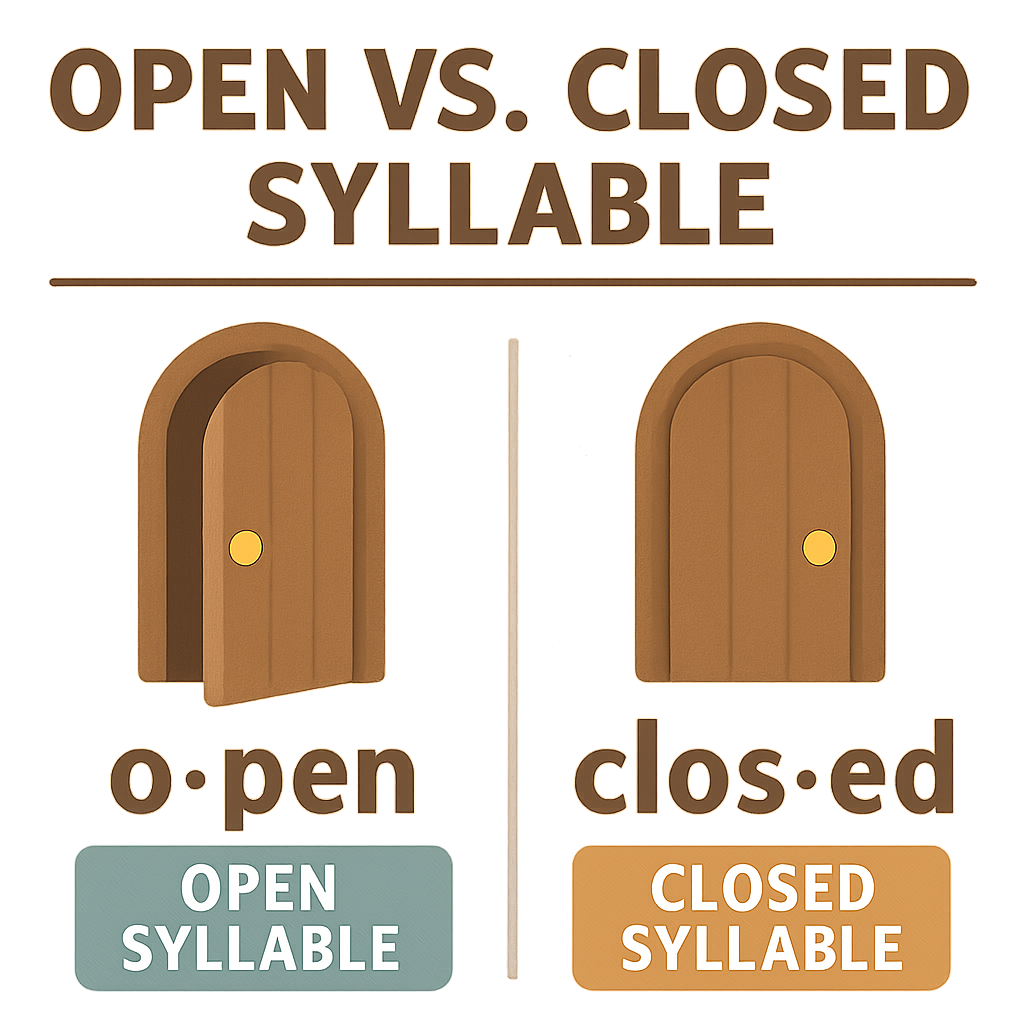
Difference Between Open and Closed Syllables
The difference between open and closed syllables is arguably the most important phonics rule an English learner can master.
1. Closed Syllables: A closed syllable ends in a consonant. The consonant “closes in” the vowel, essentially trapping it and forcing it to make a short vowel sound.
- Examples: cat, pen, fish, stop, bug.
- Rule: If a syllable has only one vowel and ends with a consonant, the vowel is almost always short. This is where your short vowel words originate.
2. Open Syllables: An open syllable ends with a vowel. Because there is no consonant to close it in, the vowel is free to shout its name, creating a long vowel sound.
- Examples: me, go, fly, we, she.
- In multi-syllabic words, open syllables explain the long sounds in words like ba-by, ti-ger, and ro-bot.
Silent E Syllable Patterns Explained
The third critical pattern is the Vowel-Consonant-E (VCe) pattern, commonly known as Magic E, Bossy E, or Silent E.
Silent e syllable patterns explained: When a syllable follows the pattern of one vowel, followed by one consonant, followed by a silent ‘e’, the first vowel is long. The ‘e’ does not make a sound; its sole job is to give all its power to the preceding vowel so it can say its name.
- Short to Long transformations:
- kit ➔ kite
- slop ➔ slope
- tub ➔ tube
- can ➔ cane
This is the exact pattern that answers the earlier questions regarding whether cake or cube are long vowel and short vowel words. Both belong to the CVCE category, making them firmly long vowel words.
Vowel Team Rules and Examples
Another way to create words with long sound is through vowel teams. A vowel team is a combination of two, three, or four letters standing together to make one vowel sound.
A popular (though not foolproof) rhyme used to teach this is: “When two vowels go walking, the first one does the talking.” While there are exceptions, it serves as a great starting point for beginners.
Vowel team rules and examples:
- AI / AY: Both make the long A sound. Ai is usually used in the middle of a word (rain), while ay is used at the end (play).
- EE / EA: Both make the long E sound. Examples include tree, meet, leaf, and beach.
- OA / OW: Both can make the long O sound. Examples include boat, soap, snow, and glow.
- IGH / IE: Make the long I sound. Examples include night, high, pie, and tie.
By understanding vowel teams alongside open/closed syllables and silent E, you unlock the vast majority of long vowels and short vowels in the English dictionary.
Exploring CVC and CVCE Patterns
To provide a concrete resource for educators and parents, here is a comparative list of CVC and CVCE words. This chart clearly demonstrates how adding a single letter alters the phonetic structure from short vowel words and long vowel words.
| Vowel | CVC Word (Short Sound) | CVCE Word (Long Sound) |
| A | mad (măd) | made (mād) |
| A | fat (făt) | fate (fāt) |
| E | pet (pĕt) | Pete (Pēt) |
| I | bit (bĭt) | bite (bīt) |
| I | rip (rĭp) | ripe (rīp) |
| O | rob (rŏb) | robe (rōb) |
| O | hop (hŏp) | hope (hōp) |
| U | cut (cŭt) | cute (cūt) |
| U | hug (hŭg) | huge (hūj) |
When doing word sorts, having students match the short vowels to their long vowel counterparts is incredibly effective. This solidifies their understanding of long and short vowel words.
The Tricky Parts of English Vowels
English is notoriously full of rule-breakers. While mastering long and short vowels will give you the tools to decode about 85% of English words, there are other phonetic phenomena you must be aware of.
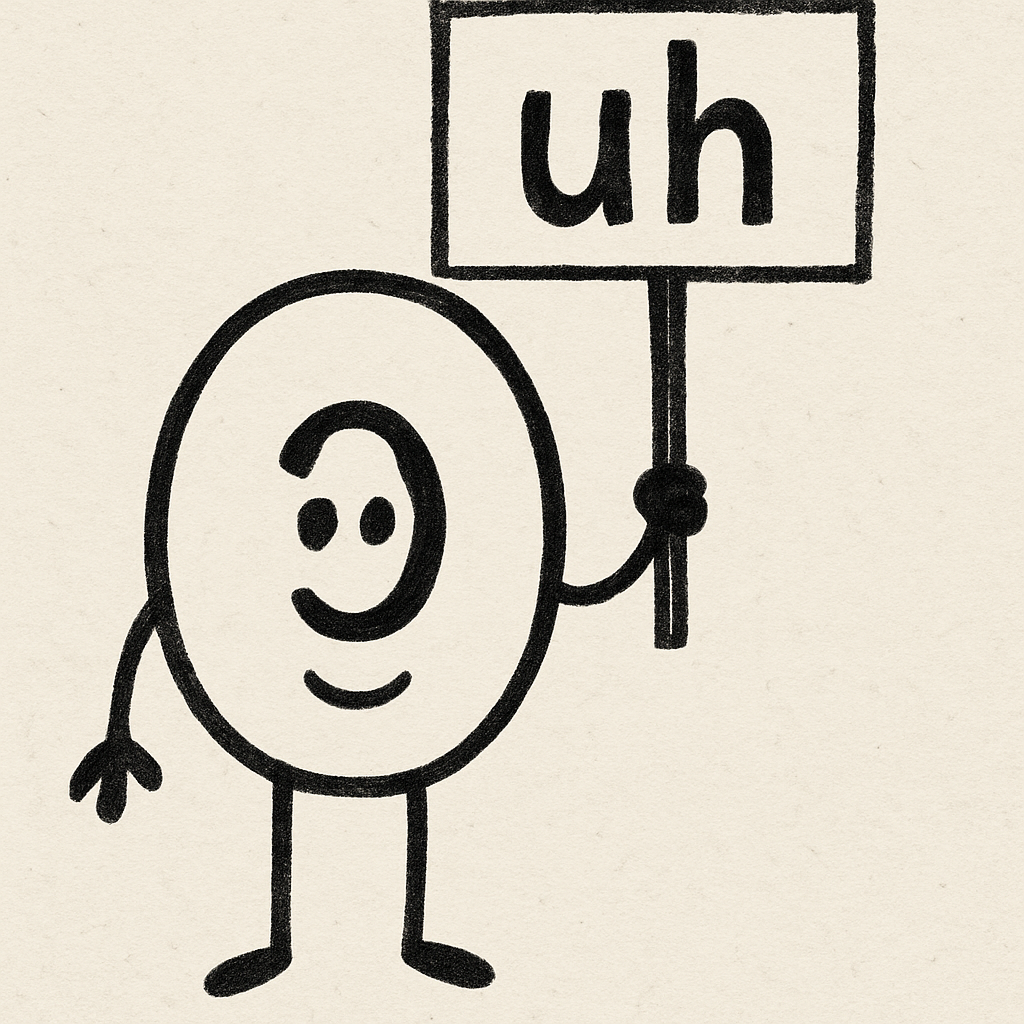
Understanding the Schwa Sound in English
The most common vowel sound in the English language is actually neither a traditional long nor short vowel. It is the schwa.
Understanding the schwa sound in English is vital for reading multi-syllabic words. The schwa is an unstressed vowel sound that sounds like a lazy, short “uh” (phonetically represented by an upside-down e: /ə/). Any vowel can make the schwa sound in an unstressed syllable.
- The ‘a’ in about (/ə-bout/)
- The ‘e’ in item (/i-təm/)
- The ‘i’ in pencil (/pen-səl/)
- The ‘o’ in lemon (/lem-ən/)
- The ‘u’ in circus (/cir-cəs/)
When teaching how to identify vowel sounds in words, educators must explain that if a vowel isn’t making its expected long or short sound, it is likely a schwa.
R-Controlled Vowels
Another exception occurs when a vowel is immediately followed by the letter ‘r’. The ‘r’ acts like a bossy manager, changing the vowel’s sound so it is neither long nor short.
- ar as in car
- er, ir, ur all typically make the /er/ sound (her, bird, turn)
- or as in fork
How to Teach Vowel Sounds Effectively
Teaching long and short vowels requires patience, multi-sensory techniques, and clear, explicit instruction. Whether you are dealing with a preschooler or an adult ELL (English Language Learner), the methodologies share common ground.
Phonemic Awareness Activities for Beginners
Before children can read letters on a page, they must be able to hear and manipulate sounds in spoken language. This is phonemic awareness. Here are effective phonemic awareness activities for beginners focusing on short vowel sounds and long vowel sounds:
- Sound Sorting (Auditory): Say a list of words and have the child jump to the left if they hear a short A sound (apple, cat) and to the right if they hear a long A sound (ape, cake). This isolates the auditory recognition of the long a vs short a sound.
- Vowel Stretching: Have students hold a pretend rubber band. As they say a CVC word like s-u-n, have them stretch the rubber band wide on the short ‘u’ sound to emphasize the vowel in the middle.
- Odd One Out: Orally provide three words (e.g., bat, hat, boat). Ask the student which word doesn’t belong based on the middle vowel sound.
- Mirror Practice: Have students look in a small mirror while articulating short vowels. Because short vowels require different mouth shapes, seeing their jaw drop for short O vs stretching wide for short I builds a physical connection to the sound.
Word Mapping for Phonics Mastery
One of the most scientifically backed methods for teaching spelling and reading is orthographic mapping. Word mapping for phonics mastery helps move words from a reader’s short-term memory into their long-term sight word memory.
Here is how to map long and short vowel words:
- Say the word: The teacher says the word (e.g., sheep).
- Tap the sounds: The student taps their fingers for each sound they hear: /sh/ /ee/ /p/ (3 sounds).
- Map the sounds: The student places a token or chip into three physical boxes drawn on paper for each sound.
- Graph the sounds (Spell): The student writes the corresponding letters in the boxes. In the middle box, they must write the vowel team ‘ee’.
Word mapping explicitly shows students that the word sheep has five letters, but only three distinct sounds, helping them visualize words that have long vowel sounds.
Phonics Instruction for Struggling Readers
For older students who are struggling, guessing words based on context clues or the first letter is a tough habit to break. Phonics instruction for struggling readers must be systematic and explicit.
- Start with diagnostics: Ensure they firmly know their short vowel word list before moving to long vowels. If they read mat as mate, they need to revisit closed syllables.
- Use nonsense words: Have students read nonsense words (e.g., bap, fote, zake). This prevents them from memorizing the word shapes and forces them to apply the phonetic rules (like recognizing the silent e in zake making it a words with long sound).
- Teach Syllable Division: Teach struggling readers how to chop multisyllabic words into manageable chunks. If they see the word rabbit, they should split it between the consonants (rab-bit). Recognizing that both syllables are closed helps them apply the short vowels accurately.
Teaching Phonetic Spelling to Children
Teaching phonetic spelling to children goes hand-in-hand with reading. When a child asks how to spell a word, do not just give them the letters. Ask them questions:
- “What is the first sound you hear?”
- “What vowel sound do you hear in the middle? Is it a short squished sound or is the vowel saying its name?”
- “If the vowel is saying its name, what rule do we need to use at the end of the word?” (Prompting for Silent E).
This cognitive process turns a spelling test from a memorization exercise into a logic puzzle.
Pronunciation Guide for English Learners
For adult ESL/ELL students, English vowels can be incredibly frustrating, especially if their native tongue only has five pure vowel sounds (like Spanish or Japanese). Here is a brief pronunciation guide for English learners:
- Focus on Jaw Drop and Lip Tension: English relies heavily on how wide the jaw is opened. For example, the difference between bit (short i) and beat (long e) is very hard for non-native speakers to hear. Practice showing that beat requires tense lips stretched into a smile, while bit requires a relaxed, neutral mouth.
- Embrace the Glides (Diphthongs): Remember that English long vowels often glide. The long O in go isn’t just a static /o/ sound; it glides into a slight ‘w’ shape at the end (/oʊ/). The long A in pay glides into a ‘y’ shape (/eɪ/).
- Beware the Schwa: Train your ear to hear the unstressed syllables. Non-native speakers often try to pronounce every vowel clearly. To sound more natural, learn to reduce unstressed vowels to the schwa (/ə/). For instance, the word photograph stresses the first and last syllables, turning the middle ‘o’ into a schwa.
The Ultimate Long and Short Vowel Sounds List and Cheat Sheet
As we draw this guide to a close, it is helpful to have a centralized reference point. Use this long and short vowel sounds list as a quick cheat sheet for classrooms, homework stations, or personal study.
Vowel A
- Short A: apple, ant, map, ask, fast, black. (Mouth wide, low tongue)
- Long A: ape, angel, plane, mail, day, baby. (Says its name, tense lips)
Vowel E
- Short E: elephant, edge, bed, spell, went, step. (Mouth half open, relaxed)
- Long E: eagle, equal, tree, eat, chief, me. (Says its name, tight smile)
Vowel I
- Short I: iguana, itch, sit, flip, list, trip. (Relaxed lips, short sound)
- Long I: ice, iron, kite, pie, light, fly. (Says its name, jaw drops then closes)
Vowel O
- Short O: octopus, odd, pot, block, lock, clock. (Jaw drops completely wide)
- Long O: ocean, open, rope, boat, toe, yellow. (Says its name, lips form an O)
Vowel U
- Short U: umbrella, up, cup, plum, crust, brush. (Neutral mouth, relaxed jaw)
- Long U: unicorn, universe, cube, glue, fruit, blue. (Says “yoo” or “oo”)
By comparing short vowel words and long vowel words side-by-side, the patterns of the English language become demystified.
Conclusion
The journey from learning the alphabet to reading fluently is paved with vowels. Understanding long and short vowels is not just about memorizing arbitrary sounds; it is about recognizing the mathematical, predictable patterns that govern English orthography.
Whether you are decoding the difference between open and closed syllables, figuring out what does long a sound like, or implementing word mapping for phonics mastery, you are actively engaging with the hidden mechanics of language.
By utilizing the long and short vowel word list provided, practicing minimal pairs like the long a vs short a sound, and applying consistent phonics instruction for struggling readers, anyone can master the art of English pronunciation and spelling.
Vowels bring consonants to life. They provide the music, the emotion, and the shape to our words. By giving them the attention they deserve, you unlock the door to confident, lifelong literacy.
Love this phonics activity? Click here to explore our entire library of premium, zero-fluff printable resources at EnglishForKiz!