
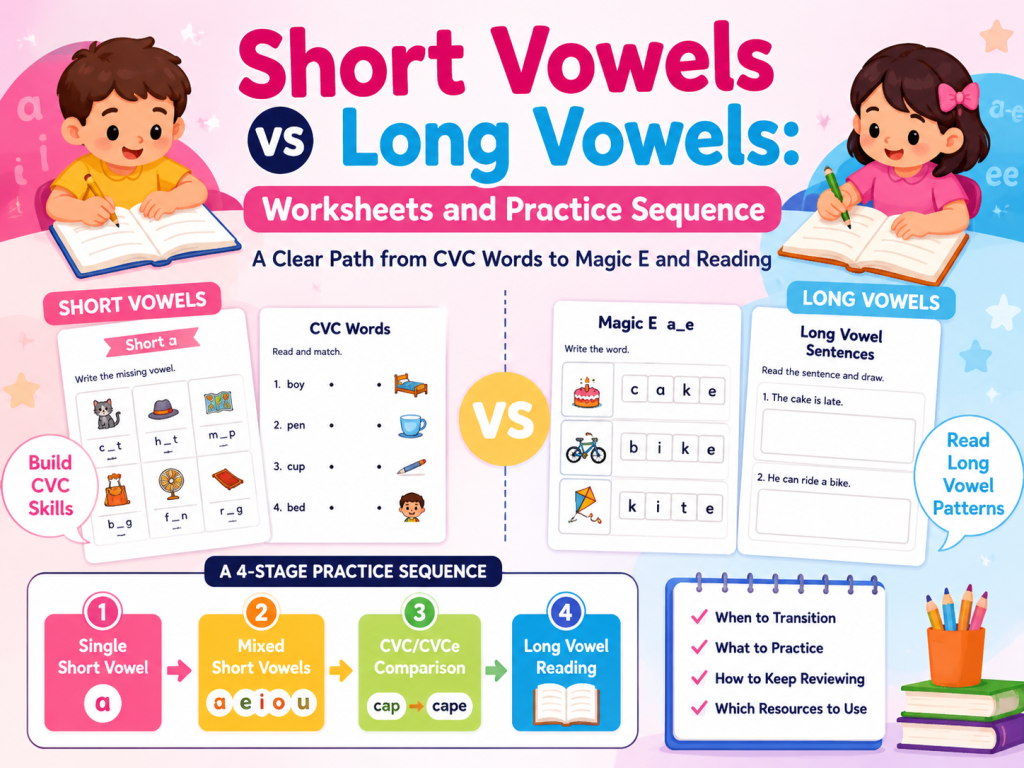
Short vowels usually provide the first dependable bridge from letter sounds to word reading. For that reason, short vowel worksheets belong before intensive long-vowel practice, but the change should not happen after an arbitrary number of pages. This guide shows how the two worksheet types differ, which reading behaviors signal readiness, and how to move from one vowel pattern to connected reading without leaving important CVC skills behind.
Short Vowel Worksheets: Core Goals and Typical Tasks
Short-vowel work teaches children to hear, hold, and blend the middle sound in a compact word. Words such as map, bed, sit, log, and sun look simple to an experienced reader. However, a beginning reader must still coordinate three separate sounds and connect them to three letters in the correct order.
The most useful early pages make one sound decision clear. A child might choose the missing vowel in m_p, sort pictures by their middle sound, or build fan with letter tiles before writing it. Each task should lead back to reading the complete word rather than ending after circling or tracing.
Hear the middle sound
Oral sorting and picture matching help children notice that the vowel changes the identity of a word.
Blend every phoneme
Sound boxes, finger tracking, and word building prevent first-letter guessing.
Move into a sentence
A short controlled sentence checks whether the word can be read outside the original activity.
Teach one vowel before mixing all five
A narrow starting point reduces unnecessary confusion. A short a lesson can use cat, map, fan, bag, ram, and tap. Once the child can read fresh words with that sound, another short vowel can enter while a few earlier examples remain in review.
Word families can make the pattern visible, but they should not become a memorization shortcut. Reading cat, hat, and mat does not prove that a learner can decode cap. Mix familiar families with new combinations so the child must inspect the whole word.
A compact activity sequence
- Say three words with the target middle sound.
- Stretch one word and tap its three phonemes.
- Build or complete two printed CVC words.
- Read a short word line in a fresh order.
- Spell one word from dictation.
- Read one sentence containing the same pattern.
This sequence moves from listening to print, then from isolated words to connected language. It also makes the printable part of a lesson rather than the entire lesson.
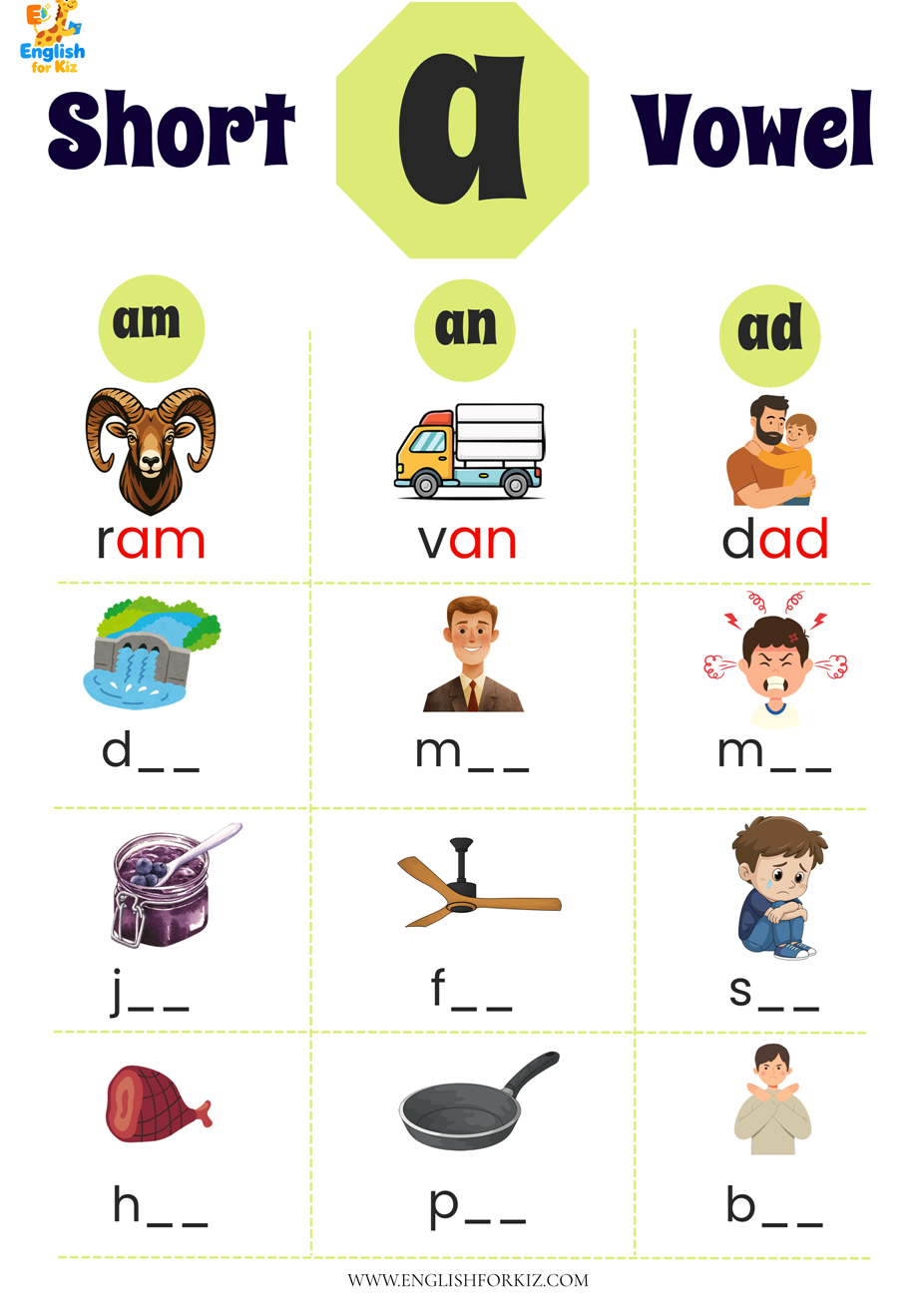
Choose this type of practice when CVC reading is still developing
A focused short-vowel page works best when the learner still needs help hearing the middle sound, completing CVC spellings, or reading word families without guessing.
Explore the Kindergarten FoundationLong Vowel Worksheets: Core Goals and Typical Tasks
Long-vowel work asks the learner to notice a larger spelling signal. Early examples often use CVCe words such as cake, bike, home, and cute. Later lessons add vowel teams such as ai, ay, ee, ea, and oa.
Because the sound depends on several letters working together, long vowel worksheets should do more than ask for missing letters. Strong practice compares patterns, maps the spoken sounds, and places the new spelling inside words and sentences.
Use CVC and CVCe pairs as the bridge
Pairs such as cap/cape, kit/kite, and hop/hope make the transition visible. Read the CVC word first, add final e, and then reread the new word. This shows that long-vowel learning grows from the earlier CVC system rather than replacing it.
Temporary markings can help during the first lessons. A child might underline the first vowel and lightly mark the silent e. Those prompts should fade once the learner begins noticing the pattern independently.
The reading goal
Recognize the whole spelling pattern, choose the expected vowel sound, and blend the complete word.
The spelling goal
Represent every sound in order and gradually learn which long-vowel spelling fits the word.
Reading often develops before independent spelling. A child may accurately read cake, rain, and play while still needing help choosing among a_e, ai, and ay. A suitable page should match the current goal instead of expecting every spelling choice at once.
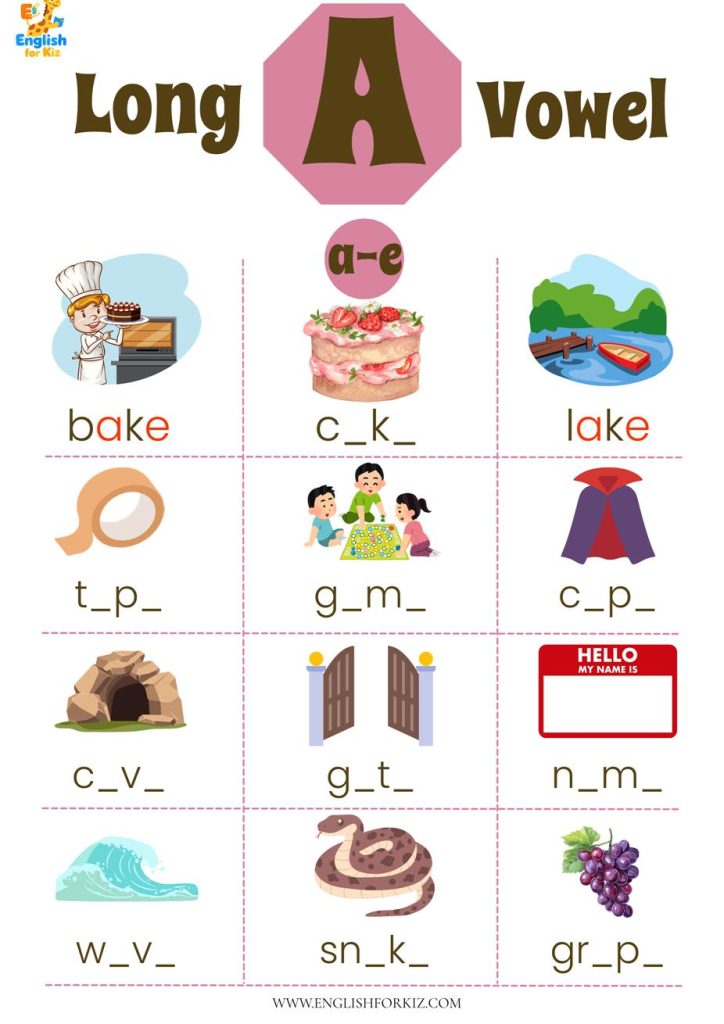
Choose this type of practice when final-e comparison is ready
A long-vowel page fits learners who can already read mixed CVC words and are ready to notice how final e changes the earlier vowel sound.
Continue to 1st Grade Long VowelsComparison Table: Pattern, Word Type, Worksheet Task and Reading Goal
The key difference is not the amount of writing on the page. It is the reading decision the child must make. Short-vowel activities usually direct attention to one middle sound, while long-vowel activities require attention to a wider spelling pattern.
| Pattern focus | Typical word type | Useful worksheet task | Main reading goal |
|---|---|---|---|
| One short vowel | cat, map, fan, bag | Picture sort, missing vowel, sound boxes | Hear and read one stable middle sound |
| Two short vowels | map/mop, pan/pin, bed/bid | Contrast sort, oral choice, mixed dictation | Distinguish similar vowel sounds |
| Mixed short vowels | CVC words across a, e, i, o, u | Mixed word list, sentence reading, spelling | Select the sound without a page clue |
| CVC and CVCe contrast | cap/cape, kit/kite, hop/hope | Add final e, compare, sort, reread | Notice how final e changes the vowel |
| One long-vowel spelling | CVCe words or one vowel team | Pattern marking, word building, sentence choice | Read one spelling pattern accurately |
| Cumulative vowel reading | Short and long patterns in mixed text | Read, explain, spell, and reread | Apply the correct pattern independently |
When selecting phonics worksheets, identify whether the page teaches, reviews, or checks a skill. A teaching page should make one new feature easy to notice. A review page can remove some support and place familiar patterns in mixed order.
Also check the response type. Matching and circling measure recognition, while spelling and oral explanation require active recall. A complete practice path gradually moves from supported choices toward independent reading and spelling.
Signs It Is Time to Move from Short to Long Vowels
The transition should depend on reading behavior rather than age or completed page count. Perfect CVC reading is not required. However, the earlier system should be stable enough that adding a new spelling pattern does not replace decoding with guessing.
Use a short readiness sample
A practical check can contain ten mixed CVC words, two short sentences, and three dictated words. Use familiar vocabulary in a fresh order. Avoid a heading that announces the vowel because the purpose is to see whether the learner reads the spelling itself.
Look at the type of error, not only the total. Confusing short e and short i may call for focused listening practice. Guessing every word from its first consonant suggests that blending still needs to become the default strategy.
A partial transition is often enough
A child may be ready for long a with final e while still reviewing one difficult short-vowel contrast. In that case, new learning and repair work can run in separate parts of the week. Progress does not need an all-or-nothing decision.
Slow down when the child regularly ignores the middle vowel, drops the final consonant, or needs heavy prompting to blend three sounds. A short return to oral segmentation, letter tiles, and compact word lines will usually help more than adding another rule.
A Four-Stage Practice Sequence
This four-stage path creates continuity from Kindergarten CVC work to 1st Grade long-vowel reading. Each stage has one job, one suitable type of practice, and one observable sign for moving forward.
Single short vowel
Begin with one short vowel and a small group of familiar consonants. Use oral listening, word building, missing-vowel tasks, and a short sentence. Five to eight carefully selected words can provide more useful practice than a crowded page.
Move forward when: fresh words with the same vowel can be blended without relying on the original worksheet order.
Mixed short vowels
Compare two vowels before mixing all five. Short a and short i, or short e and short i, can appear in sorting, dictation, and sentence tasks. The child must now choose the sound from the word rather than from the section title.
Move forward when: most mixed CVC words receive full attention and errors no longer come from routinely skipping the middle letter.
CVC and CVCe comparison
Read the short word, add final e, and compare the result. Use a small set of clear pairs, then place CVC and CVCe words in mixed order. Follow the word work with a phrase or sentence so the spelling change remains connected to meaning.
Move forward when: final e is noticed without needing a color code, arrow, or reminder on every word.
Long-vowel reading in connected text
Move from word lists into controlled sentences and short passages. Preview only vocabulary that contains untaught code. The learner should have a real opportunity to apply the current pattern rather than hearing every target word in advance.
Continue building when: the pattern can be found inside text and the child can reread the full sentence after correcting an error.
A lesson that links practice to reading
- Review three familiar CVC words.
- Introduce one sound or spelling contrast.
- Build one example with letters.
- Read a fresh mixed word line.
- Use the pattern in a sentence.
- Finish with one dictated word.
The application step matters because a completed page does not automatically produce connected reading. After focused word work, decodable readers can place the same spelling pattern inside sentences where decoding, phrasing, and meaning work together.
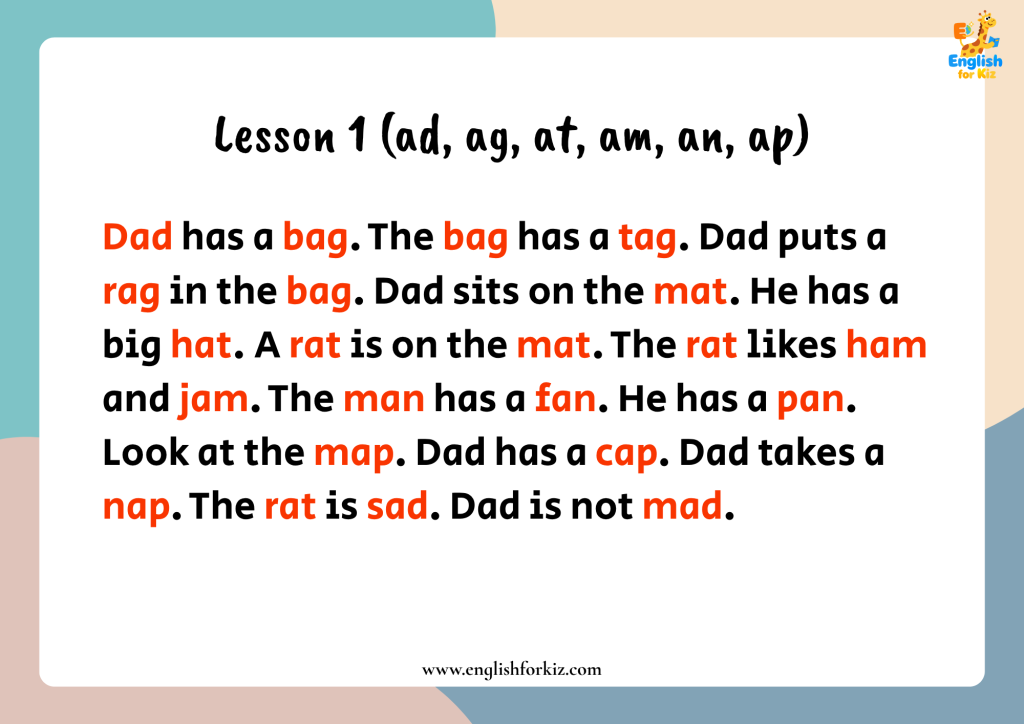
From CVC words to a readable passage
Choose this level when the learner can blend short-vowel words but still needs controlled sentences before broader story reading.
Explore Decodable Stories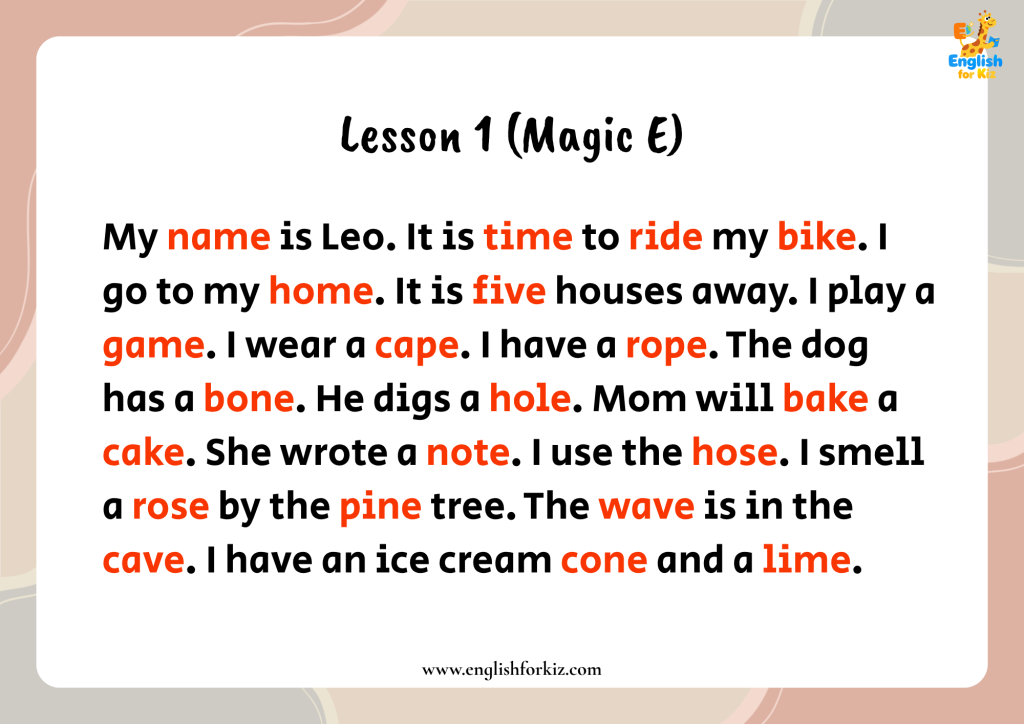
From Magic E practice to connected reading
Choose this level after final-e words are readable in mixed lists and the pattern needs practice inside complete sentences.
Read Long-Vowel StoriesHow to Keep Short Vowels in Review
Short-vowel practice should become smaller after long vowels begin, but it should not disappear. The contrast between cap and cape only remains useful when both patterns stay available. Brief cumulative review also prevents a learner from applying the newest long sound to every vowel.
A small daily set may include three short-vowel words, two current long-vowel words, and one controlled sentence. Change the order and examples regularly so correct reading cannot come from memorizing a card sequence.
Match correction to the error
If kit becomes kite, place the words side by side and ask which spelling signal appears in only one word. If hope becomes hop, mark the complete word and reread the pair. The correction should point directly to the overlooked feature.
When worksheet reading is accurate but story reading remains weak, the learner may be using page clues. Use a shorter controlled passage, pause at the target word, and reread the full sentence after correction. This keeps decoding connected to meaning and fluency.
Choose Kindergarten or 1st Grade Resources
Choose the next resource by the skill that can be used independently, not by age alone. Kindergarten material fits learners who still need reliable short-vowel discrimination, CVC blending, spelling, and simple sentence reading. The 1st Grade path fits learners ready to compare CVC and CVCe words and expand into organized long-vowel patterns.
Stay with the Kindergarten path when
- Middle vowels are often skipped or confused.
- Pictures still provide most of the answer.
- CVC spelling regularly loses one sound.
- Simple sentences require repeated word-by-word prompting.
Move into the 1st Grade path when
- Mixed CVC reading is mostly accurate.
- The full word receives attention.
- CVC and CVCe pairs can be compared with light support.
- Known patterns transfer into short controlled passages.
Some learners need both levels for a short period. One short-vowel contrast can remain in review while one carefully chosen long-vowel pattern enters as new instruction. Keep the goals separate within the lesson so the learner knows which feature to notice.
For a single gap, use the worksheet library to choose one focused activity rather than repeating an entire level. A page should answer a specific need, such as mixed short-vowel listening, CVCe comparison, or sentence transfer.
Choose the Path That Matches the Current Reading Stage
Continue with the Kindergarten sequence when CVC blending and middle-vowel accuracy remain the main need. Move into the 1st Grade sequence when mixed short vowels are stable and final-e comparison is ready. This keeps the next lesson challenging without making the pattern system confusing.
Need one targeted activity instead of a full level? Browse worksheets by grade and phonics skill.
Continue the Learning Path
These pages support different points in the same sequence. Choose the one that matches the learner’s current decoding task rather than opening several resources at once.
FAQ
What is the main difference between short-vowel and long-vowel practice?
Short-vowel practice usually asks the learner to identify one middle sound inside a CVC word. Long-vowel practice asks the learner to notice a wider spelling signal, such as final e or a vowel team, and connect that pattern to the expected sound.
When should Magic E words enter the sequence?
Magic E can enter when mixed CVC reading is mostly stable and the learner attends to the complete word. Start with a few clear CVC and CVCe pairs rather than a large mixed long-vowel unit.
Should short-vowel review stop after long vowels begin?
No. Brief mixed review keeps the short-versus-long contrast clear and reduces overgeneralization. A few words, one dictated example, and a short sentence are usually enough.
How should a worksheet and a decodable reader be used together?
Introduce the pattern orally, complete one focused worksheet task, and then read fresh words. Follow with a controlled reader that contains the same code, and finish with one spelling or sentence check.
What if a child finishes pages quickly but still guesses in books?
Fast completion may come from pictures, repeated order, or familiar word families. Cover the illustrations, mix the words, and use a fresh sentence or passage. The result will show whether the pattern can transfer beyond the original page.
- Check mixed CVC reading before introducing a new long-vowel pattern.
- Teach one visible contrast and apply it in connected text.
- Keep a small short-vowel review set after the transition begins.
A well-planned sequence does not treat short vowel worksheets as a finished chapter. They remain a compact review tool while long-vowel reading grows through comparison, controlled practice, and meaningful text.