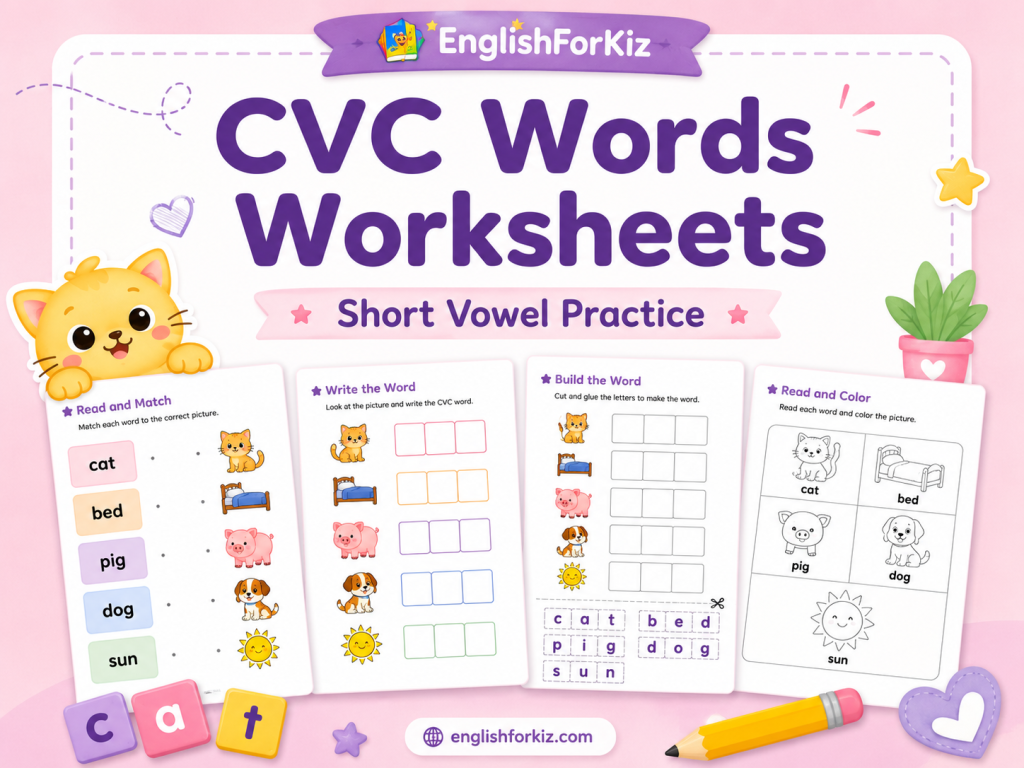
Early readers often know letter sounds before they can blend those sounds into real words. Therefore, short vowel practice needs a clear path: hear the sound, blend the word, write the word, and read it again in a simple phrase or story.
This guide explains how CVC words worksheets can support short vowels, word families, blending, spelling, and early reading confidence for parents, teachers, and homeschool families.
What Are CVC Words?
First, CVC words are short words with a consonant, a vowel, and another consonant. Words such as cat, bed, pig, hop, and sun follow this pattern. Because each word has three clear sounds, children can practice reading from left to right.
However, CVC practice is not only about memorizing simple words. It helps children understand how sounds connect to letters. When a child reads /c/ /a/ /t/ and blends the sounds into cat, decoding begins to feel manageable.
In addition, CVC word families give children a predictable pattern. For example, cat, mat, sat, and bat share the same ending. Once children notice the pattern, they can read several new words with less guessing.
Why Short Vowels Need Focused Practice
Short vowels can be hard for early readers because the middle sound changes the whole word. For example, cat, cut, cot, and kit look similar. Still, each word sounds different because the vowel changes.
Therefore, children need time to hear, say, compare, and write the vowel sound. A focused routine helps prevent guessing from the first letter or relying only on pictures. It also supports spelling because children learn to map every sound in order.
This approach also matches the general direction of structured early reading guidance. The IES What Works Clearinghouse practice guide recommends helping K–3 learners connect speech sounds to letters, decode words, analyze word parts, and read connected text regularly. For deeper professional reference, see the official foundational reading skills practice guide.
How to Use CVC Practice Without Turning It into Busywork
First, choose one short vowel and one word family. Then, ask children to say each sound before reading the full word. This small step keeps the focus on decoding instead of copying.
Next, connect the word to meaning. A picture, object, or short sentence can confirm that the child read a real word. After that, a short writing task can strengthen spelling memory.
A simple lesson flow
- Step 1: Review three to five letter sounds.
- Step 2: Introduce one short vowel sound.
- Step 3: Blend four or five words from one word family.
- Step 4: Match words with pictures or simple objects.
- Step 5: Write one or two words with sound-by-sound attention.
- Step 6: Read a short phrase or sentence using a known word.
Short A, E, I, O, and U Practice Ideas
Short a is often a friendly starting point because many words are easy to picture. Words such as cat, mat, fan, map, and bag help children connect print with familiar objects.
Meanwhile, short e and short i need careful listening. Words such as pen and pin can sound close to new readers. Therefore, each vowel should receive separate practice before mixed review begins.
Finally, short o and short u work well with action words and story language. Words such as hop, dog, sun, run, and bug can move naturally from single-word reading into phrases and short decodable stories.
Who This CVC Practice Is Best For
This type of practice is especially helpful when children already know several letter sounds but still need support blending those sounds into words. In other words, it fits the important stage between alphabet knowledge and early sentence reading.
- Parents: helpful for short, calm practice at home after school or during review time.
- Kindergarten teachers: useful for small-group phonics, literacy centers, and short vowel review.
- Homeschool families: practical for building a weekly phonics routine without scattered materials.
- ESL and EFL learners: supportive for connecting English sounds with simple printed words.
- Early readers who guess: helpful when children skip the middle vowel or read from pictures instead of letters.
Which Resource Should Start First?
A good resource path should match the child’s current reading step. If the child is still learning short vowels, start with printed word family practice. If the child can already read a few words, add games or short readers.
For a broader early reading path, the phonics for kids system connects worksheets, games, readers, flashcards, and video lessons across Preschool to 2nd Grade.
- Start with worksheets when the child needs handwriting, spelling, and sound mapping.
- Add games when the child needs more repetition without another paper page.
- Add readers when the child can decode words and needs sentence-level practice.
- Use membership when a complete, organized phonics path is needed.
Recommended EnglishForKiz Resources
The following 2×2 resource path keeps the next step clear. Each image and button links to the matching EnglishForKiz page, so the reading path does not stop at the article.
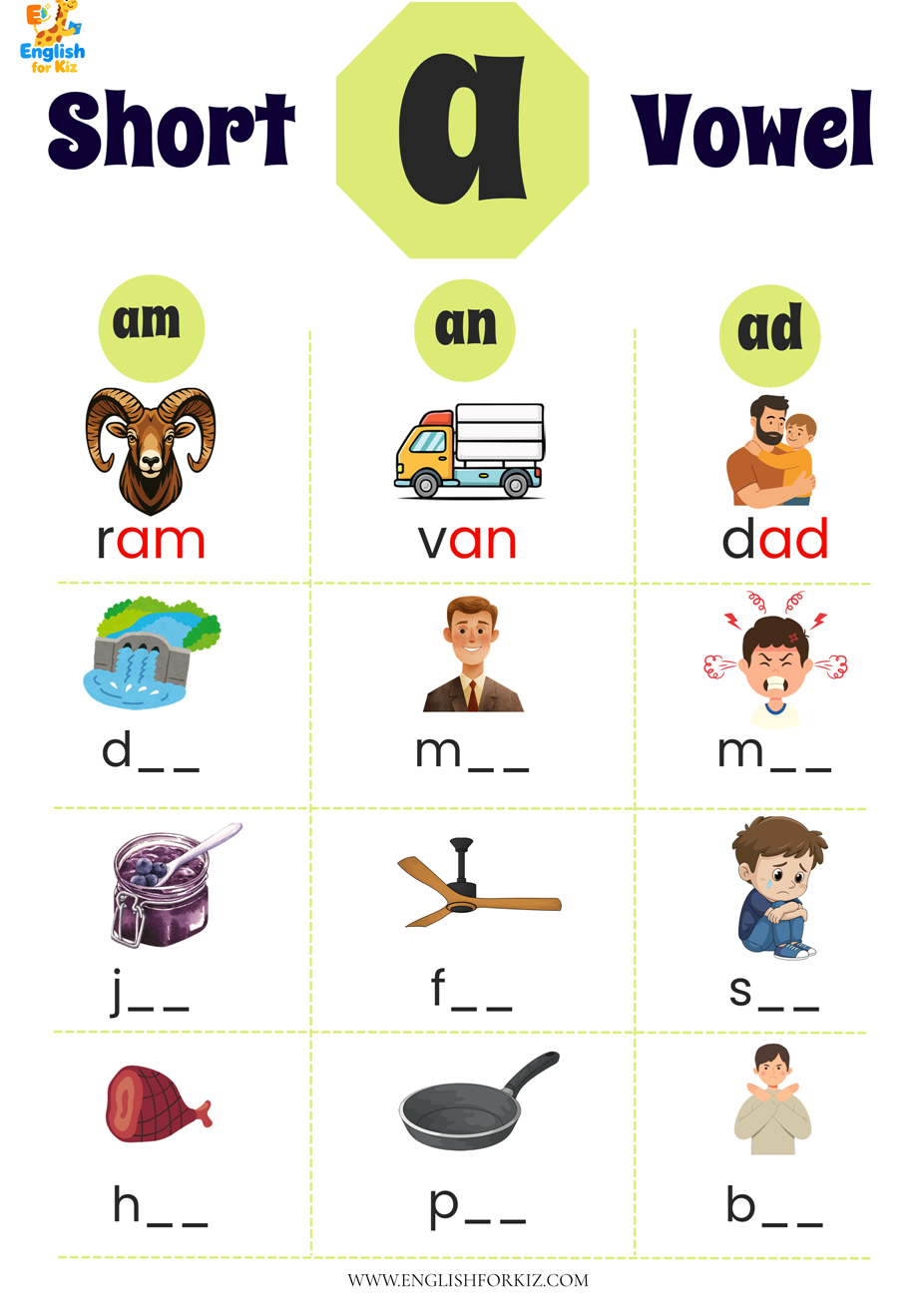
Start with CVC Word Families
Best for short vowel practice, word family sorting, blending, spelling, and early handwriting support.
Start CVC Practice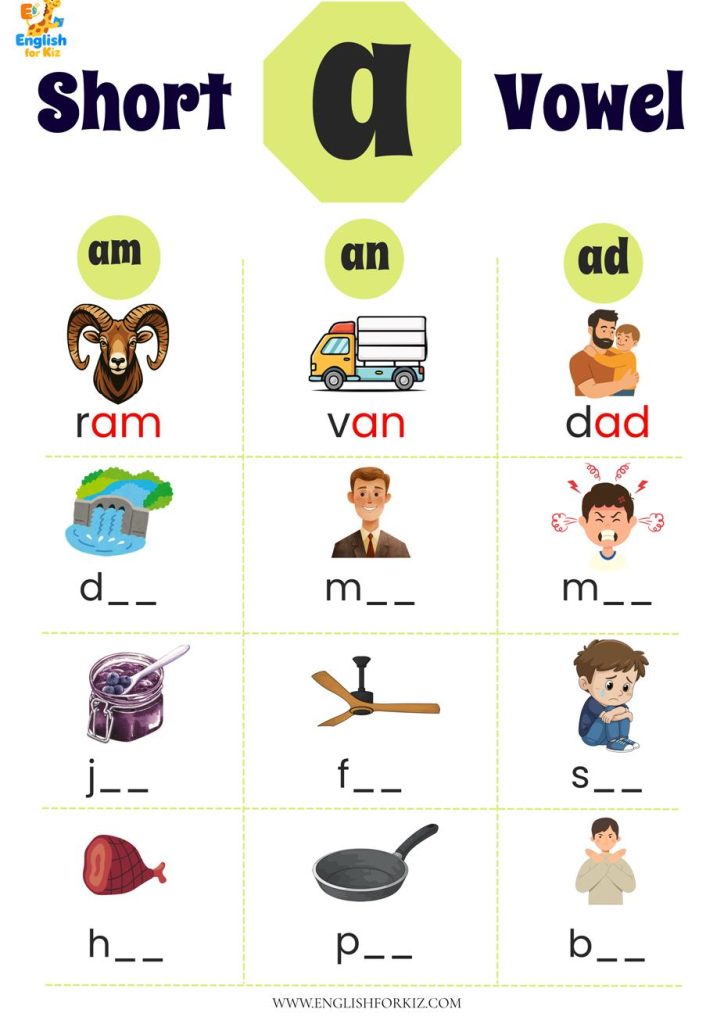
Add Printable Phonics Worksheets
Best for families and classrooms that need structured offline practice across early phonics skills.
View Phonics Worksheets
Review with Phonics Games
Best for extra repetition after paper practice, especially when children need a more active review format.
Play Phonics Games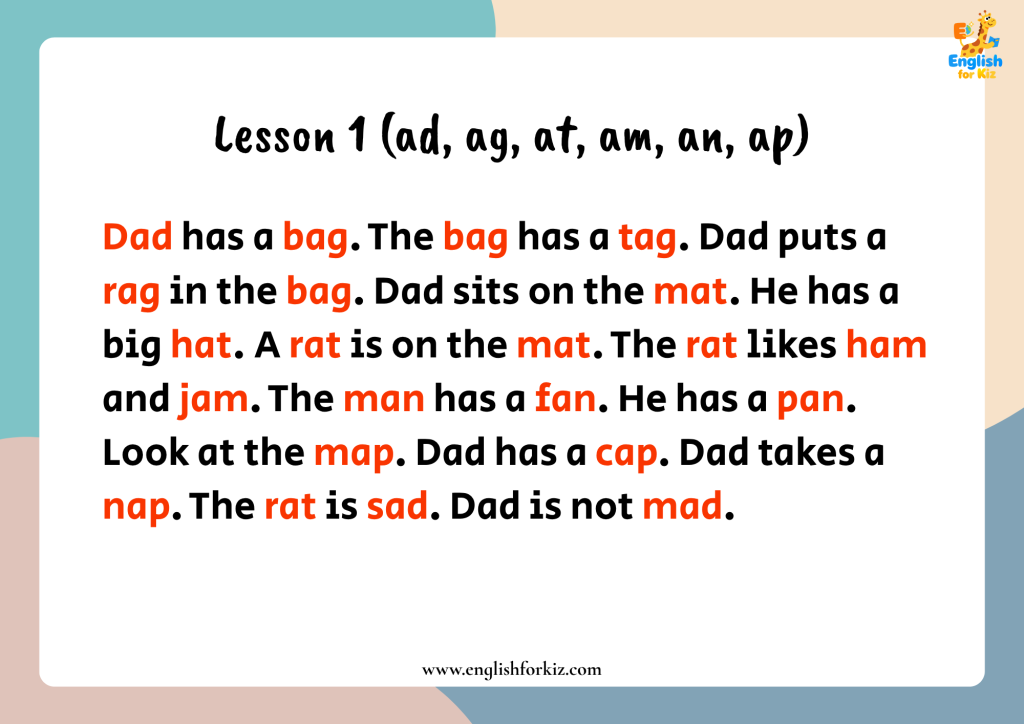
Move into Decodable Readers
Best for children who can read CVC words and need short sentences, meaning, and fluency practice.
Read Decodable StoriesA Practical Weekly CVC Routine
A weekly routine helps children meet the same pattern several times without repeating the exact same task. For example, short a practice can begin with -at words and slowly expand into -an, -ap, and -ag words.
- Monday: introduce one short vowel and one word family.
- Tuesday: blend and write words from the same pattern.
- Wednesday: sort words by vowel sound or word family ending.
- Thursday: read short phrases or sentences with known words.
- Friday: review with a game, decodable story, or quick spelling check.
Common Mistakes to Watch For
Mistakes can show what to teach next. For instance, a child who reads pin as pan may need more short i and short a contrast work. A child who says only the first sound may need more support with blending.
- Guessing from the picture: ask the child to look at the letters first.
- Skipping the vowel: point to the middle sound and reread slowly.
- Mixing short e and short i: practice each vowel separately before comparison.
- Reading sounds but not blending: model how to slide the sounds together.
- Copying without reading: ask the child to read every written word aloud.
Final Recommendation
In summary, CVC practice works best when it follows a clear path. Children need to hear the vowel, blend the word, write the word, and then read that word in a phrase, game, or short story.
For a focused next step, begin with the short vowel CVC page. For a complete Preschool to 2nd Grade resource path, EnglishForKiz membership gives access to worksheets, games, readers, flashcards, and video lessons in one place.
FAQ
What are CVC words?
CVC words are short words with a consonant, a vowel, and another consonant. Examples include cat, bed, pig, hop, and sun. They are useful because children can practice three clear sounds in a simple word.
Are CVC words good for kindergarten?
Yes. CVC words are especially helpful in kindergarten because they support blending, short vowel recognition, spelling, and simple sentence reading.
Which short vowel should children learn first?
Many routines begin with short a because words such as cat, mat, sat, fan, and map are familiar and easy to picture. Still, the best order should follow the child’s current phonics sequence.
How do CVC worksheets help blending?
They guide children to say each sound, look at the middle vowel, and blend the whole word. Picture matching, sound boxes, and short spelling tasks also help children connect reading with meaning.
Should CVC practice include reading stories?
Yes. Once children can read words in isolation, short decodable stories help them apply the same patterns in connected text. This supports fluency, meaning, and reading confidence.