

A child might know the letters Q and U but still pause at queen or quick. Reading the letter names separately does not produce the sounds in either word.
In many familiar English words, QU represents /kw/: a quick /k/ sound followed by /w/. When teaching children to read QU words, start by showing how those sounds blend, then choose examples with vowel spellings the child already knows.
Why do Q and U usually appear together?
In English spelling, Q is usually followed by U. The pairing has a long history: Latin used QV for a sound similar to /kw/, and after U and V became separate letters, the spelling became QU. English later adopted this convention, replacing older spellings such as cwen for queen. This familiar pairing appears in quit, quiz, quick, and queen. In each of those words, QU spells a sequence of two consonant sounds, /k/ and /w/. It is not one single phoneme, even though the two letters are helpful to recognize as a spelling unit.
The /k/ is the opening sound in cat; /w/ is the opening sound in win. Say them closely together, and the beginning of queen becomes easier to hear. This is the usual QU spelling pattern, not a guarantee about every English word containing those letters.
Blend QU without adding an extra vowel
When a child says something like “cue-ee-n” for queen, the problem may be letter-name reading rather than sound blending. Model the beginning as a brief /k/ moving straight into /w/. Avoid “kuh-wuh,” which adds vowel sounds that the word does not contain.
Both words begin the same way. What changes is the spelling after QU: quick has short I and final CK, while queen has EE for the long E sound.
Try covering the endings and showing only QU. Ask, “What two sounds do we hear at the start?” Then uncover the rest of one familiar word. The child can practise the opening sequence without being distracted by every letter at once.
When spoken blending is comfortable but the child needs written reinforcement, kindergarten phonics worksheets offer a paper-based next step. The collection includes CK/QU practice; choose an activity only after checking that its other word patterns are familiar.
Choose words that match the learner’s other known sounds
Words beginning with QU are not all equally simple to read. A child may blend /kw/ correctly yet hesitate over the vowel or ending. That difference matters: repeating QU alone will not teach an unfamiliar EE or CK spelling.
Quit (/kwɪt/) and quiz (/kwɪz/) make a useful early pair when short I and the final consonants are already known. They keep the rest of the word relatively straightforward, so attention can stay on the QU beginning.
Quick (/kwɪk/) adds CK at the end. Queen (/kwiːn/) introduces EE. Both are familiar words, but neither is automatically easier simply because a child has heard it before. Someone still learning vowel teams can recognize QU in queen while an adult supplies the rest of the pronunciation.
If quit is easy but queen is not, check whether EE is familiar before assuming the QU sound needs reteaching. Choose the next word by the sounds and spellings the learner already recognizes, not by grade label alone.
What about QU exceptions?
QU does not always represent /kw/. In quiche (/kiːʃ/), the opening is /k/ rather than /kw/. At the end of antique (/ænˈtiːk/), QUE corresponds to a final /k/. And queue is pronounced /kjuː/, like the letter name Q, rather than beginning with the /kw/ sequence in queen.
These exceptions are worth knowing, but they do not belong in the first small set of /kw/ words. If one appears in a story, say the word naturally and explain that its spelling is unusual. A reliable learner’s dictionary with audio can settle uncertainty, especially for unfamiliar words and accent-dependent pronunciations.
QU Sound Detective
Tap the two words where QU represents /kw/ at the beginning. Choose both words, then check your answer.
Read a short QU word set, then practise on paper
Start with a small group: quit, quiz, quick, queen. Point to QU in each word and ask what beginning sounds it represents. Help with any other spelling the child has not learned instead of using the activity as a test of unfamiliar vowel patterns.
Read together: The queen is quick.
An adult can support the other words in the sentence. Then ask:
- Which two words in the sentence begin with QU?
- What two sounds does QU represent in those words?
- Which word contains EE?
- Which word ends with CK?
Show the answers
1. queen and quick.
2. /k/ followed by /w/.
3. queen.
4. quick.
If the first two answers are difficult, return to just one spoken /kw/ example before introducing more words.
When the child can recognize the beginning sounds, a written activity can reinforce the connection between spoken words and spelling. EnglishForKiz includes a CK/QU worksheet in its kindergarten collection. It combines QU with other spellings, so check the words before deciding whether it suits the learner.
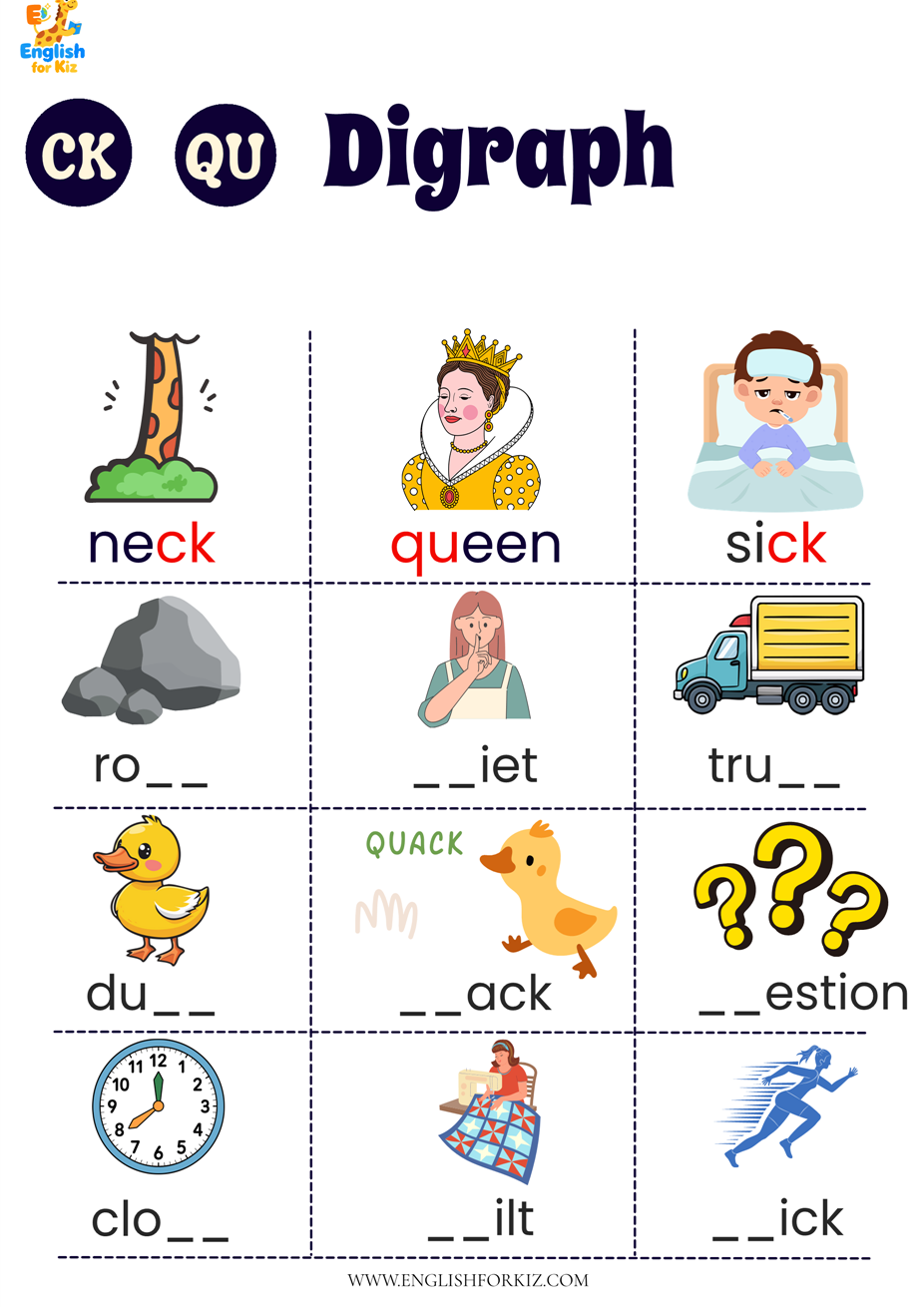
This EnglishForKiz worksheet places QU words alongside CK words. Its picture prompts include queen and missing-letter words, so it suits children ready to connect sounds with printed spellings.
Because it mixes CK and QU, review both patterns before assigning the whole page. It does not teach the pronunciation exceptions discussed above.
View Kindergarten WorksheetsFAQ
Does QU represent one sound or a sound sequence?
In words such as queen and quick, QU represents two phonemes: /k/ and /w/. The letters form a recognizable spelling unit, but /kw/ is a sequence of sounds, not one phoneme.
Should U be read as its letter name in queen?
No. The letters QU together spell /kw/ at the beginning of queen. Saying U as “you” would add sounds that do not belong in the word.
Are there words where Q is not followed by U?
Yes. Qi, an English dictionary word borrowed from Chinese, is one example. Such spellings are exceptions and need not be part of a beginner’s first QU practice.
For most familiar beginning-QU words, the reading decision is straightforward: recognize the pair, blend /k/ with /w/, then read the remaining spelling patterns the child already knows. If queen or quick is still difficult, find out whether the hesitation is at QU, EE, or CK before choosing more practice.
Choose practice that fits the sounds already learned
After the short reading activity, browse the kindergarten collection for focused phonics practice. Look at the words on the activity and check access conditions before choosing it; the whole collection is not a substitute for introducing the sounds first.