Engaging Phonics Games for Early Readers
Watching a child decode their very first word is a magical milestone. It is a moment where squiggly lines on a page suddenly transform into meaningful sound, opening the door to a lifelong journey of imagination, learning, and discovery. However, the path to reading is rarely a straight line. For many children, sitting still and memorizing flashcards can feel tedious, leading to frustration for both the learner and the educator. This is where the power of play comes in.
Integrating learning phonics games into a child’s daily routine transforms the difficult cognitive task of reading into a joyful, engaging experience. By leveraging play, educators and parents can capture a child’s natural curiosity and channel it toward mastering the foundational skills required for literacy.
In this comprehensive guide, we will explore the deep connection between play and literacy. We will unpack the science of reading, delve into specific, actionable games you can play at home or in the classroom, and answer common questions about early reading instruction. Whether you are a classroom teacher looking to spice up your literacy centers, or you are piecing together a dynamic phonics curriculum for homeschooling parents, this guide will provide you with the tools necessary to make reading instruction wildly successful and incredibly fun.
The Science of Early Reading: Why Phonics Matters
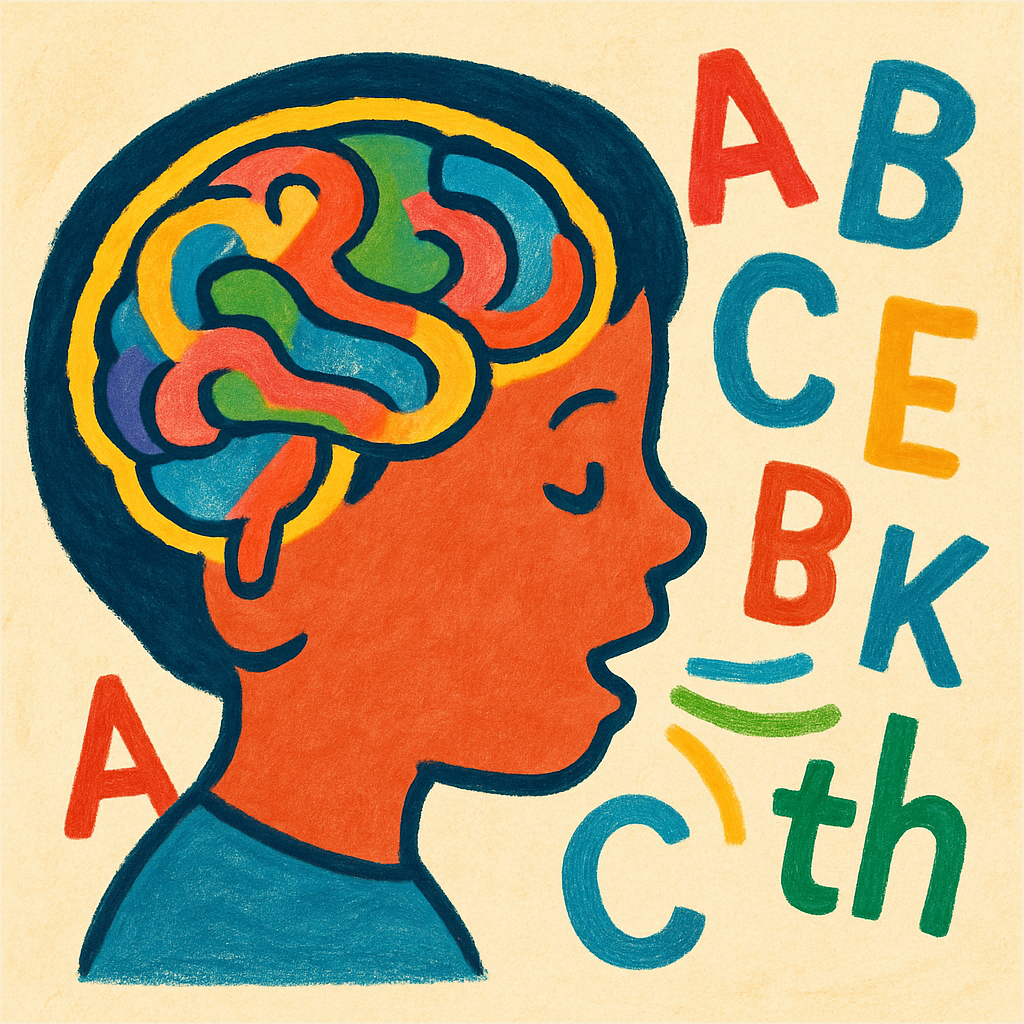
Before we dive into the games, it is crucial to understand how the brain learns to read. Unlike spoken language, which human brains are naturally wired to acquire through exposure, reading is a human invention. The brain must be explicitly taught to map sounds to symbols.
Understanding Early Literacy Development Milestones
To effectively teach phonics, it helps to know where your child stands on the developmental continuum. Recognizing early literacy development milestones ensures that you are providing the right games at the right time, preventing frustration and promoting steady growth.
- Ages 0-2 (The Spoken Language Foundation): At this stage, children are absorbing vocabulary, rhythm, and syntax. Milestones include cooing, babbling, responding to their name, and eventually speaking in short sentences. The best literacy preparation here involves talking, singing, and reading aloud daily.
- Ages 3-4 (Phonological Awareness): Preschoolers begin to recognize that spoken language can be broken down into smaller parts. They might start identifying rhymes, clapping out syllables in their names, and noticing when words start with the same sound (alliteration).
- Ages 5-6 (The Alphabetic Principle): Kindergarteners typically begin to understand that written letters represent spoken sounds. They learn to decode simple CVC (consonant-vowel-consonant) words, recognize their names in print, and write basic letters.
- Ages 6-8 (Fluency and Comprehension): As phonics skills become automatic, children spend less mental energy sounding out words and more energy understanding what those words mean. Reading becomes smoother and more expressive.
Implementing a Structured Literacy Approach for Preschoolers
Historically, some early childhood philosophies leaned heavily on “whole language” approaches, assuming kids would learn to read simply by being surrounded by good books. However, cognitive science overwhelmingly supports explicit, systematic phonics instruction.
Adopting a structured literacy approach for preschoolers doesn’t mean forcing three-year-olds to sit at desks with worksheets. Instead, it means being intentional with your play. Structured literacy focuses on teaching the structure of language—phonemes (sounds), graphemes (letters), and syllables—in a logical sequence. You can easily adapt this systematic progression into your learning phonics games, ensuring that every moment of play has a targeted educational purpose.
Step 1: Training the Ear Before the Eye
A common mistake in early reading instruction is rushing straight to printed letters. However, a child must be able to hear and manipulate sounds in spoken language before they can attach those sounds to written symbols.
Interactive Phonological Awareness Activities
Phonological awareness is an umbrella term that encompasses the ability to recognize and manipulate the spoken parts of sentences and words. It is purely auditory—you can do these activities in the dark! Here are some highly effective and interactive phonological awareness activities:
1. The “Silly Sentence” Game (Sentence Segmentation)
- The Goal: Helping children understand that sentences are made of individual words.
- How to Play: Say a sentence, such as, “The cat is big.” Have your child take a giant leap forward for every word in the sentence. Alternatively, they can place a block in a tower for each word.
- Why it Works: It gives a physical, tangible representation to the abstract concept of words.
2. Rhyme Time Relay (Rhyme Recognition and Production)
- The Goal: Hearing the ending sounds of words.
- How to Play: Set up a relay race. Give the child a starting word (e.g., “Bat”). They must run across the room, touch the wall, and run back, shouting a word that rhymes with “Bat” (e.g., “Cat!”). If they can’t think of a real word, nonsense words (“Zat!”) are perfectly acceptable, as they still prove the child hears the phoneme.
3. The Mystery Bag (Syllable Awareness)
- The Goal: Breaking words into syllables.
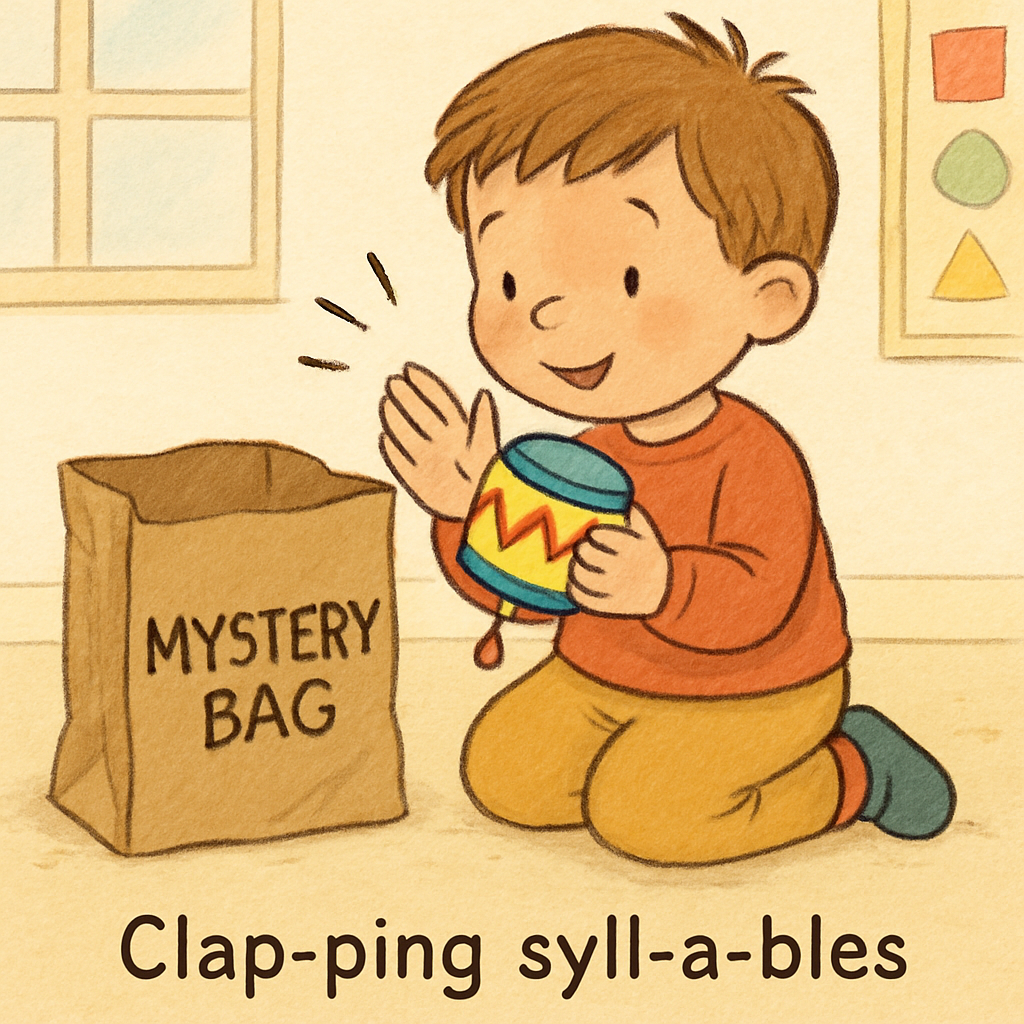
- How to Play: Fill a bag with various household items (a spoon, an apple, a dinosaur toy). Have the child pull an item out without looking. Once they identify the object, have them clap out the syllables (“di-no-saur” = 3 claps).
Step 2: Mastering the Alphabet
Once a child’s ears are tuned to the sounds of language, it is time to introduce the visual representations of those sounds: the alphabet.
Engaging Alphabet Recognition Exercises
Learning to identify 52 distinct shapes (26 uppercase, 26 lowercase) is a massive visual discrimination task for a young brain. Engaging alphabet recognition exercises ensure that this memorization process feels like a treasure hunt rather than a chore.
4. Sticky Note Letter Rescue
- How to Play: Write various letters on sticky notes and hide them around the house. Give your child a “rescue vehicle” (a toy dump truck or a basket) and tell them they need to rescue specific letters. “Oh no! The letter M is stuck under the kitchen table, go rescue it!”
- Variation: To increase the challenge, ask them to rescue both the uppercase and lowercase versions of the same letter.
5. Flashlight Letter Hunt
- How to Play: Tape letter cards to a blank wall. Turn off the lights and hand your child a flashlight. Call out a letter (or a letter sound), and have them shine the flashlight on the correct card. This game is incredibly engaging for kids who are highly active.
The Debate: Letter Sound Correspondence vs Hands-on Play
Some educators debate the mechanics of early literacy, weighing letter sound correspondence vs hands-on play. Should we drill flashcards so kids know their letter sounds perfectly, or should we let them play with blocks and discover literacy organically?
The truth is, these two concepts are not mutually exclusive—they are the ultimate partnership. When you combine explicit instruction of letter-sound correspondence with hands-on play, you create deep neural pathways. For example, telling a child “The letter S makes the /s/ sound” is explicit instruction. Having that child trace the letter S in a tray of sand while making a hissing snake sound is hands-on play. Together, they create a memorable learning experience.
Step 3: Multisensory and Kinesthetic Phonics
Children are naturally wired to move, touch, and explore their environment. Traditional reading instruction often requires children to be passive, visual learners. By bringing touch and movement into phonics, you engage multiple areas of the brain simultaneously.
Exploring Multisensory Literacy Tools for Beginners
Multisensory learning involves using visual, auditory, and kinesthetic-tactile pathways simultaneously to enhance memory and learning of written language. Here are fantastic multisensory literacy tools for beginners:
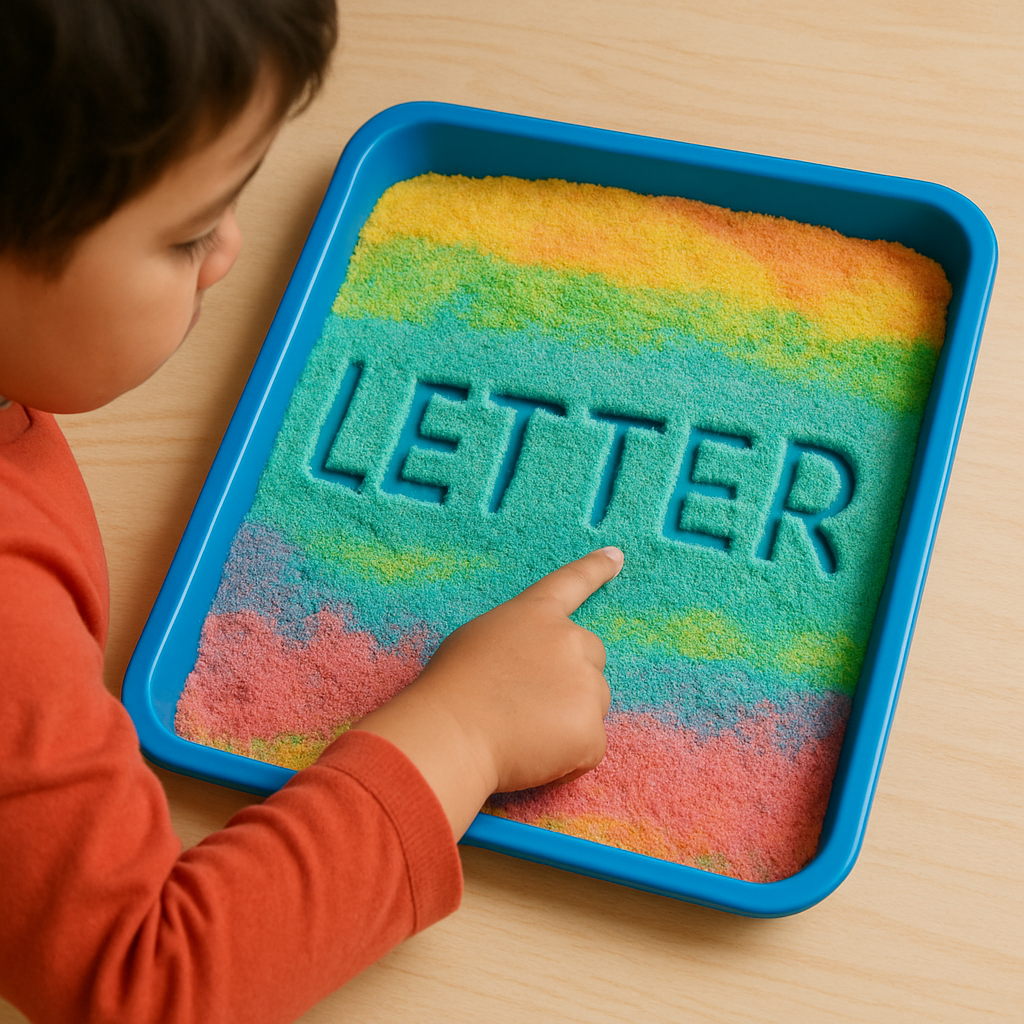
- Sand or Salt Trays: Pour colored sand or regular table salt into a shallow baking sheet. Children use their index and middle fingers to write letters while saying the sound aloud. The texture provides tactile feedback to the brain.
- Sensory Writing Bags: Fill a heavy-duty ziplock bag with cheap hair gel and a few drops of food coloring. Seal it tightly (and tape the top for safety). Children can press their fingers into the bag to “write” letters, watching the gel displace.
- Textured Letters: Cut letters out of sandpaper, corrugated cardboard, or fuzzy felt. When children trace these letters with their fingers, the rough or soft textures help anchor the shape of the letter in their memory.
Kinesthetic Learning Methods for Letter Sounds
For the child who simply cannot sit still, kinesthetic learning methods for letter sounds are a game-changer. These phonics games require whole-body movement.
6. Letter Sound Hopscotch
- How to Play: Draw a traditional hopscotch board on the driveway with chalk, but instead of numbers, write letters. As the child hops into each square, they must shout the sound that the letter makes (not just the letter name).
7. Fly Swatter Phonics
- How to Play: Spread flashcards with letters or simple words on the floor. Give the child a clean, plastic fly swatter. You call out a sound (e.g., “/b/!”), and the child races to “swat” the correct letter card. The physical action of swinging the swatter releases energy and makes the learning process thrilling.
8. Body Letters
- How to Play: Ask the child to use their entire body to form the shape of a letter. Can they stand tall with their arms out to make a ‘T’? Can they curl up on the floor to make a ‘C’? As they form the letter, have them loudly declare the letter’s sound.
Step 4: The Core of Reading – Blending and Segmenting
Once a child knows their letter sounds, they must learn to push those sounds together to make words (blending) and pull words apart into individual sounds (segmenting). This is often the most challenging hurdle in early literacy.
How to Teach Blending and Segmenting Effectively
If you are wondering how to teach blending and segmenting without causing tears, the secret lies in scaffolding—providing visual and physical supports until the child can do the mental work independently.
9. The “Robot Talk” Game (Blending)
- The Concept: Blending requires holding multiple sounds in short-term memory and synthesizing them.
- How to Play: Tell your child you are a robot whose translation chip is broken. You can only speak in sounds, and you need them to translate for you. Say, “I want to pet the d-o-g.” Pause between each sound. The child listens, blends the sounds mentally, and shouts, “Dog!”
- Progression: Start with compound words (cow-boy), move to syllables (ti-ger), and finally move to individual phonemes (c-a-t).
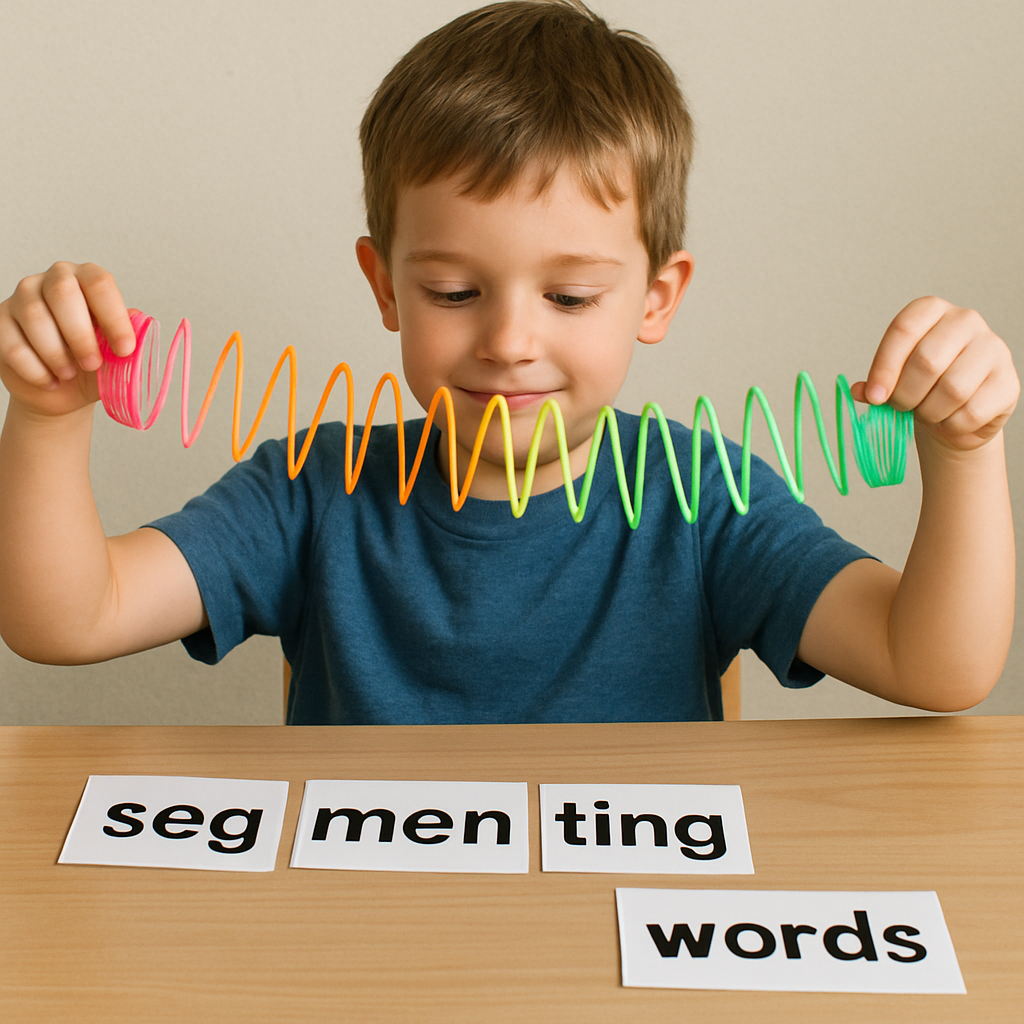
10. Slinky Sounds (Segmenting)
- The Concept: Segmenting is spelling; it is the ability to hear a word and break it into its component parts.
- How to Play: Give the child a plastic Slinky toy. Say a word, like “Sun.” As the child says the first sound (/s/), they pull the Slinky apart a little bit. For the middle sound (/u/), they stretch it further. For the final sound (/n/), they stretch it all the way. Then, they snap the Slinky back together and say the whole word “Sun!”
11. Toy Car Sound Blending
- How to Play: Write a CVC word (like C-A-T) on a large piece of paper, spacing the letters out widely. Have the child take a toy car and “drive” it slowly under the letters. As the car passes under the ‘C’, they say /c/. As it moves under ‘A’, they say /a/. As the car speeds up, they say the sounds faster until they blend into the word.
Utilizing Printable Word Building Cards
As kids grasp blending, printable word building cards become an invaluable resource. These are typically sets of consonant and vowel cards that kids can manipulate physically.
12. Word Building Puzzles
- How to Play: Print out cards where the onset (the initial consonant) is on one puzzle piece, and the rime (the vowel and ending consonant, like -at, -ig, -op) is on the interlocking piece. Kids can physically connect a ‘B’ card to an ‘-at’ card to build “Bat.”
- Why it Works: It visually demonstrates how manipulating just one letter changes the entire word. Swap the ‘B’ for an ‘M’, and “Bat” becomes “Mat.”
Addressing Common Questions and Debates in Early Reading
As you delve into teaching phonics, you will inevitably encounter some pedagogical debates. Understanding the theory behind your learning phonics games will make you a more confident guide for your child.
Can Play-Based Activities Improve Reading Fluency?
Fluency is the ability to read with speed, accuracy, and proper expression. Many parents wonder: can play-based activities improve reading fluency, or does fluency only come from silently reading books for hours?
The answer is a resounding yes—play can drastically improve fluency! Fluency is built on automaticity. A child must recognize words so quickly that they don’t have to pause to decode them. Games provide the repetition required for automaticity without the boredom of rote drills.
13. Roll and Read
- How to Play: Create a grid on a piece of paper. Label the columns 1 through 6, corresponding to the sides of a die. Fill the columns with words the child is currently practicing. The child rolls a die, finds the matching column, and reads the words in that column as fast as they can. By turning reading into a race against the die, children happily read the same words dozens of times, building immense fluency.
Sight Word Mastery vs Phonetic Instruction
For decades, there has been a push-and-pull between sight word mastery vs phonetic instruction. Sight words are words that appear frequently in text (like the, said, was). Previously, educators believed these words broke phonetic rules and had to be memorized visually as whole shapes.
Modern reading science, however, tells us that reading is not a visual memory process; it is a phonological process. The brain connects sounds to letters through a process called orthographic mapping.
Instead of pitting sight words against phonics, the best games integrate them using the “Heart Word” method.
14. Heart Word Mapping
- How to Play: Take a high-frequency word like “SAID”. Have the child draw three boxes on a whiteboard (one for each sound: /s/ /e/ /d/).
- The Process:
- They write ‘S’ in the first box (it makes its normal sound).
- They write ‘D’ in the last box (it makes its normal sound).
- In the middle box, they write ‘AI’. This is the tricky part that doesn’t follow normal rules. You have the child draw a small heart above the ‘AI’, explaining that this is the part of the word we have to “learn by heart.”
- The Result: You are still teaching phonics, but you are giving them a strategy for irregular words without relying purely on visual flashcard memorization.

Step 5: Advancing to Complex Sounds and Rules
Once children master CVC words, the English language throws a curveball. Letters start teaming up to make entirely new sounds. These are known as digraphs (two letters making one sound, like sh, ch, th) and diphthongs (gliding vowel sounds, like oi, ou, aw).
Teaching Digraphs and Diphthongs Through Play
Teaching digraphs and diphthongs through play is essential because these concepts can be highly confusing. Kids often try to sound out ‘sh’ as /s/ /h/, which leads to frustration.
15. Digraph Dig
- How to Play: Fill a sensory bin (with rice, beans, or kinetic sand) with small objects or picture cards that begin with digraphs (e.g., a toy sheep, a chair, a thimble, a whale). Set out four bowls labeled SH, CH, TH, and WH. Have the child dig through the bin and sort the items into the correct bowls based on their starting sounds.
16. Diphthong Fishing
- How to Play: Cut out paper fish and write words containing diphthongs on them (e.g., coin, boy, loud, cow). Attach a paperclip to each fish. Create a fishing pole using a stick, a piece of string, and a small magnet. Have the child “fish” for a word. When they catch one, they must identify the diphthong, make the sound, and read the word to keep their catch.
Effective Decoding Strategies for Struggling Readers
If a child is having a hard time, traditional reading practice can trigger anxiety, raising what linguists call the “affective filter.” When a child is stressed, their brain literally blocks learning. Using games is one of the most effective decoding strategies for struggling readers because play lowers the affective filter. It reduces the stakes.
17. Word Chaining (Phoneme Manipulation)
- The Strategy: For struggling readers, it is vital to show them how words are connected. Word chaining builds confidence.
- How to Play: Use magnetic letters on a fridge or whiteboard. Start with the word “CAT”. Ask the child to read it. Then say, “Abracadabra! I am taking away the ‘C’ and putting a ‘B’. What word is it now?” (BAT). “Now I’m taking away the ‘A’ and putting an ‘I’. What is it now?” (BIT).
- Why it Works: It forces the child to attend to every single letter in the word, preventing them from guessing based on the first letter—a common habit among struggling readers.
Integrating Technology: The Digital Phonics Realm
While physical, hands-on games are crucial, we cannot ignore the digital world. Screens, when used intentionally and moderately, can be powerful supplemental tools for literacy.
Best Reading Apps for Kindergarteners
The app store is flooded with “educational” games, but many of them are simply digital flashcards or games that allow kids to guess their way to victory without actually reading. The best reading apps for kindergarteners require active phonological processing.
When looking for reading apps, seek out those that align with the Science of Reading:
- Emphasis on Phonics over Guessing: The app should teach kids to decode words left-to-right rather than encouraging them to guess words based on pictures.
- Decodable Texts: The stories within the app should use words containing phonics rules the child has already learned.
- Interactive Voice Recognition: Some cutting-edge apps listen to the child read aloud and provide real-time feedback, acting as a digital reading tutor.
Note: While technology is a fantastic tool, it should never fully replace interactive, face-to-face phonics games. A tablet cannot replicate the nuanced feedback, emotional connection, and spontaneous adjustments that a parent or teacher provides.
Building a Home Literacy Environment
For parents choosing to educate their children at home, structuring literacy time can feel daunting. How do you fit all these games into a cohesive plan?
Designing a Phonics Curriculum for Homeschooling Parents
Creating a phonics curriculum for homeschooling parents doesn’t require an expensive boxed set. It requires consistency, a logical progression of skills, and a willingness to follow the child’s pace.
A Sample 30-Minute Daily Phonics Routine:
- Warm-up (5 minutes): Phonological Awareness. Play a quick oral game, like the Rhyme Time Relay or Sentence Segmentation jumping game. No reading required; just waking up the ears.
- Review (5 minutes): Flashcard or Kinesthetic Play. Review previously learned letter sounds or digraphs using Fly Swatter Phonics or Letter Sound Hopscotch. Keep it fast-paced and fun.
- Explicit Instruction (10 minutes): New Skill. Introduce the new concept for the day. For example, if you are teaching the ‘CH’ digraph, explain the rule, show them the letters, and practice building words with printable word building cards.
- Application (10 minutes): Decodable Reading or Writing. Have the child apply the new skill. Read a short decodable book together that features ‘CH’ words, or have them write a silly sentence in a sensory sand tray.
Tracking Progress and Celebrating Success It is incredibly important to celebrate micro-milestones. Did they remember that ‘sh’ makes the “quiet” sound? Celebrate it! Did they successfully segment a four-sound word? Do a victory dance! Tracking progress shouldn’t just be about standardized test scores; it should be about acknowledging the immense cognitive effort your child is putting into learning this complex human invention called reading.
Beyond the Basics: Making Reading a Lifestyle
The ultimate goal of learning phonics games is not just to teach a child to read, but to teach them to love reading. When reading is associated with laughter, movement, and quality time with a caregiver, the child develops a positive psychological association with books.
Connecting Phonics to Real Life
To truly cement these skills, bring phonics into your daily errands and routines.
- Grocery Store Phonics: “I need something that starts with the /b/ sound. Can you find the /b/ /a/ /n/ /a/ /n/ /a/s?”
- Car Ride I-Spy: “I spy with my little eye, something that ends with the /t/ sound.” (Street, cat, light).
- Menu Decoding: When out to eat, highlight simple, decodable words on the menu and ask your child to help you read them (e.g., ham, bun, hot).
The Role of Patience in Early Literacy
It is vital to remember that learning to read is a marathon, not a sprint. Some children will pick up blending in a matter of weeks; others may take months of steady practice. There will be days when a child seems to have forgotten a rule they knew perfectly yesterday. This is a normal part of cognitive development.
When frustration bubbles up—for either of you—step back. Close the books. Turn off the apps. Pivot back to a high-energy, low-stakes game like Fly Swatter Phonics or a silly Rhyme Time Relay. Remind your child (and yourself) that learning is an adventure, not a chore.
Summary of Key Takeaways for Educators and Parents
To wrap up this extensive guide, let’s distill the core principles of using games to teach early reading:
- Start with the Ears: Before showing letters, ensure you are utilizing interactive phonological awareness activities to train children to hear rhythms, rhymes, and individual phonemes.
- Make it Multisensory: Ditch the static worksheets. Embrace multisensory literacy tools for beginners like sand trays, shaving cream, and textured letters to build strong neural pathways.
- Get Them Moving: Integrate kinesthetic learning methods for letter sounds. Jumping, swatting, and running help energetic children focus and retain information better than sitting at a desk.
- Teach Blending Explicitly: Do not assume kids will naturally figure out how to push sounds together. Use games like Robot Talk and Slinky Sounds to model how to teach blending and segmenting.
- Tackle Complex Rules with Play: When advancing to trickier concepts, remember that teaching digraphs and diphthongs through play prevents frustration and makes abstract rules concrete.
- Bridge Sight Words and Phonics: Move past the sight word mastery vs phonetic instruction debate by using techniques like Heart Word mapping, allowing children to decode what they can and map the irregular parts.
- Support Struggling Readers: Use games as effective decoding strategies for struggling readers to lower anxiety and build confidence through word chaining and phoneme manipulation.
Reading is the key that unlocks the rest of a child’s education. By wrapping the rigorous science of reading in the joyful package of learning phonics games, you are giving early readers a gift that will last a lifetime. You are showing them that words are not just marks on a page, but puzzle pieces waiting to be put together, magical codes waiting to be cracked, and stories waiting to be discovered.
So grab some chalk, clear a space on the floor, cut out some flashcards, and get ready to play your way to literacy!