science of reading kindergarten synthetic phonics vs sight words
Watching a child learn to read is nothing short of magical. In kindergarten, children transition from viewing text as a jumble of abstract squiggles to recognizing them as meaningful stories, instructions, and ideas. But behind this “magic” lies a complex, highly structured cognitive process.
For decades, educators and parents have debated the best way to teach early literacy. If you are navigating the educational landscape today, you have likely encountered the ongoing discussion surrounding the Science of Reading in Kindergarten: Synthetic Phonics vs Sight Words. Which method truly unlocks a child’s reading potential? Should we focus on teaching children to sound out every single letter, or should we encourage them to memorize high-frequency words as whole visual units?
In this comprehensive guide, we will unpack the monumental shift occurring in early childhood education. We will explore the brain science behind how young children learn to read, dismantle outdated practices, and provide actionable, evidence-based strategies to help your kindergarteners build robust, lifelong reading skills.

What Exactly is the Science of Reading?
The “Science of Reading” is not a specific curriculum, a phonics program, or a passing educational trend. Rather, it is a vast, interdisciplinary body of scientifically based research drawn from cognitive psychology, linguistics, neuroscience, and education. It explains exactly how the human brain learns to read and write.
Unlike spoken language, which is naturally acquired through immersion and exposure, reading is not biologically hardwired into the human brain. We must build new neural pathways to connect the visual recognition of symbols (letters) to the auditory processing of sounds (speech).
Brain Research on Early Reading Development
Modern neuroimaging has given us a literal window into the reading brain. Brain research on early reading development shows that successful readers develop a specialized area in the left hemisphere of the brain, often called the “visual word form area” or the brain’s “letterbox.”
When kindergarteners are explicitly taught how to connect sounds to letters, they actively build the neural bridges between the frontal lobe (which handles speech production) and the temporal lobe (which processes phonemes, or individual sounds). Teaching reading is, quite literally, brain construction.
The Simple View of Reading Framework
To simplify this complex brain science, researchers Philip Gough and William Tunmer introduced The Simple View of Reading framework in 1986. This framework proposes a straightforward formula:
Decoding (D) x Language Comprehension (LC) = Reading Comprehension (RC)
If a child has excellent language comprehension but cannot decode the words on the page, their reading comprehension is zero. Conversely, if a child can sound out every word beautifully but does not know what the words mean, their reading comprehension is also zero. Both elements are indispensable.
Scarborough’s Reading Rope
Building on the Simple View, Dr. Hollis Scarborough created a visual metaphor known as Scarborough’s Reading Rope for parents and teachers.
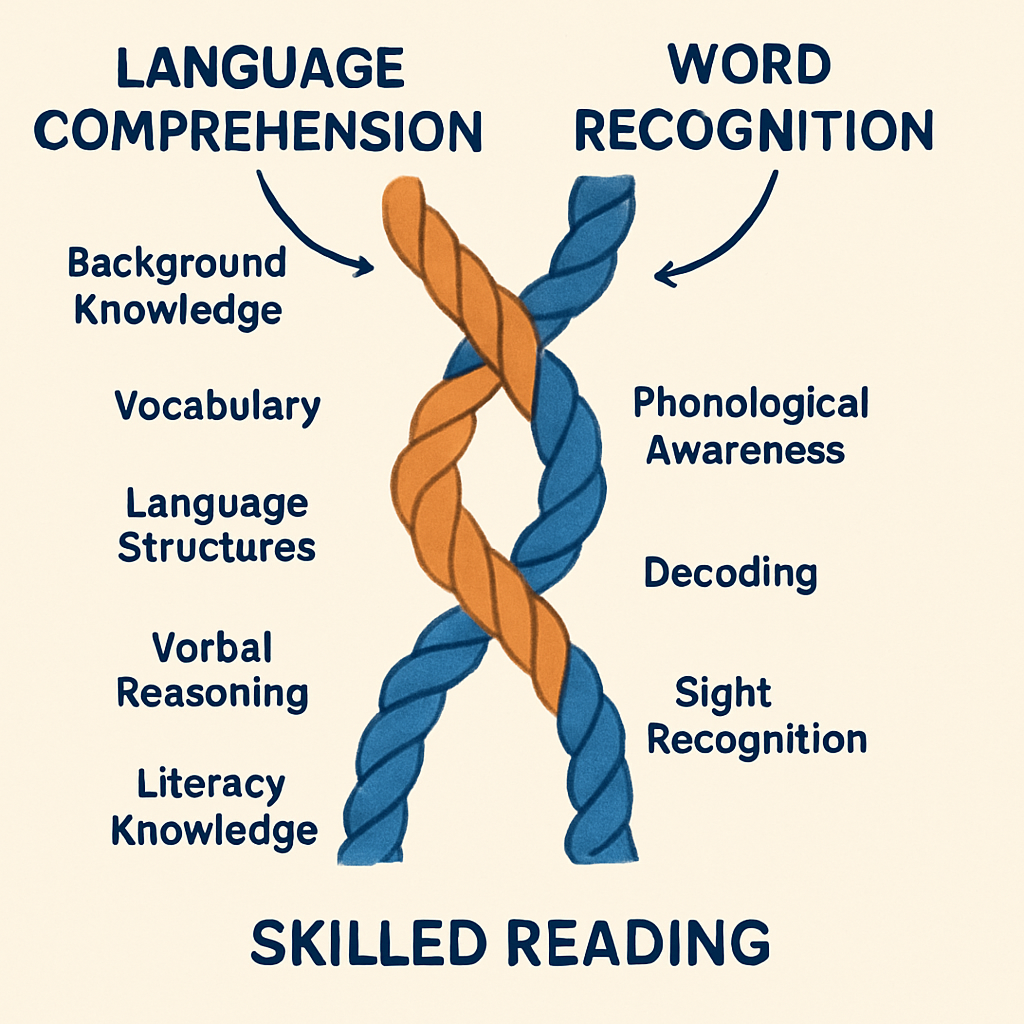
The rope consists of two main sections:
- Language Comprehension (Upper Strands): Background knowledge, vocabulary, language structures, verbal reasoning, and literacy knowledge.
- Word Recognition (Lower Strands): Phonological awareness, decoding (phonics), and sight recognition.
In kindergarten, the primary focus is heavily weighted toward building those lower strands—specifically through phonological awareness and phonics—so that word recognition becomes increasingly automatic. As these strands intertwine, fluent reading emerges.
The Core Debate: Structured Literacy vs Whole Language Approach
To understand the current emphasis on synthetic phonics, we must look at the historical context of reading instruction. For years, the pendulum has swung between two primary philosophies: the structured literacy vs whole language approach.
The Downfall of Balanced Literacy and Whole Language
The whole language approach (often rebranded later as “balanced literacy”) operates on the assumption that reading is a natural process, much like speaking. It suggests that if children are immersed in a rich, literature-filled environment, they will naturally absorb the ability to read.
A hallmark of this approach is teaching young readers to use multiple cues to figure out unknown words. However, cognitive science has highlighted the severe limitations of three-cueing systems in literacy. The three-cueing system teaches children to guess words based on:
- Meaning: “Look at the picture. What makes sense?”
- Structure: “Does that sound right in a sentence?”
- Visual: “What letter does the word start with?”
While this might sound helpful, encouraging a child to guess a word based on a picture is actually teaching them the habits of poor readers. Strong readers do not guess; they look at the letters and decode the sounds from left to right.
The Rise of Structured Literacy
Structured literacy, grounded in the Science of Reading, leaves nothing to chance. It is explicit, systematic, cumulative, and diagnostic. It demands that teachers instruct children on exactly how the English language works, starting from the smallest units of sound (phonemes) and moving to text.
Unpacking Synthetic Phonics in Kindergarten
When evaluating the debate of synthetic phonics vs sight words, we must first thoroughly understand synthetic phonics.
Synthetic phonics is an instructional method where children are taught to link individual speech sounds (phonemes) to specific letters or letter combinations (graphemes). Once they know these links, they “synthesize,” or blend, the sounds together to form a word.
Teaching Grapheme Phoneme Correspondence
The foundation of synthetic phonics is teaching grapheme phoneme correspondence (GPC). English has 44 unique phonemes, but only 26 letters to represent them. Therefore, children must learn that sometimes one letter makes one sound (like /t/ in “top”), and sometimes multiple letters make one sound (like /sh/ in “ship” or /igh/ in “night”).
In a kindergarten classroom utilizing explicit systematic phonics instruction, a teacher does not wait for a student to stumble upon the “sh” sound in a book. Instead, the teacher explicitly introduces the grapheme “sh,” explains the sound it makes, and provides the children with immediate practice reading and writing words like ship, shop, shed, and fish.
Benefits of Explicit Decoding Strategies
The benefits of explicit decoding strategies are profound. When children are taught the alphabetic code directly:
- They gain independence: They do not need to rely on pictures or adult intervention to read an unknown word.
- They build confidence: Guessing leads to anxiety; decoding leads to certainty.
- They acquire a scalable skill: Once a child can decode CVC (consonant-vowel-consonant) words, they can apply those same phonetic rules to multisyllabic words later in their academic journey.
How to Teach Phoneme Blending to Five Year Olds
Knowing letter sounds is not enough; kindergarteners must learn to push those sounds together. For many five-year-olds, blending is a massive cognitive leap. If you are wondering how to teach phoneme blending to five year olds, here is a highly effective, step-by-step approach:
- Start with Oral Blending: Before introducing letters, play verbal games. Say, “I am thinking of an animal: /c/ /a/ /t/. What is it?” The child listens and blends the sounds to say, “Cat!”
- Use Continuous Consonants: When moving to printed letters, start with continuous sounds that can be stretched without distortion (like /m/, /s/, /f/, /l/). Blending “s-u-n” is much easier for a beginner than blending “b-a-t” because the /s/ sound can flow directly into the /u/ sound (sssuuunnn).
- Employ the “Successive Blending” Technique: Instead of having the child say all three sounds separately (/m/ … /a/ … /p/) and then forgetting the first sound by the time they reach the last, teach them to blend as they go: “/m/ /a/ -> /ma/ … /p/ -> map.”
- Make it Tactile: Use manipulatives. Have the child touch a different block or move a token for each sound they say, physically pushing them together as they say the whole word.
The Role of Sight Words: Moving Beyond Memorization
Now, let’s look at the other side of the equation. What is the role of sight words in early literacy?
Historically, sight words were considered words that children simply had to memorize by their “shape” or whole visual appearance because they were assumed to be non-decodable, or because they appeared so frequently in text that decoding them every time would slow down reading fluency.
The Problem with the Dolch and Fry Lists
For generations, kindergarten teachers have relied heavily on the Dolch and Fry high frequency word lists. These lists contain the most common words found in the English language (e.g., the, to, and, he, a, I, you, it, of).
Parents were sent home with stacks of flashcards, and children were drilled relentlessly to memorize these words as whole visual units. However, rote memorization is incredibly inefficient. The human memory can only reliably store a limited number of arbitrary visual shapes. When children are forced to memorize words as whole shapes, they often confuse similar-looking words like house and horse, or there and three.
Furthermore, a significant portion of the words on the Dolch and Fry lists are actually completely decodable (e.g., and, in, that, it, on, up). Forcing a child to memorize “and” as a sight word bypasses the valuable phonetic skills they are learning.
Integrating Heart Words into Phonics Lessons
The Science of Reading does not discard high-frequency words; it reimagines how we teach them. Instead of whole-word memorization, educators are now integrating heart words into phonics lessons.
The “Heart Word” method (or “Word Mapping”) acknowledges that while some high-frequency words have irregular spellings, they are rarely completely irregular.
Take the word “said.”
- In the whole-language approach, a child memorizes the shape of s-a-i-d.
- In the structured literacy approach, the teacher explains that the word “said” has three sounds: /s/ /e/ /d/.
- The first sound /s/ is spelled with the letter ‘s’ (regular).
- The last sound /d/ is spelled with the letter ‘d’ (regular).
- Only the middle sound /e/ is spelled irregularly with the letters ‘ai’.
The teacher draws a small heart over the ‘ai’ to indicate that this is the part of the word the child needs to “learn by heart.”
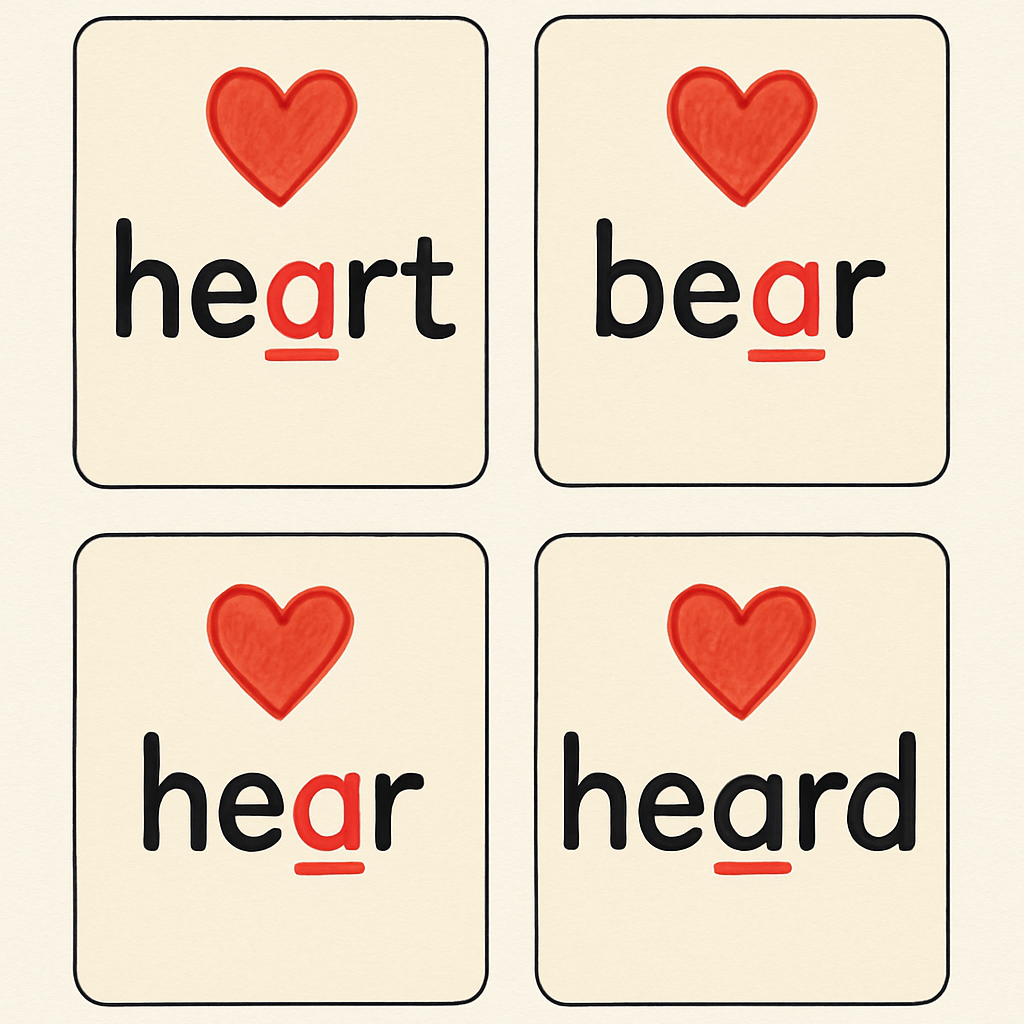
By highlighting the parts of the word that do follow phonetic rules, we reduce the cognitive load on the student. They aren’t memorizing an arbitrary shape; they are mapping letters to sounds, with one small, memorable exception.
Synthetic Phonics vs Sight Words: Finding the Balance
So, when we look at the core premise—synthetic phonics vs sight words—which wins?
The truth is, it is a false dichotomy. Excellent reading instruction requires both, but they must be taught through the lens of phonics.
Synthetic phonics is the engine that drives a child’s ability to tackle the English language. It provides the reading strategies necessary to approach unknown text. However, knowing high-frequency words (taught correctly via the heart-word method) provides the grease that allows that engine to run smoothly and fluently.
A kindergarten reading block should not separate these concepts. When a teacher introduces a new phonics rule (e.g., short ‘a’), the high-frequency words taught alongside it should align with that rule (e.g., am, an, at, and). By aligning these instruction methods, we accelerate the acquisition of fundamental reading skills.
The Magic of Orthographic Mapping
To truly grasp how synthetic phonics and high-frequency words come together, we must look at the orthographic mapping process for beginners.
Orthographic mapping is the cognitive process by which the brain forms a permanent connection between the written letters (orthography), the sounds (phonology), and the meaning (semantics) of a word.
When a child orthographically maps a word, it becomes a true sight word. In cognitive science, a “sight word” is not a word from a flashcard; it is any word a reader instantly recognizes without having to consciously sound it out. For a literate adult, almost every word you are reading in this article is a sight word.
How Does a Word Get Mapped?
Words are not mapped by looking at their shape. They are mapped through phoneme-grapheme connections.
- Phonological Awareness: The child hears the word “mat” and breaks it into three sounds: /m/ /a/ /t/.
- Phonics: The child connects those sounds to the letters M-A-T.
- Mapping: After decoding M-A-T successfully a few times (typically 1-4 exposures for a neurotypical learner), the brain binds the spelling, pronunciation, and meaning together.
- Instant Recognition: The next time the child sees M-A-T, they do not need to sound it out. They instantly recognize it.
This is why explicit systematic phonics instruction is vastly superior to rote visual memorization. Phonics facilitates orthographic mapping. Memorizing flashcards attempts to bypass it, which ultimately stalls reading development.
Putting It into Practice: Classroom and Home Strategies
Understanding the science is step one. Applying it effectively with five-year-olds is step two. Whether you are a classroom teacher planning your literacy block or a parent supporting your child at home, here are practical, evidence-based ways to implement the Science of Reading.
1. Conduct Regular Phonological Assessments
Before a child can map letters to sounds, they must be able to hear and manipulate the sounds in spoken language. Implementing a phonological awareness assessment for kindergarten is crucial early in the school year.
This assessment should test:
- Rhyming: “Do bat and cat rhyme?”
- Sentence Segmentation: Clapping for each word in a spoken sentence.
- Syllable Blending: “What word do these make: rain… bow?”
- Phoneme Isolation: “What is the first sound you hear in the word dog?” (/d/)
- Phoneme Segmentation: “Tell me all the sounds in the word sun.” (/s/ /u/ /n/)
If a child struggles with phonemic awareness (the deepest level of phonological awareness dealing with individual sounds), placing letters in front of them will only cause frustration. Focus on oral/auditory games until their ear for language develops.
2. Utilize Multisensory Literacy Activities
Kindergarteners are highly active, tactile learners. Multisensory literacy activities for early learners help solidify the neural connections required for orthographic mapping by engaging the visual, auditory, and kinesthetic pathways simultaneously.
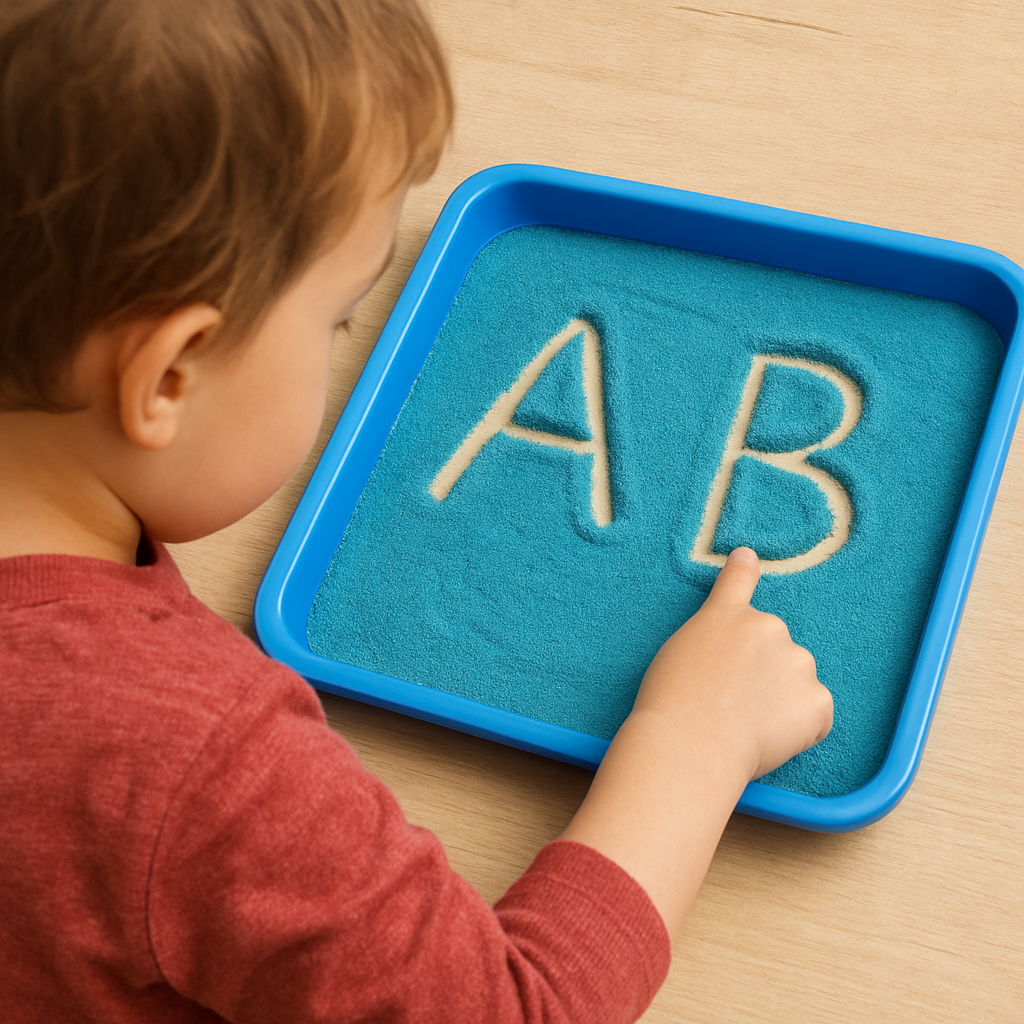
- Sand Tracing: Have children say the sound (auditory) while tracing the corresponding letter in a tray of colored sand (kinesthetic/tactile) and looking at the letter they are forming (visual).
- Elkonin Boxes (Sound Boxes): Draw three boxes on a piece of paper. Give the child three small tokens (like buttons or coins). As the child segments a three-sound word like “bug” (/b/ /u/ /g/), they push one token into a box for each sound they hear.
- Sky Writing: Using gross motor skills to write large letters in the air while vocalizing the sound.
- Play-Doh Letters: Rolling out Play-Doh to build letters, physically reinforcing the shape of the graphemes while discussing their corresponding phonemes.
3. Choose the Right Text: Decodable Books vs Leveled Readers
One of the most immediate changes a teacher or parent can make to align with the Science of Reading is auditing the books they provide to early readers. You must understand the critical difference of decodable books versus leveled readers.
Leveled Readers (Predictable Texts) Leveled readers are a staple of the whole language approach. They usually feature repetitive sentence structures with heavy picture support.
- Example: Page 1 shows a picture of a bear and says, “Look at the bear.” Page 2 shows a tiger and says, “Look at the tiger.” Page 3 shows a monkey and says, “Look at the monkey.”
- The Problem: The child is not reading the words “bear,” “tiger,” or “monkey.” They are memorizing the pattern “Look at the…” and using the pictures to guess the last word. This reinforces the harmful three-cueing habits.
Decodable Books Decodable books are carefully written to only include phonics patterns and high-frequency words that the child has already been explicitly taught.
- Example: If a child has only learned short vowels and the consonants s, m, t, p, and c, their decodable book will say, “The cat sat on the mat. Pam sat on the mat.”
- The Benefit: There is no guessing. The child is forced to look closely at the letters, practice their explicit decoding strategies, and map the words orthographically. Pictures are present, but they cannot be used to guess the words. Decodable texts build authentic reading skills and true self-reliance.
4. Create a Daily Phonics Routine
Consistency is key in kindergarten. A structured literacy routine should be a daily occurrence and should include:
- Phonemic Awareness Warm-up (3-5 minutes): Oral games manipulating sounds.
- Review (3-5 minutes): Rapid review of previously taught letter-sound correspondences using flashcards.
- Explicit Instruction (5-10 minutes): Introduction of a new grapheme-phoneme correspondence. (e.g., “Today we are learning that ‘ch’ makes the /ch/ sound like in chin.”)
- Word Building/Blending (5-10 minutes): Practicing the new skill by reading words on a whiteboard or using magnetic letters.
- Heart Words (3-5 minutes): Introducing or reviewing high-frequency words by mapping their sounds and pointing out the irregular spelling.
- Application (10-15 minutes): Reading a decodable text that features the newly learned skill.
Bridging the Gap: Communicating with Parents
For the Science of Reading to be truly effective, the strategies must extend beyond the classroom. Teachers need to communicate the “why” behind these methods to parents, who likely learned to read during the balanced literacy era.
Sharing tools like Scarborough’s Reading Rope for parents and teachers during parent-teacher conferences is an excellent way to visually explain how reading develops. Educate parents on why sending home decodable books is more beneficial than traditional leveled readers. Provide them with a list of “Heart Words” rather than standard Dolch sight word lists, and teach them how to do simple sound-mapping at home.
When parents understand that guessing from pictures is counterproductive, they can gently guide their children during bedtime reading. Instead of saying, “Look at the picture, what do you think it is?”, parents can learn to say, “Look at the letters, let’s sound it out together.” This unified front drastically accelerates a kindergartener’s progress.
Conclusion
The debate surrounding the Science of Reading in Kindergarten: Synthetic Phonics vs Sight Words is ultimately a story of evolution in education. By moving away from the whole language approach, discarding the flawed three-cueing systems, and embracing explicit systematic phonics instruction, we are aligning our teaching methods with how the human brain actually learns.
Kindergarten is the foundational year for literacy. By prioritizing phonemic awareness, explicitly teaching grapheme-phoneme correspondences, seamlessly integrating heart words, and providing children with decodable texts, we give them the tools they need to orthographically map words into their permanent memory.
Reading is not a guessing game. It is a precise, beautiful code waiting to be cracked. When we equip our five-year-olds with the right reading strategies and explicit decoding skills, we do more than teach them to read a sentence—we unlock a lifetime of independent, joyful literacy. Let us embrace the science, abandon rote memorization, and watch our youngest learners truly thrive.